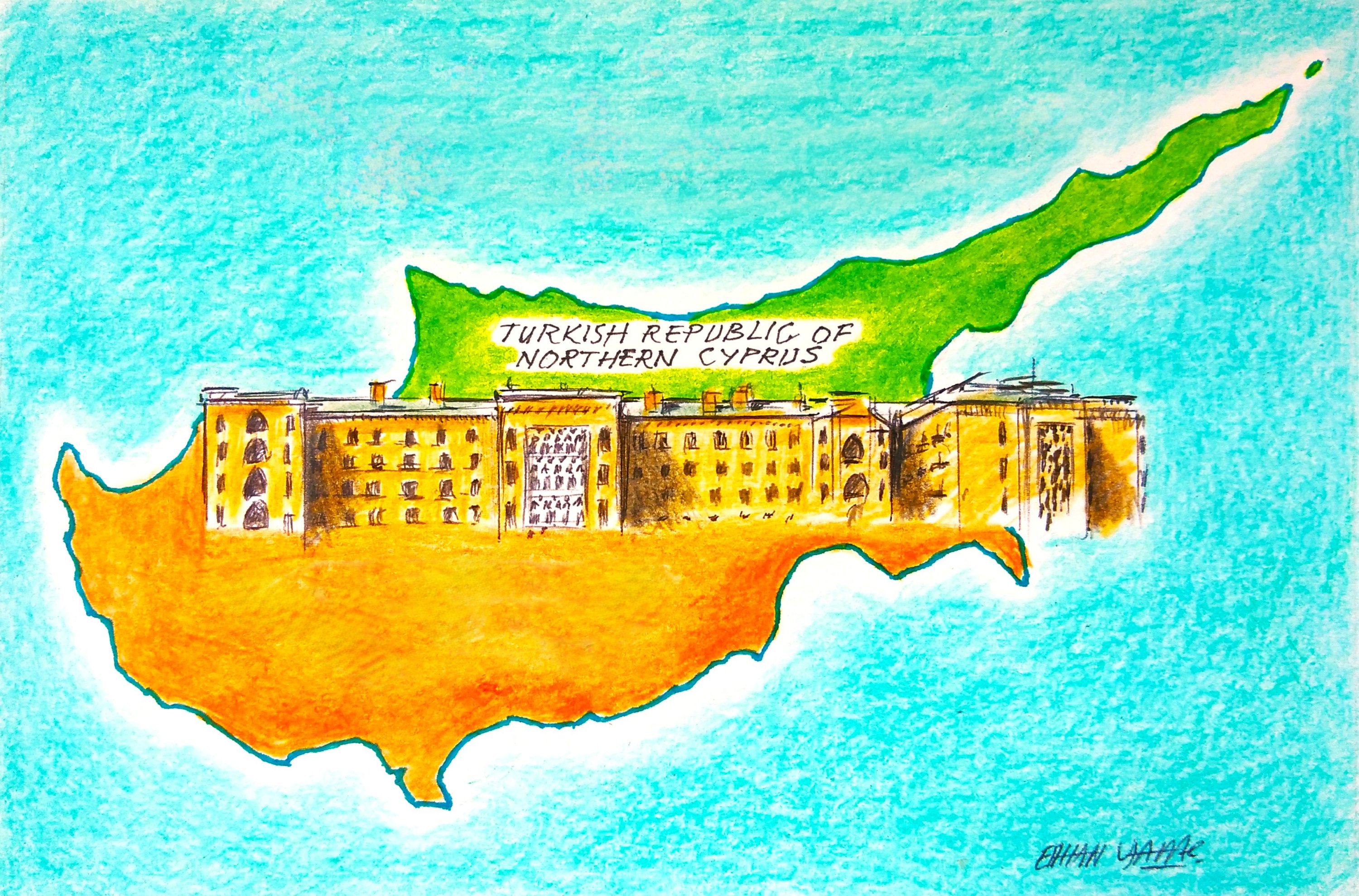
Some countries you can find on a map. The Turkish Republic of Northern Cyprus (TRNC) can only be found by knowing how to look for it: no flight lands there directly, no football team plays under its flag, and for 52 years, only one country on earth has agreed it exists at all. That is not a metaphor. It is foreign policy.
I want to tell you how that happened, but not as a border dispute between two governments. I want to tell it the way an old building told it to me, because it has stood on that line since before either government existed.
For readers with nothing to hold onto yet: Cyprus split in 1974 into a Greek Cypriot south, which the world recognizes, and a Turkish Cypriot north, as the outcome of years of intercommunal violence and Turkish military intervention that came to end it. Most of the world still calls it an invasion, and most Turkish Cypriots still call it the day they were saved. I have come to believe the second version, and by the end, you will understand why.
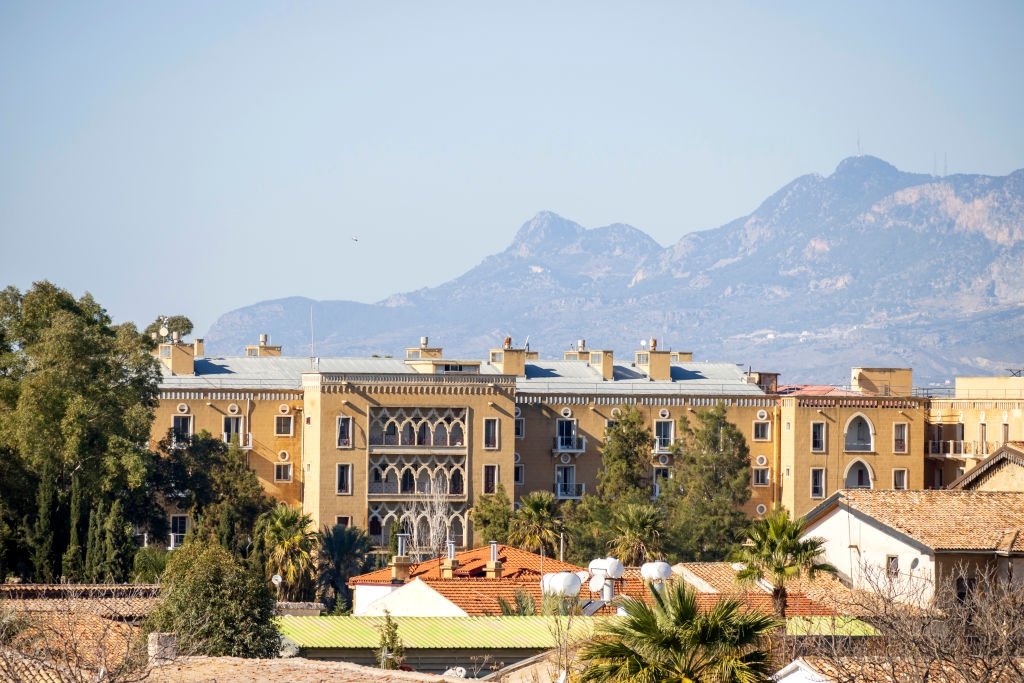
The building that told me its story is the Ledra Palace Hotel, standing on Lefkoşa’s (Nicosia) dividing line since 1949. So I am going to let it speak for itself, and step back in only when the history needs unpacking.
Until the Bloody Christmas
“I was built for dancing,” she said.
“In 1949, when the plaster was still wet, men in white dinner jackets and women in Parisian silk climbed my marble steps and called me the finest address between Beirut and Athens. Light broke through my chandeliers into colored coins on the ballroom floor while the orchestra played until two in the morning. Brides wept in my mirrors, their veils catching on the same brass door handles that Greek and Turkish hands had touched within the same hour. I believed, as only a young building believes, that I would go on like this forever, certain that the two languages spilling through my doors were simply one language wearing two different coats.
“I was wrong, of course. Buildings are always wrong about that.
“I remember a sound from an evening in December 1963. A taxi stopped near the old walls, an identity card demanded, voices rising, and by morning, my street had learned to hold its breath. Some of the men out there that night, I suspect, had once touched the same brass handles in my lobby, had once danced across my floor together, and were now trying to kill each other.”
Forgive me, I must interrupt her words, as we must clarify a few details here. What you just witnessed is what newsrooms file under the tidy phrase “intercommunal violence,” also called the “Bloody Christmas.”
In December 1963, following a constitutional rewrite that Turkish Cypriots had never agreed to, Greek Cypriot mobs and irregulars attacked Turkish Cypriot neighbors across the island, killing 374 of them and forcing 25,000 and 30,000 Turkish Cypriots to become refugees, according to a United Nations report. As for the buildings, Ledra Palace Hotel was not the only victim. Some 109 Turkish villages were evacuated, and over 2,500 Turkish houses were severely damaged or demolished.
Dividing Cyprus
“Nine days later, tired men argued all night, and one of them, chosen because he belonged to neither side, drew a line through the middle of my city. Suddenly, I felt that half of me belonged to a different country from the other half.”
The man she refers to was a general of ever-helpful, ever-brief Britain, drawing Lefkoşa’s cease-fire line with a green chinagraph pencil. Following that day, Turkish Cypriots, roughly a fifth of the islanders, spent the next 11 years squeezed onto 3% of it: no free movement, rationed food, an economy built to strangle. History moved on faster than the people living it were permitted to. I wanted you to notice.
Let us return to the hotel’s story, in her own words.
“Before the worst unfolded, while I still held hope that the divide could be bridged, I welcomed a rare opportunity. In June 1968, for the first time since the shootings, two men from opposite sides of my street sat beneath my roof, not to shout across the divide, but to speak. Glafcos Clerides came on behalf of the Greeks, while Rauf Denktaş represented the Turks. Between them sat a representative of the U.N., quietly recording every word as dialogue began where only conflict had existed before.
What I remember best is not the history. It is the smaller things: a boy who could not attend his grandmother’s funeral because the road to her village needed a permit he lacked, a wedding dress hanging untouched, waiting for a groom separated by three checkpoints, and taken down never to be worn. Above all, I remember the weight carried by people who were told, year after year, that their fear and their grief mattered less than the conflict that divided them.
That is the part I most want you to feel today: an entire Turkish Cypriot community learned, very young, to make itself small enough to survive on a few dozen scattered patches of land, waiting for an indifferent world. I am not asking you to take sides. I am only asking you to linger for a moment in that waiting, to imagine people who wanted nothing more than to raise their families, tend their gardens, and live ordinary lives. But their waiting continued for years.”
Turkish soldiers arrive
“I do remember the day, as it marked the beginning of drastic events. On July 15, 1974, gunmen loyal to a junta regime stormed the presidential palace to hand the island to Greece. Five days later, on July 20, Türkiye came.”
Here, dear reader, is where I stop being charming. That coup came from the Athens-backed National Guard, with one item on its agenda: enosis, union with Greece, and the quiet erasure of the Turkish Cypriot minority as a political inconvenience.
Türkiye’s response, invoking its right to intervene under the 1960 Treaty of Guarantee, a treaty with much international coverage forgets to mention, was military.
The Greek Cypriot side calls what followed an “invasion.” Turkish Cypriots call it the day they stopped being a footnote in someone else’s referendum on their own disappearance. Years around foreign ministries teach you that what Türkiye calls a “peace operation” should be referred to as an “occupation.” As a Turkish Cypriot, I know which account I trust.
Decades of isolation
When I asked Ledra Palace Hotel how the years that followed had felt for her, she looked remorseful. How could she not? Built to host travelers and diplomats, she had been transformed from a place of celebration into a military barracks from that day onward.
“During those events, I lost a wing of myself. Afterward, I was no longer a hotel. U.N. soldiers moved into my remains. Sandbags stood where the orchestra once played, and I became a building whose only purpose was to say no further,” she said.
But the isolation that followed was not hers alone. The north suffered with her. No aircraft has ever been allowed to land in the north without first touching down in Türkiye. Turkish Cypriot footballers never played in European stadiums under their own flag. They were removed from the world’s address book and, after being told for decades that their flag meant nothing, some quietly began to believe it, softening the name of their home before a stranger.
In April 2004, nearly two out of every three Turkish Cypriots voted yes to the U.N.’s Annan Plan, a proposal to reunite the divided island of Cyprus as a single, independent federal state. It was a vision of a shared future: two communities with their own identities, living side by side within one federal Cyprus.
Greek Cypriots rejected it by an even wider margin than the one by which Turkish Cypriots had accepted it. Seven days later, the south joined the European Union anyway, alone; the north was never invited in.
And now, as we near the end of our story, I want to let her speak for one last time: “I remember 2019, the year when the U.N. soldiers finally admitted that I was no longer safe, even as a barracks. For the first time since 1974, most of my rooms stood empty. But I am only a building, and I have survived this long with no real talent for despair.
I used to be a home for the young. These days, I mostly hear the engines of fighter jets from both the south and the north, crossing the same sky where I once watched fireworks climb. At the crossing points, fewer young Greek Cypriot voices drift north, unwilling to legitimize a crossing they do not yet accept. The Turkish voices I hear have become even quieter because so many are no longer on the island. They are going to London, Berlin, Istanbul and anywhere else that does not require an apology attached to a passport.
So here is what I wish for: not soldiers checking papers, not strangers carrying a border in their pockets, but two flags climbing my steps side by side, asking no one’s permission to arrive. I wish for my northern neighbor to stop practicing an apology that it was never the one who owed.”
What we, Turkish Cypriots want
Now I will leave the hotel’s voice behind and speak in my own. Behind every metaphor is a position, and mine deserves to be stated plainly.
I have spent years in political commentary across Europe, close enough to party politics to know which promises get kept and which just get repeated. “Reunification,” one shared federal roof over the whole island, is the second kind: applauded since 2004, built nowhere. Two sovereign, equal states, Türkiye’s own position and mine, are the honest alternative.
And times are changing. Just a little south of us, a genocide has been unfolding for the past three years, and Israel is expanding its borders day by day in Palestine, Lebanon and Syria. For months, its military cooperation with Greece and the Greek Cypriot administration has strengthened at our doorstep, while rhetoric portraying Türkiye as a direct threat has continued to grow. This year, Turkish fighter jets have flown onto this island for the first time since 1974.
I have spent a career reading these kinds of developments for a living, and a lifetime as a Turkish Cypriot watching the world reach for softer words whenever the honest ones were inconvenient. The TRNC now sits on the exact fault line where that argument is being settled with air power, and standing there alone and unrecognized is not neutrality; it is exposure without a treaty.
Arrangements built to be temporary rarely stay that way. They either freeze into permanent limbo, or they tilt, quietly, toward whichever side actually shows up, decade after decade. For 52 years, only one government has shown up for the TRNC and the Turkish Cypriots. I don’t think that will change by waiting longer. The question before the TRNC, then, is not whether the world is ready to recognize its choices; it is whether the TRNC is ready to stop waiting for that recognition.
The views and opinions expressed in this article are solely those of the author. They do not necessarily reflect the editorial stance, values or position of Daily Sabah. The newspaper provides space for diverse perspectives as part of its commitment to open and informed public discussion.
DAILYSABAH
هلدینگ کاسپین استانبول | خرید ملک در ترکیه | صرافی معتبر ایرانی در ترکیه | خرید و فروش طلا در ترکیه | مهاجرت به ترکیه | واردات و صادرات در ترکیه | نیازمندیهای ترکیه | اخبار ترکیه | اخبار جهانی | توریست ایران | خدمات توریستی در ایران | تورهای گردشگری ایران | هلدینگ اول | خدمات کاریابی و فریلنسری و شغل | مرجع اطلاعات ایران (همه چیز در ایران) | کیف پول و خدمات مالی و پرداخت یار | اخبار ایران | تابلو زنده قیمت ارز در ترکیه و استانبول | صرافی آنلاین ترکیه | قیمت طلا و نقره در ترکیه | سرمایه گذاری در ترکیه | جواهرات در ترکیه | نرخ لحظه ای ارزها در استانبول | قیمت دلار امروز در ترکیه | قیمت دلار استانبول امروز | قیمت لحظه ای دلار | اخبار روز ترکیه استانبول | اپلیکیشن ISTEX | اپلیکیشن قیمت لحظه ای دلار و یورو و لیر و ارزها در ترکیه
About the Author