The Trump administration signed a nuclear agreement with Saudi Arabia on Wednesday that could enable the kingdom to enrich its own uranium for nuclear reactors, US Energy secretary Chris Wright said in a press release.
According to a statement from the Department of Energy, Wright and his Saudi counterpart, Prince Abdulaziz bin Salman, signed “a peaceful nuclear cooperation agreement” and “an accompanying bilateral safeguards agreement.”
The question of what those safeguards look like, given the potential for enriched uranium to be used to make nuclear weapons, will be closely scrutinized when the agreement is sent to Congress for review.
The two agreements, the press release said, “lay the legal foundation for a decades-long, multi-billion-dollar partnership that advances several priority economic and strategic objectives, including nuclear nonproliferation.”
“These agreements reflect our two nations’ shared commitment to strengthening U.S.-Saudi commercial relations, delivering prosperity at home and security to our allies abroad,” Wright said in a statement. “Rest assured, these agreements uphold the highest standards of nuclear safety and nonproliferation, while relying on the world’s best nuclear technology and scientists, designed right here in the United States.”
As our colleague Patrick Wintour reported earlier:
The timing of the announcement is controversial as the US’s war with Iran is being fought in part to prevent Tehran enriching uranium domestically and make it near-impossible for Iran to build a nuclear weapon.
The US-Saudi deal is expected to last 30 years and involve US firms such as Westinghouse in developing the programme.
It could allow for the building of a uranium enrichment facility in Saudi Arabia after a joint US-Saudi study. The proposal has been in discussion for years. At one point the Biden administration wanted to condition Saudi Arabia’s access to the technology on normalising relations with Israel, something Saudi Arabia is still refusing to do.
The plan is expected to be submitted to Congress for review, where it could face opposition among lawmakers who fear a lack of monitoring safeguards to restrict Saudi Arabia’s uranium enrichment.
As the US strikes again targets in Iran in retaliation for that nation’s blockade of the strait of Hormuz, Iran-backed Houthi rebels in Yemen claim to have attacked two Saudi oil tankers for violating a blockade near the Bab el-Mandeb Strait, a chokepoint for oil exports transiting the Red Sea.
Saudi Arabia, which borders Yemen, led a military intervention in 2015, triggering a year-long civil war to prop up Yemen’s Saudi-backed government.
The United Kingdom Maritime Trade Operations Centre said in an alert issued on Wednesday night it “has received a report of an incident 70NM southwest of AL SHUQAIQ, Saudi Arabia. The Master of a tanker reports being struck by an unknown projectile which has caused a fire onboard that the crew are currently fighting.”
Senator Chris Murphy, a Connecticut Democrat, responded to news of the Houthi attacks by writing on social media: “Everyone saw all of this coming. This chaos was totally foreseeable and Trump chose to start this war anyway.”
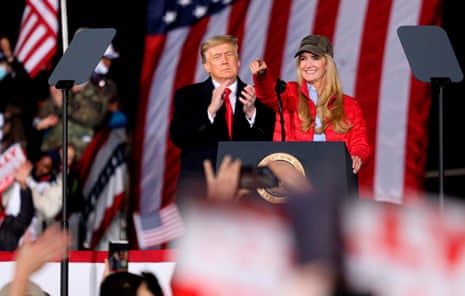
During his 75-minute address to supporters in Georgia on Wednesday, Donald Trump took some time out from boasting about what he calls his many accomplishments to attack Jon Ossoff, the incumbent Democratic senator whose withering criticism of the president has thrilled Democrats and led to calls for Ossoff to mount a 2028 presidential campaign, should he first win his reelection bid in November.
“I fought Ossoff before, as you know, and we won. We had a great success against this guy,” Trump said, fondly recalling his role in Ossoff’s narrow loss in a 2017 special election in Georgia’s sixth congressional district, in what was then a Republican-dominated Atlanta suburb.
“He reminds me of Pinky Herman,” the president said. “Do you ever see Pinky Herman?” Trump asked, a comment that prompted some laughter from his supporters in the hall, and a scramble, among journalists, to figure out what, exactly, he was talking about.
It was not until fully thirteen minutes later, when Trump predicted that Ossoff’s Republican challenger, Mike Collins, is “going to beat Pee-wee Herman”, that the 80-year-old president’s reference to the character played by the late comic actor Paul Reubens four decades ago became clear.
For a president who rose to power largely through his insult-comic hits on his political opponents, it was a peculiarly low-energy jibe, given that Ossoff, who was once as skinny as the Reubens character, has now bulked up, and speaks about the president in a tone of righteous indignation that bears no resemblance to Pee-wee’s squeaky voice.
Trump made no mention at all of the prominent role he played in trying, and failing, to stop Ossoff from winning his Senate seat in a run-off election on 5 January, 2021.
The night before that election, in which Democratic senator Raphael Warnock also won his seat, Trump had traveled to Georgia to speak at a rally for the two Republican candidates, senators Kelly Loeffler and David Perdue.
Rather than urging voters to support the Republican candidates, Trump instead undermined confidence in the electoral system in remarks focused mainly on his claim that the presidential election just two months earlier had been stolen from him.
“Hello, Georgia! By the way, there is no way we lost Georgia. There’s no way, … That was a rigged election” Trump began his speech that night.
“When you win in a landslide, and they steal it, and it’s rigged, it’s not acceptable,” he told the crowd, hours before Republican turnout slumped and Ossoff and Warnock were elected, swinging control of the Senate to the Democrats.
The Trump administration signed a nuclear agreement with Saudi Arabia on Wednesday that could enable the kingdom to enrich its own uranium for nuclear reactors, US Energy secretary Chris Wright said in a press release.
According to a statement from the Department of Energy, Wright and his Saudi counterpart, Prince Abdulaziz bin Salman, signed “a peaceful nuclear cooperation agreement” and “an accompanying bilateral safeguards agreement.”
The question of what those safeguards look like, given the potential for enriched uranium to be used to make nuclear weapons, will be closely scrutinized when the agreement is sent to Congress for review.
The two agreements, the press release said, “lay the legal foundation for a decades-long, multi-billion-dollar partnership that advances several priority economic and strategic objectives, including nuclear nonproliferation.”
“These agreements reflect our two nations’ shared commitment to strengthening U.S.-Saudi commercial relations, delivering prosperity at home and security to our allies abroad,” Wright said in a statement. “Rest assured, these agreements uphold the highest standards of nuclear safety and nonproliferation, while relying on the world’s best nuclear technology and scientists, designed right here in the United States.”
As our colleague Patrick Wintour reported earlier:
The timing of the announcement is controversial as the US’s war with Iran is being fought in part to prevent Tehran enriching uranium domestically and make it near-impossible for Iran to build a nuclear weapon.
The US-Saudi deal is expected to last 30 years and involve US firms such as Westinghouse in developing the programme.
It could allow for the building of a uranium enrichment facility in Saudi Arabia after a joint US-Saudi study. The proposal has been in discussion for years. At one point the Biden administration wanted to condition Saudi Arabia’s access to the technology on normalising relations with Israel, something Saudi Arabia is still refusing to do.
The plan is expected to be submitted to Congress for review, where it could face opposition among lawmakers who fear a lack of monitoring safeguards to restrict Saudi Arabia’s uranium enrichment.
The US House of Representatives passed a $1.15tn defense policy bill in a near-party-line vote on Wednesday, after Democrats refused to back the measure amid the war with Iran and Donald Trump’s push to impose new restrictions on voting nationwide.
A key plank of the president’s plan to spend $1.5tn on the military in the 2027 fiscal year, the National Defense Authorization Act (NDAA), passed the Republican-controlled chamber by a 216-212 vote, with nearly all Democrats opposing its passage. The measure now goes to the Senate.
Congress passes the NDAA each year with bipartisan margins, with the measure’s high cost seen as necessary to make generational investments in the military.
“For the first time in 40 years, we’ve been presented a budget that accounts for the true cost of American deterrence. This topline begins to reverse the damage caused by decades of underinvestment in the US military,” Mike Rogers, the House armed services committee chair, said before the vote.
But the path to enactment for this year’s NDAA has been complicated by the president’s decision to join Israel in attacking Iran without first seeking authorization from Congress. Last week, Senate Democrats blocked the advancement of that chamber’s version of the NDAA in protest of the war, which has flared anew after a memorandum of understanding meant to spur peace talks collapsed.
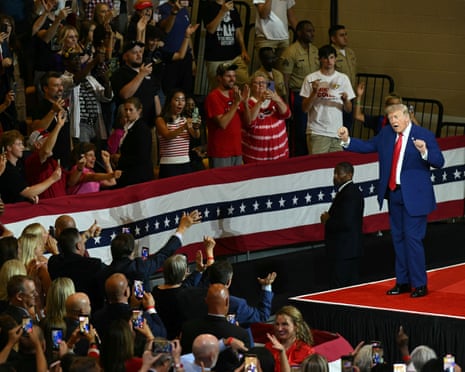
Donald Trump is currently delivering what is supposedly a presidential address to promote a new domestic policy, namely the investment accounts for children he calls Trump accounts, but, surrounded by supporters in Marietta, Georgia, his remarks quickly became deeply partisan, repeatedly attacking Democrats and falsely claiming the party is now filled with “communists”.
Trump, whose political mentor Roy Cohn led senator Joseph McCarthy’s 1950s witch hunts for imaginary communist infiltrators in the US government, made the wild claim that Democrats he called “communists by another name” want to blow up Mount Rushmore. He then proclaimed: “we declare again today that the United States of America will never be a communist country!” The crowd, led by a group of die-hard Trump supporters who call themselves Front Row Joes, for their repeated presence at his rallies, broke into a chant of “USA! USA!”
As I noted earlier, the parents of Lt Tyler Feehan accompanied Trump from Dover to Georgia aboard Air Force One, after the president attended a dignified transfer for four service members killed in the Middle East.
Trump addressed Feehan’s family and their loss in his remarks today. “[Feehan] was a person that was going all the way. He was going to be a general. He would have been a general very quickly. He was heading in that path,” Trump said.
Donald Trump has started speaking in Marietta, Georgia. He started his speech joking that he was announces his candidacy for another term in office.
Despite insisting that he was only “kidding”, it is something that the president has routinely floated – even though a third term would be in direct violation of the US constitution.
The number of measles cases in the US has hit a 35-year high according to new data released by Johns Hopkins University.
According to the tracker, there have been 2,295 cases of measles in 2026, as of 21 July.
This number is already higher than the 2,286 reported throughout the whole of 2025, and the highest level since 1991.
The grim milestone is also the most cases reported in a single year since the disease was declared eliminated in the US in 2000.
Unvaccinated individuals or those with unknown vaccination status represent almost all reported measles cases, according to Johns Hopkins.
“High vaccination coverage has protected even the un- and undervaccinated because of herd protection, keeping measles at bay for the past few decades,” said William Moss, an epidemiology professor at Johns Hopkins Bloomberg School of Public Health. “But in communities with pockets of susceptible individuals across a broad age range, measles has been able to take hold, infecting those who are susceptible and spreading rapidly.”
“Measles vaccines are extremely safe and effective,” Moss added. “Getting you or your child vaccinated is the best way to protect against disease.”
The Mexican man who was hit and killed by a semi-truck in Florida when running away from federal immigration officials was vacationing in the US with a tourist visa, according to news reports this week.
The 28-year-old, Juan Jairo Coronilla Durán, was killed on 14 July after an “encounter” with federal officials, including those with Immigration and Customs Enforcement (ICE), a state highway patrol spokesperson said last week.
After federal officials approached him and a group of four men at a gas station that Tuesday morning, they all took off running. The Florida highway patrol spokesperson said Coronilla ran into traffic and was hit by a semi-truck.
Coronilla’s death is one of the four ICE-related deaths that took place in less than one week. Two people, one in Texas and one in Maine, were shot and killed by ICE officers. And a fourth person died in ICE custody, while being transferred to an immigration detention center in Georgia. The four deaths have led to renewed calls by the public and lawmakers to reign in ICE and its parent agency, the Department of Homeland Security (DHS), as they carry out the Trump administration’s aggressive “mass deportation” campaign promise.
Ahead of Trump’s arrival in Georgia, here’s what’s happened today.
-
On Capitol Hill, Jamieson Greer, the US trade representative, defended the Trump administration’s unremitting “tariff spree” and insisted that prices for American families have not increased in the wake of the president’s duties on several countries. During a heated back and forth with Senator Elizabeth Warren, a Democrat from Massachusetts, Greer noted that “core inflation fell to 2.6 % year on year – much better than in January 2025.” While this metric excludes food and energy, overall inflation is actually around o.5% higher than it was when Trump took office.
-
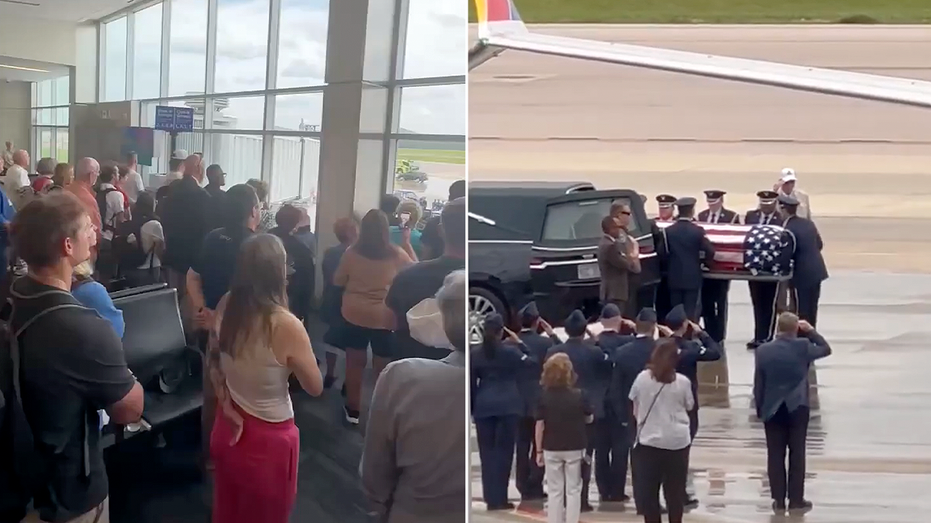
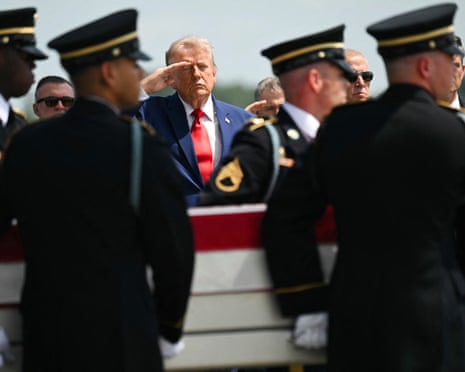
Trump attended the dignified transfer today of four US service members killed in the Middle East. It was the third ceremony that the president has attended since he launched the war in Iran in February. Speaking to reporters on his way to Dover, Trump called it “one of the hardest things to do as a president.” His message to grieving families, he said, will simply be “we love you, we love your child”.
-
Earlier, the president took to Truth Social and noted that the US will destroy one bridge or power plant, including those near Tehran, “any time” that Iran “shoots a ship” in the strait of Hormuz. This comes after the US conducted its 11th consecutive day of strikes on Iran, with the war showing no sign if easing.
-
Senate Republicans have also released the text for the Clarity act today – the legislation that would ban public officials from issuing or sponsoring cryptocurrency or digital assets. The bill’s guardrails would apply to the president, vice-president, members of Congress, federal judges and their spouses, and wouldn’t expire until January 2029 – the end of Trump’s term. The bill is one of the first major attempts to shape cryptocurrency use for those in office, and comes after the president’s financial disclosures revealed the president took in more than $1bn from his crypto businesses since returning to the White House.
-
Meanwhile, in the House, Republican speaker Mike Johnson is desperate to pass the framework for a budget bill that would guarantee funding for the war with Iran. The legislation, which GOP leaders are hoping to pass by reconciliation and avoid the Senate filibuster,faces an array of challenges, including from fiscal hawks who complain that its expected $95bn cost is not offset by any spending cuts, and other Republicans upset that it does not answer the Trump administration’s request for an extra $350bn in defense spending. Johnson can only afford to lose two votes in his quest to pass the package.
A series of health challenges – hantavirus, screwworm, Ebola, cyclospora, measles, whooping cough, bird flu – are exposing the widening gaps in America’s ability to prevent, identify and halt infectious disease outbreaks.
The rapid dismantling of the US public health system at all levels means the US is in worse shape than it was before the Covid pandemic, former top CDC officials say.
The US Centers for Disease Control and Prevention (CDC) lost much of its funding for battling parasites, which are notable global killers, in the last year. Experts were tasked with monitoring potential outbreaks – such as a previously rare parasite called cyclospora – around the US and the world, lending expertise to help stop crises in their tracks.
But their funding was decimated, and many people at the CDC were laid off or resigned without being replaced.
“Are we ready for the next big pandemic? My answer is no,” said Dan Jernigan, the former director of the CDC’s National Center for Emerging and Zoonotic Infectious Diseases.
Debra Houry, the former chief medical officer of the CDC, told the Guardian: “Unfortunately, we’re really moving in the wrong direction.”
Some 80% of senior leadership positions at the CDC still have no permanent officials appointed, and between 25 and 30% of the CDC’s entire staff are gone.
“Those are boots on the ground,” Houry said. “When you have Ebola, hantavirus, measles, and throw cyclospora in there – staffers were already spread thin, and now they’re spread even more thin.”
Read the full report:
As we noted earlier, Trump is now headed to Marietta, Georgia, where he’ll deliver remarks at a local high school at 3pm ET. We’ll bring you the latest as that gets under way.
In the meantime, a White House official says that the family of 1Lt Tyler James Feehan, one of the US soldiers killed during Iranian strikes in Jordan, will be flying with the president and his team. Feehan’s family are from Georgia, the official notes, and the president “offered to give them a ride home”.
Senate Republicans have also released the text for the Clarity act today – the legislation that would ban public officials from issuing or sponsoring cryptocurrency or digital assets.
The bill’s guardrails would apply to the president, vice-president, members of Congress, federal judges and their spouses, and wouldn’t expire until January 2029 – the end of Donald Trump’s term.
It also requires officials to either sell their crypto holdings and investments in crypto companies or place them in a blind trust they are not able to control.
The bill is one of the first major attempts to shape cryptocurrency use for those in office.
A reminder that Trump took in more than $1bn from his crypto businesses since returning to the White House, according to recent financial disclosures. They showed the president earned more than $500m from his World Liberty Financial business selling new crypto products, while another crypto business, CIC Digital LLC, took in more than $600m from sales of souvenir-type “meme” coins stamped with Trump’s face that launched days before his inauguration.
Also today, top Democrat Chuck Schumer plans to seek unanimous consent to pass his Presidential Airlift Security Act, which would stop the Pentagon from spending more to modify, restore, or maintain the Boeing 747-8 gifted by the government of Qatar, which Donald Trump has started to use as the new Air Force One.
Republicans previously blocked the legislation, introduced by the Senate minority leader, last year.
On Sunday, Trump admitted that his jet – valued at close to $400m – cannot match the defensive armor of a true presidential aircraft, telling reporters it will soon be grounded and “maxed out” with the protections it was never built with.
This comes after the New York Times reported that the new plane lacks defensive systems fitted to the purpose-built Air Force One fleet, including infrared countermeasures to divert heat-seeking missiles and sensors to detect incoming launches.
The president flew the jet to Ankara, Turkey for the Nato summit earlier this month but switched to an older, more heavily defended aircraft for his return to the US – at the advice of the Secret Service.
Earlier today, ahead of attending a dignified transfer of US service members who died in the Middle East, Trump claimed that a new poll just claimed that while “Americans don’t want high gasoline prices but they’re not against the war”. However, the president didn’t elaborate on who published the new data.
For context, a recent Washington Post-Ipsos poll actually found that only 29% of Americans approve of Trump’s conduct in overseeing the war with Iran.
Donald Trump salutes the coffins of the US service members killed in the Middle East last week.
The Guardian wp:paragraph
هلدینگ کاسپین استانبول | خرید ملک در ترکیه | صرافی معتبر ایرانی در ترکیه | خرید و فروش طلا در ترکیه | مهاجرت به ترکیه | واردات و صادرات در ترکیه | نیازمندیهای ترکیه | اخبار ترکیه | اخبار جهانی | توریست ایران | خدمات توریستی در ایران | تورهای گردشگری ایران | هلدینگ اول | خدمات کاریابی و فریلنسری و شغل | مرجع اطلاعات ایران (همه چیز در ایران) | کیف پول و خدمات مالی و پرداخت یار | اخبار ایران | تابلو زنده قیمت ارز در ترکیه و استانبول | صرافی آنلاین ترکیه | قیمت طلا و نقره در ترکیه | سرمایه گذاری در ترکیه | جواهرات در ترکیه | نرخ لحظه ای ارزها در استانبول | قیمت دلار امروز در ترکیه | قیمت دلار استانبول امروز | قیمت لحظه ای دلار | اخبار روز ترکیه استانبول | اپلیکیشن ISTEX | اپلیکیشن قیمت لحظه ای دلار و یورو و لیر و ارزها در ترکیه
/wp:paragraph wp:paragraph /wp:paragraph
About the Author