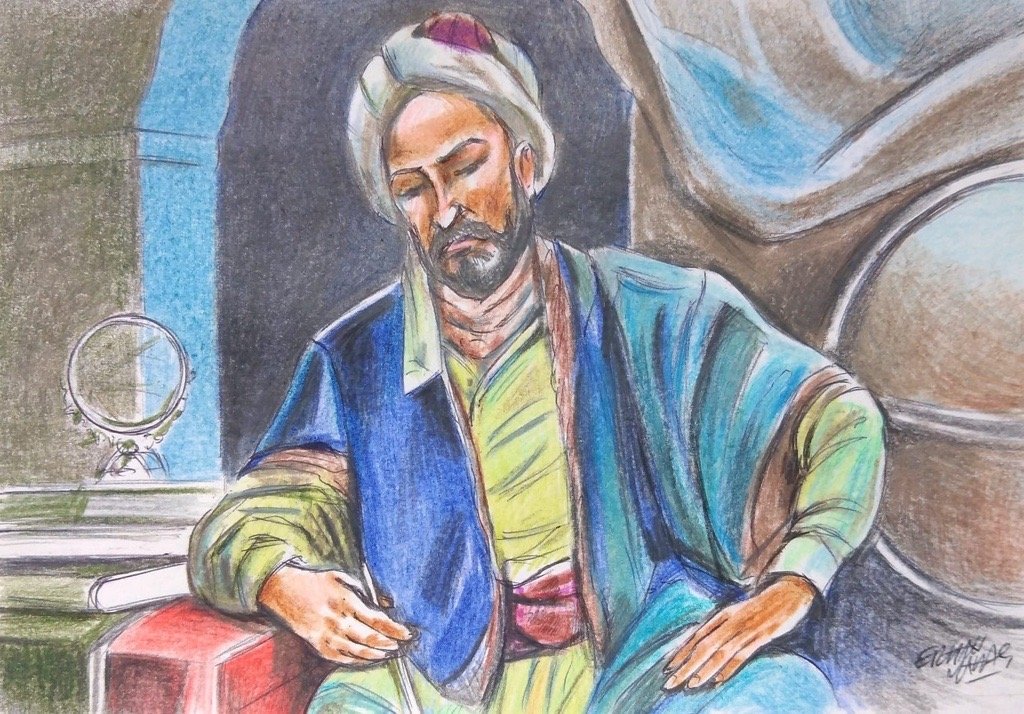
Nasir al-Din al-Tusi occupies a distinctive position in the intellectual history of the Islamic world. His establishment of the Maragha School of Mathematics and Astronomy, together with the scholarly tradition that developed around it, played a pivotal role in the advancement of scientific thought. The achievements of this school subsequently paved the way for the emergence of the Samarkand School of Mathematics and Astronomy. As is well known, the intellectual legacy of these institutions was transmitted organically to the Ottoman scholarly tradition. A polymath who produced influential works across a wide range of disciplines – including mathematics, astronomy, philosophy, medicine, and ethics – al-Tusi authored “Akhlaq-i Nasiri,” one of the most extensively commented-upon works in the Islamic intellectual tradition. The book played a decisive role in shaping subsequent studies of ethics.
The book’s privileged status in the history of Islamic thought stems not merely from its being a comprehensive treatise on ethics. Rather, al-Tusi systematically reinterpreted and integrated the ethical, political and anthropological perspectives developed by earlier thinkers such as Ibn Miskawayh, al-Farabi and Ibn Sina (commonly known in the West as Avicenna) into a coherent intellectual framework. In doing so, he profoundly influenced numerous ethical works composed in subsequent centuries. His impact is particularly evident in such classical texts as Jalal al-Din al-Dawwani’s “Akhlaq-i Jalali” and Kınalızade Ali Efendi’s “Akhlaq-i Alai,” leading Akhlaq-i Nasiri to be widely recognized as one of the foundational texts of Islamic ethical thought.
The governor of the time initially requested that al-Tusi translate Ibn Miskawayh’s “Tahdhib al-Akhlaq” (moral cultivation). However, considering the limited scope of the original work, Al-Tusi chose instead to compose an entirely new treatise, resulting in a comprehensive work consisting of three parts. It is generally acknowledged that the first part, Tahdhib al-Akhlaq, bears the intellectual imprint of Ibn Miskawayh; the second part, “Tadbir al-Manzil” (household management), reflects the influence of Ibn Sina; and the third part, “Siyasat al-Mudun” (political governance), is shaped by the thought of al-Farabi. This threefold classification is far from arbitrary. According to al-Tusi, practical philosophy – the branch of philosophy that guides human beings in regulating their worldly and otherworldly affairs and makes them aware of the consequences of their voluntary actions on the path toward perfection – consists precisely of these three domains. In other words, although the individual occupies the central place in the journey toward perfection by virtue of the substance of the human soul, this journey is inevitably embedded within and influenced by the family and the broader public sphere. Consequently, ethics must encompass all three of these domains.
Since human beings cannot sustain their lives without mutual cooperation, they are necessarily obliged to live together. According to al-Tusi, the term “madinah” (“city”) does not merely refer to a physical place of residence but rather to the distinctive form of association that exists among its inhabitants. The just governance of this distinctive association is what al-Tusi calls “siyasah” (“politics”): “For this reason, governance must ensure that everyone is content with the position they rightfully deserve, that each person receives what is due to them, that individuals are prevented from violating the rights of others or exercising illegitimate control over them, and that each person is directed toward the work most appropriate to them. Such governance (tadbir) is called politics (siyasah).” According to al-Tusi, while each craft or discipline is practiced within its own proper sphere, the art of politics occupies a unique position because it evaluates the actions of all other arts in terms of their moral quality – that is, whether they are good or bad. For this reason, the art of politics stands above all other arts, just as metaphysics stands in relation to the other sciences.
Al-Tusi also divides the social classes of the city into four categories, associating each with one of the four classical elements – fire, water, air, and earth. He likens to water the class of the “people of the pen,” which includes scholars, jurists, judges, gnostics, poets, and engineers, emphasizing that both religion and worldly affairs are sustained through their contributions. The class responsible for maintaining public order and security is associated with fire. Those engaged in the professions and commerce – in short, the people of economic transactions who constitute the labor market – are identified with air, whereas those involved in agriculture, food production, and the food supply chain are associated with earth. According to al-Tusi, one of the primary conditions of justice in the city is that politics maintain a proper balance among these four elements.
What is particularly noteworthy here is that al-Tusi does not conceive of these social groups as competing factions engaged in a struggle for superiority. Rather, he understands them as complementary components of the same social organism, each performing a distinct and indispensable function. Just as fire, water, air, and earth together constitute the natural order, the different classes of society are regarded as mutually dependent conditions for one another’s existence. Consequently, the task of politics is not to establish the dominance of one class over the others, but to secure justice and maintain equilibrium among all the constituent elements of society.
Al-Tusi explains why human beings ought to strive for perfection through an analysis of the composite nature of the soul and the body. Human beings consist of both soul and body, and since the soul is not subject to annihilation, it does not cease to exist when its union with the body is dissolved. Moreover, because everything derives strength from what belongs to its own kind and is weakened by its opposite, the soul becomes stronger as it distances itself from corporeal things. The soul’s journey toward perfection is, in essence, a journey of detachment from the material and bodily realm. Along this journey, al-Tusi argues that human beings must properly regulate three distinct faculties, one of which is unique to humans while the other two are shared with animals: the rational faculty, associated with speech and thought; the appetitive faculty, associated with desire and attraction; and the irascible faculty, associated with anger and repulsion. Although human beings are created in an intermediate state by nature, the manner in which they exercise these three faculties determines, through the operation of their free will, whether they ascend to a higher level of perfection or descend to a lower condition.
According to al-Tusi, the perfection of every being consists in the complete actualization of the activity that is proper to its nature. What is expected of human beings, therefore, is the voluntary striving to bring the soul to this state of perfection. Such striving is simultaneously the pursuit of happiness and virtue. Accordingly, in al-Tusi’s thought, perfection signifies the progression of the rational substance of the human soul from potentiality to actuality. Although human beings share certain characteristics with other living creatures, what fundamentally distinguishes them is their capacity to think, to apprehend truth and to make voluntary choices. For this reason, genuine human happiness does not arise from external possessions or worldly advantages, but from the actualization of the capacities inherent in the soul. Moral education, the cultivation of the virtues and the ordering of social life ultimately serve this process of perfection. In short, al-Tusi maintains that what distinguishes human beings from all other creatures is the rational soul, and that true happiness is attainable only through the maturation and full actualization of this rational essence.
Happiness encompasses the four cardinal virtues: wisdom, courage, temperance and justice. When the rational faculty is directed toward moderation, the virtue of wisdom emerges; when the appetitive faculty is brought into moderation, the virtue of temperance is realized; and when the irascible faculty is moderated, the virtue of courage comes into being. Justice, in turn, arises when all three faculties are held in proper balance – that is, when the virtues of wisdom, temperance and courage have been attained and harmoniously integrated. According to al-Tusi, the completion of the order of existence and the prevention of corruption and disorder require balance and order, both of which ultimately depend upon justice. In other words, justice constitutes the ultimate end toward which all the other virtues are directed. Whereas the acquisition of wisdom, temperance and courage pertains to the cultivation of individual character, the realization of justice depends upon the harmonious presence of all three. Consequently, whenever these faculties deviate from moderation – that is, whenever they depart from virtue – they must first be restored to their proper equilibrium before justice can be achieved.
The purpose of human beings in living together is, of course, not merely the preservation of life. Rather, communal life is intended to expand and support the opportunities available to individuals as they voluntarily strive for the perfection of the soul. Accordingly, al-Tusi evaluates political regimes according to the extent to which they facilitate or hinder this journey toward perfection. Just as the human soul is naturally oriented toward attaining perfection, so too the ideal form of politics is that which enables and promotes this process of perfection through virtuous governance. Accordingly, happiness in this world is attained through the cultivation of both spiritual and bodily virtues. Among the four cardinal virtues, wisdom resides in the rational soul, whereas the remaining virtues are manifested through the body. These bodily virtues are expressed in human conduct and therefore require deliberate practice. For such voluntary efforts to become stable moral dispositions, they must be cultivated through persistent repetition, patience and steadfastness.
Viewed as a whole, Akhlaq-i Nasiri makes it clear that justice is not merely one of the four cardinal virtues. Rather, justice functions as the organizing principle of the entire work. At the level of the individual, it signifies the harmonious balance among the faculties of the soul; within the family, it denotes harmony among its members; and in political life, it represents the proper order among the different groups that constitute society. Accordingly, the progression of Akhlaq-i Nasiri from ethics to household management and ultimately to politics can be understood as an exploration of the diverse manifestations of a single underlying principle – justice. In other words, the work establishes a parallel between the equilibrium of the human faculties and the equilibrium of the social order. Just as justice within the individual emerges from the harmonious integration of wisdom, temperance and courage, justice at the societal level is realized through the harmonious ordering of the different classes of society.
In sum, Akhlaq-i Nasiri is far more than a treatise on individual moral virtues. It presents a comprehensive vision of human life in which the individual’s striving for perfection through the cultivation of the soul is inseparably connected with the ordering of family life and political society. In this respect, al-Tusi departs from modern approaches that confine morality to the private sphere, arguing instead that genuine human happiness can be realized only within a social order founded upon justice. Despite the passage of centuries, in a world increasingly marked by unrestrained individual desires, social fragmentation and political tensions, al-Tusi’s emphasis on balance, moderation, virtue, and justice continues to stand as a powerful intellectual legacy that deserves careful study and renewed reflection.
The views and opinions expressed in this article are solely those of the author. They do not necessarily reflect the editorial stance, values or position of Daily Sabah. The newspaper provides space for diverse perspectives as part of its commitment to open and informed public discussion.
DAILYSABAH
هلدینگ کاسپین استانبول | خرید ملک در ترکیه | صرافی معتبر ایرانی در ترکیه | خرید و فروش طلا در ترکیه | مهاجرت به ترکیه | واردات و صادرات در ترکیه | نیازمندیهای ترکیه | اخبار ترکیه | اخبار جهانی | توریست ایران | خدمات توریستی در ایران | تورهای گردشگری ایران | هلدینگ اول | خدمات کاریابی و فریلنسری و شغل | مرجع اطلاعات ایران (همه چیز در ایران) | کیف پول و خدمات مالی و پرداخت یار | اخبار ایران | تابلو زنده قیمت ارز در ترکیه و استانبول | صرافی آنلاین ترکیه | قیمت طلا و نقره در ترکیه | سرمایه گذاری در ترکیه | جواهرات در ترکیه | نرخ لحظه ای ارزها در استانبول | قیمت دلار امروز در ترکیه | قیمت دلار استانبول امروز | قیمت لحظه ای دلار | اخبار روز ترکیه استانبول | اپلیکیشن ISTEX | اپلیکیشن قیمت لحظه ای دلار و یورو و لیر و ارزها در ترکیه
About the Author