
When the Indian government announced the resignation of its education minister in late July after weeks of protest, there were widespread celebrations. Students from across the country had joined the mass demonstrations led by the Cockroach Janta party amid growing resentment over repeated examination cancellations and question paper leaks.
The pressure of exams in the country has only increased in recent years. The number of student suicides rose from 8,068 in 2014, to 14,488 in 2024 – an increase of roughly 80% – according to the Accidental Deaths and Suicides in India report released by the country’s National Crime Records Bureau. After family problems, failure in examinations has been listed as the leading cause of suicides among students.
For families who say they lost their children to education system mismanagement and examination scandals, watching the protest scenes unfold on television came with mixed feelings. Some were happy that future students may be spared the same fate; others questioned why it had taken so long.
The Guardian spoke to four families about what happened to their children and how they feel today.
Anshika Pandey, 20, Delhi
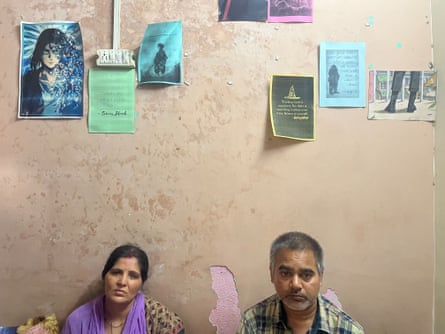
Anshika Pandey, the eldest of twin sisters and four siblings, was, her father says, the calmest, quietest and most responsible member of the family. Revision books still lie neatly stacked, bags and accreditation cards hang from the nails where they were last placed. Her ambition was to be a doctor in the community where she lived, to be able to help the “poor people in need of medical care” some day.
Pandey studied for more than 12 hours every day, worked part-time at a store for nearly six hours and slept no more than five hours each night.
This year’s national eligibility cum entrance test (Neet) to gain entrance to medical training was her third attempt at becoming a doctor. After sitting the exam on 3 May, she was hopeful. But on 12 May she learned that the exam had been leaked for the second year in a row and there would be a resit.
“Anshika was deeply hurt. She had been hoping to enter college this year and was happy with the exam she had taken. Still, after cancellation, when I tried to console her, all she lamented was how could she hope to give another good exam,” says her father, Indradhar Pandey, a cab driver in Delhi.
Anshika remained calm and performed her household duties and engaged with everyone normally. But two days later, on 14 May, when everyone had left for work and her twin sister and younger brother were napping, she hanged herself.
Anshika’s dream had been to move her family, especially her siblings, from the slum where they lived. Her younger sister, Pragati, hopes to fulfil that dream and reminisces about how the two sisters had talked about it several times.
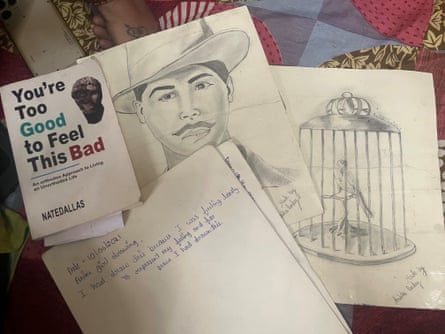
Anshika’s sketches and positive messages and mantra chants on the walls of their home, which she wrote to motivate herself, are now the memories her family is refusing to let go of.
Sufi Shaheen, 19, Delhi
Before leaving the house on the morning of 25 October 2024, Sufi Shaheen straightened her hair and put on her favourite jeans. As she left, she asked her mother for 10 rupees (8p), unlike other days when she would ask for 100. Then she headed for her joint entrance examination (Jee) lesson.
Her mother, Sultana Khatoon, asked her why she was leaving the house on an empty stomach. Shaheen replied she would be back soon. Twenty minutes later, she jumped from the seventh floor of a tutoring centre, about a mile away from her home.
It has been almost two years since she died, but Khatoon has not recovered from that day. She is being treated for severe depression and bouts of headaches.
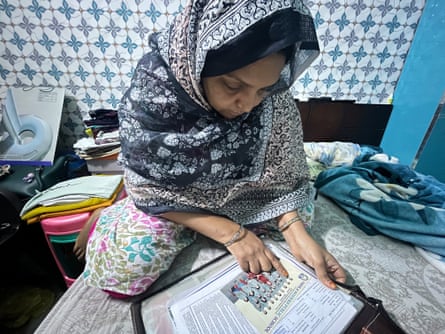
“She was my only daughter of the four children and more like a friend. Every time I stepped out of the house, she would help me get ready. Even though she was deeply passionate about studying and becoming an engineer, she also loved dressing up and made everyone in the house do it too,” says Khatoon, as she looks through her daughter’s school photos.

Living with her parents and three brothers on her father’s modest income as a technical engineer, Shaheen had dreamed of becoming a software engineer and “excelling even more than the boys in her community”, says her mother.
A quick learner and highly motivated, Shaheen taught herself to draw and paint, and even learned to speak Japanese and Korean. But she had been stressed for several months and feared not being able to clear her second attempt at the national engineering entrance exam in January 2025.
When India’s National Testing Agency made changes to the Jee exam syllabus, Shaheen couldn’t sleep for days. She remained stressed, cried when talking to her brother and her best friend on the phone, and wrote a note to her parents in which she apologised and asked her younger brother, Masoom, to make their dreams come true.
“Almost two years later, Masoom was ranked 188th in the whole of India in his CUET [common university entrance test]. But we do not have Shaheen to celebrate this with,” says Khatoon.
Pradeep Kumar Mahich, 22, Rajasthan
“Even God will not be able to stop me from becoming a doctor this year,” were 22-year-old Pradeep Mahich’s words to his father right after his Neet exam on 3 May. This was his fourth attempt and, most importantly, he felt confident. But the announcement of the exam paper leak and resit broke his heart.
No one in the family had ever “dreamt so big”, says Pradeep’s father, Rajesh Kumar, a farmer in Rajasthan’s Sikar district. Kumar sold a large part of his farmland and took a loan of 11 lakhs (£8,600) under the farmer’s crop loan schemes.
“Sikar, the main coaching hub for Neet, is only an hour and a half from our village. My eldest daughter, Babita, who was preparing to join the police, and my son were both studying in Sikar, renting an apartment. This was his fourth year of tutoring, and the money from selling the land and the loan was slowly being consumed. I would send monthly expenses of £250 and Pradeep’s annual tutoring fees of £4,000, asking them not to worry about money and focus on his studies,” says Kumar.
“Pradeep had told me, ‘Papa, we will do a big celebration before I go to college. And one day I’ll return to serve the people of the village,’” says Kumar.
On 15 May, as he did every day, Kumar sent milk and curd to his two children on a bus that goes to Sikar; Pradeep came to pick it up at 9.30am then went home and told his sister he would help prepare lunch. But when his sister was showering, he hanged himself. She has taken a break from her studies and returned home.
Seeing students protesting on his television screen, Kumar says he is relieved that the eduction minister has gone but says there should be a proper investigation so that “no family suffers the same fate that we did”.
S Anitha, 17, Tamil Nadu
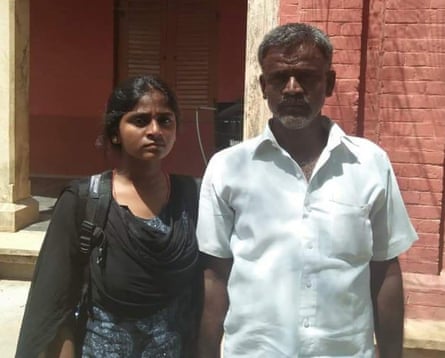
S Anitha belonged to an underprivileged lower caste, or Dalit, community from Tamil Nadu’s Ariyalur district. Born to a daily wage labourer, her mother died when she was seven, leaving her grandparents to raise her.
As a teenager, she decided she wanted to become a doctor. “At such a tender age, she was so focused that we used to feel proud of her,” says her brother, Manirathinam. “She knew what she wanted and never distracted herself with anything else. She never asked for any clothes, jewellery or food – her focus was clear and she knew the circumstances.”
She scored a perfect 100 in physics and chemistry at school and was offered a place to study aeronautical engineering at the state’s technological institute. But when she could not even meet the cut-off marks in the Neet exam, she realised that she had been studying a different syllabus.
Tamil Nadu had already criticised the national government for imposing an all-India examination – “disrupting the federal structure” – because it had a different education system. As a result, the state was exempted from Neet in 2016, but not in 2017, the year Anitha sat the exam.
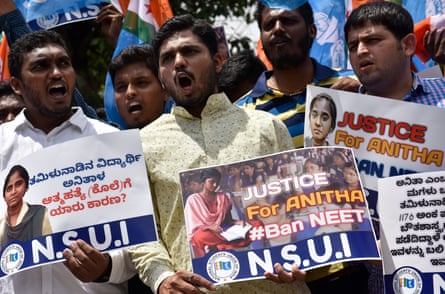
When the supreme court ruled on 22 August 2017 that admissions to medical school would be based only on the Neet exam, she lost hope. On 1 September, Anitha hanged herself in her grandparents’ home. Her suicide became the subject of a public debate and led to widespread protests across the state and even in Delhi.
Her brother took part in last month’s protests in the capital and, while happy about the Indian education minister’s resignation in July, argues that all exams should become state-run, rather than by central government, as not everyone can afford the hefty tutoring fees needed to sit the Neet exam.
He now runs a free library and education centre in Anitha’s name.
The Guardian wp:paragraph
هلدینگ کاسپین استانبول | خرید ملک در ترکیه | صرافی معتبر ایرانی در ترکیه | خرید و فروش طلا در ترکیه | مهاجرت به ترکیه | واردات و صادرات در ترکیه | نیازمندیهای ترکیه | اخبار ترکیه | اخبار جهانی | توریست ایران | خدمات توریستی در ایران | تورهای گردشگری ایران | هلدینگ اول | خدمات کاریابی و فریلنسری و شغل | مرجع اطلاعات ایران (همه چیز در ایران) | کیف پول و خدمات مالی و پرداخت یار | اخبار ایران | تابلو زنده قیمت ارز در ترکیه و استانبول | صرافی آنلاین ترکیه | قیمت طلا و نقره در ترکیه | سرمایه گذاری در ترکیه | جواهرات در ترکیه | نرخ لحظه ای ارزها در استانبول | قیمت دلار امروز در ترکیه | قیمت دلار استانبول امروز | قیمت لحظه ای دلار | اخبار روز ترکیه استانبول | اپلیکیشن ISTEX | اپلیکیشن قیمت لحظه ای دلار و یورو و لیر و ارزها در ترکیه
/wp:paragraph wp:paragraph /wp:paragraph
About the Author