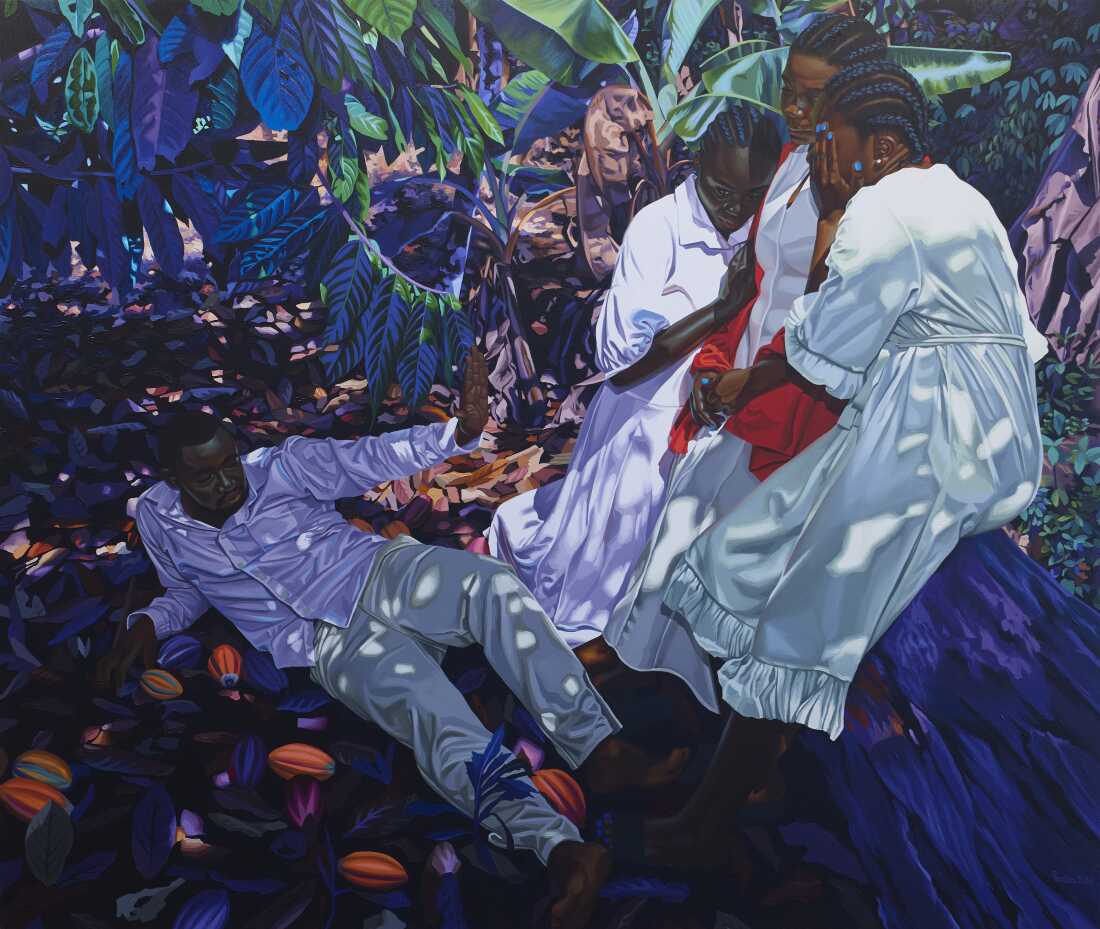
Marc Padeu, a painter from Cameroon, draws inspiration from Renaissance art brought into an African landscape. The above painting is title “Sous le poids de la coupe” — under the weight of the cup.
Copyright The Artist/Courtesy Larkin Durey
Copyright The Artist/Courtesy Larkin Durey
Cameroonian painter Marc Padeu says that being an African artist means “being the heir to an extraordinarily rich history.” But he also says it can mean “living and working on a continent where artistic infrastructure is virtually nonexistent.”
Padeu’s work often takes inspiration from religious paintings from the European Renaissance –- but reimagines them, depicting people in Cameroon’s cocoa plantations. London gallery Larkin Durey is currently holding an exhibition of Padeu’s latest work.

Marc Padeu, a painter from Cameroon, has a new show at the London gallery
London gallery Larkin Durey.
Courtesy of Larkin Durey
Courtesy of Larkin Durey
Oliver Durey, the gallery’s director, said: “Mark’s work is timeless. His visual style is simultaneously very contemporary but also deeply rooted in that old tradition –- so there is something extremely fresh about it.”
Padeu is from Bafang in the West Region of Cameroon and is part of the Bamileké ethnic group. The 36-year-old now lives in Yaoundé, the country’s political capital. In an interview with NPR, Padeu explained his art — and what inspires him.
Can you talk about why you meld classic Western paintings with African scenes?
I wouldn’t say that I’m trying to fuse Western painting with African scenes. For me, it’s more a question of placing images that everyone recognizes within a setting that is familiar to me. I grew up in Cameroon, surrounded by plantations, villages and people who make their living from the land. That’s the world I know best, so it’s only natural that this is the setting in which I want to tell these stories.
At one point, I asked myself why certain images seemed to belong exclusively to Europe. Why should the Nativity, the Last Supper or Christ in Gethsemane always be depicted with the same faces and the same landscapes? Yet what they convey goes far beyond any particular place or era. They speak of love, sacrifice, fear, hope, family. These are profoundly human, universal experiences.
How did you become an artist?
It’s certainly down to genetics, first and foremost. My mother is a fashion designer. She doesn’t work much any more, but when I was younger, I used to see her fashion sketchbooks. So I inherited this talent from my mother. I was already drawing a lot at primary school and then at secondary school. I was the one who often helped teachers draw their demonstration sketches on the blackboard in front of my classmates. This often earned me a certain reputation at the various schools I attended.
Later on, I went on to study at the school of fine arts. I must say the timing was perfect in that respect. The very year I passed my A-levels, the Cameroonian government opened the country’s very first art schools. So I’m part of the very first ever intake of graduates from that school. It was a very traditional course, based mainly on the study of art history.
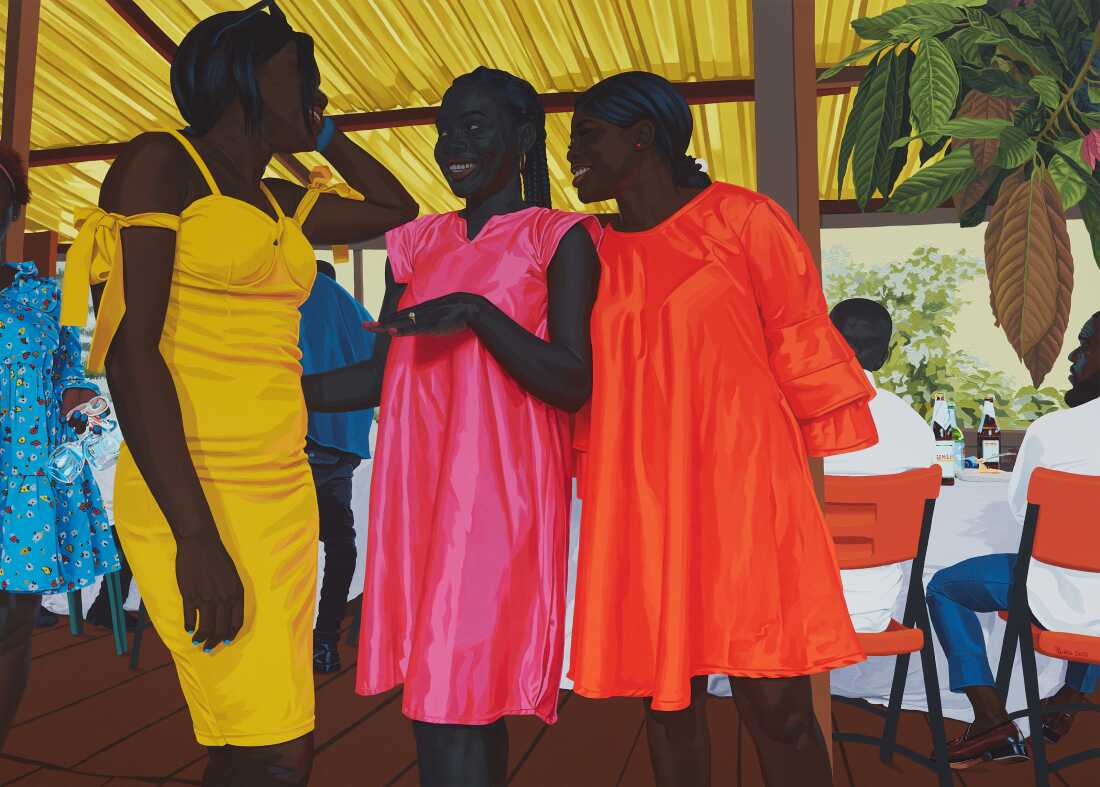
“La bague de Roxane” — Roxane’s ring — by Marc Padeu
Private Collection, USA/Image copyright of the artist, courtesy of Larkin Durey
Private Collection, USA/Image copyright of the artist, courtesy of Larkin Durey
Is there one artist who inspired you most?
The African American painter Kerry James Marshall.Marshall was a significant discovery for me, not because I wanted to paint like him, but because he showed me that it was possible to reestablish Black bodies at the heart of the great tradition of painting. He never merely added Black figures to an art history that had already been written; he demonstrated that they were an integral part of it.
I do think, however, that our approaches subsequently take different directions. He is very interested in the social and political history of African American communities. My work is more permeated by philosophical and spiritual questions. I explore the major themes of existence: birth, sacrifice, death, hope, promise by embodying them in scenes from everyday life in Cameroon.
Is it right that you used to be a fresco painter in a church?
That’s right. I created a few murals in the churches of Nkongsamba, where I was studying at the school of fine arts. At first, it was just a part-time job to earn a bit of money. But the murals were so successful that I was very quickly inundated with commissions, mainly of religious murals. The churches commissioned me to paint scenes inspired by the Bible: episodes from the life of Christ, the Virgin Mary, the various apostles, angels and certain saints.
One evening, whilst I was still painting on the scaffolding inside the town’s grand cathedral, a few women from a prayer group entered the church and prostrated themselves before the still-unfinished mural. It gave me a very strange feeling. But above all, it was at that moment that I realized the power that images and representations can have.
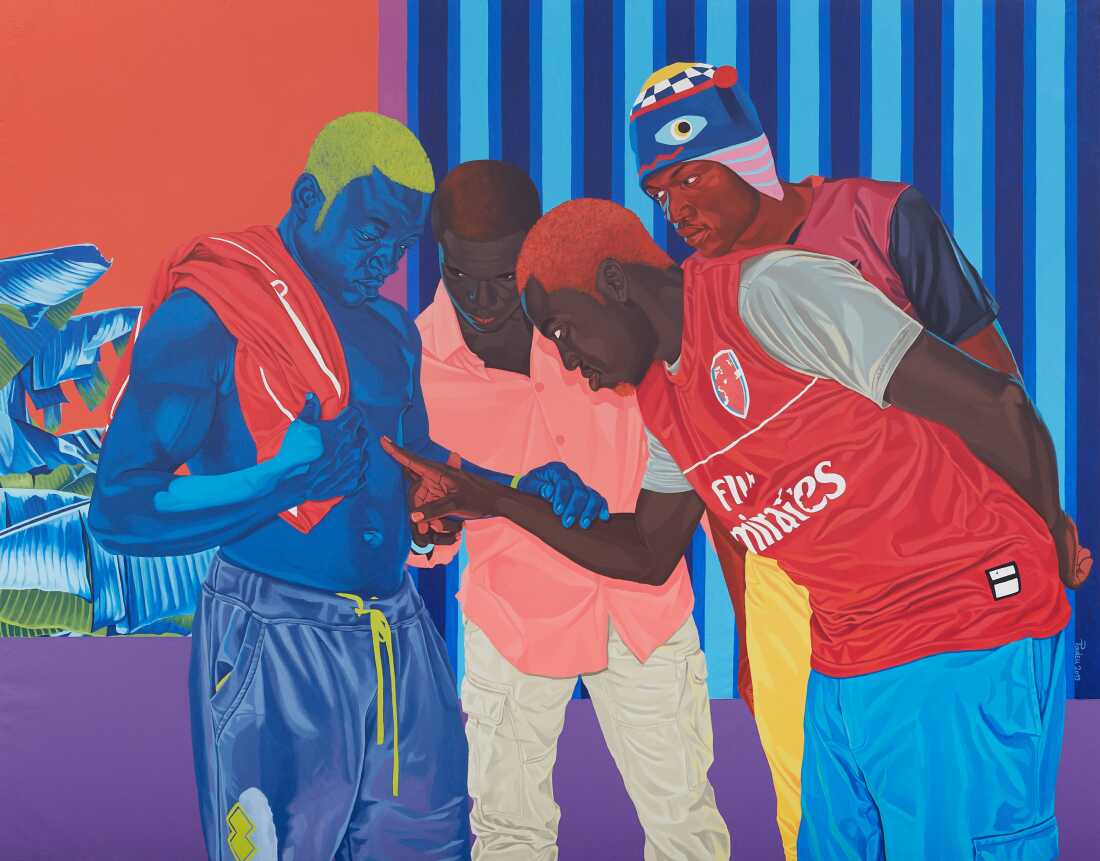
“The Blue Man of Njombé,” by Marc Padeu
Private Collection, USA/Image copyright of the artist, courtesy of Larkin Durey
Private Collection, USA/Image copyright of the artist, courtesy of Larkin Durey
I have read that you take inspiration from religious paintings from Europe, especially from the Renaissance era.
Through constantly depicting these religious images, I began to take a deeper interest in them. I remember one in particular: The Coronation of the Virgin by Diego Velázquez. This painting, which I consider a masterpiece of composition, fascinated me to such an extent that I created my own reinterpretation, which I would call The Blue Virgin. The same is true of Caravaggio’s The Incredulity of Saint Thomas, which I reinterpreted as The Blue Man of Njombé.
Can you tell us a bit more about The Blue Virgin – with its depiction of a woman whose skin and clothing is blue?
The Blue Virgin is one of the first works in which I sought to create a dialogue between Christian iconography and my own visual world. I depict a young African woman striking the serene, frontal pose of Renaissance Madonnas. Inspired by Diego Velázquez’s The Coronation of the Virgin, this is not a Virgin in the religious or devotional sense. Rather, she is a symbolic figure. She embodies motherhood, promise and a form of silent presence. By giving her the features of a young Cameroonian woman, I wanted to show that these foundational figures of art history can be reinvented through other faces, other stories and other places.
The luminous skull resting on the figure’s lap is undoubtedly the most important element in the painting. It refers to the memento mori نیازمندیهای ترکیه
About the Author