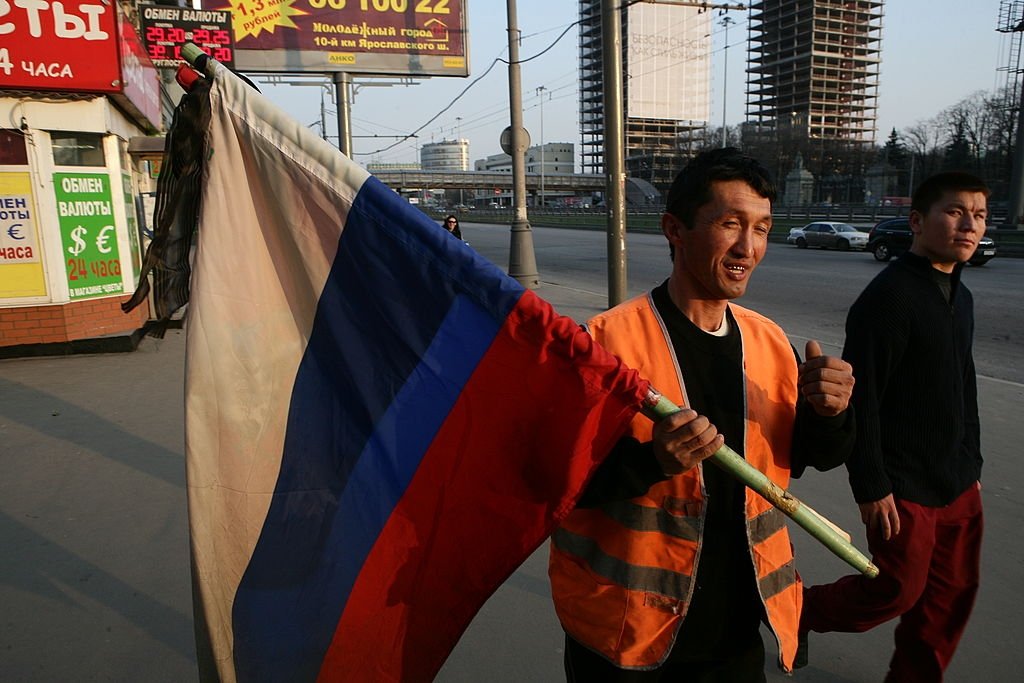
The Russian economy is facing a new front in the shadow of war: a labor shortage. An analysis published by the business daily Vedomosti, based on official data, revealed that the number of migrant workers arriving from Central Asia fell by 15% during the first half of 2026.
Work-related entries by citizens of Uzbekistan, Tajikistan and Kyrgyzstan dropped from 2.3 million to 1.9 million, with all three countries recording double-digit declines. Entries from Uzbekistan fell 13.2% to 1.1 million, from Tajikistan 17.9% to 494,500, and from Kyrgyzstan 16.7% to 289,100. As Moscow’s war economy hungers for workers, the decline in migrant numbers lays bare the cost of the security-driven migration policy the Kremlin has pursued in recent years.
This decline can also be read as a sign of a quiet but determined shift underway in the migration policies of Tashkent, Bishkek and Dushanbe. Central Asian workers form the backbone of sectors such as construction, municipal services and sanitation, jobs Russians have long avoided. As this labor pool shrinks, disruptions are beginning to reach even the most basic functions of urban life.
Kremlin losing labor force
The first cause behind Russia’s decline is bureaucratic. Work permit and medical certificate costs have multiplied in recent years, and registration procedures have grown more complicated. According to Alexander Safonov of the Financial University, whose assessment was cited by Vedomosti, tightened migration legislation and rising documentation costs rank among the main factors deterring workers. Yet the real story behind the numbers has less to do with legislation than with the broader social climate.
Following the 2024 Crocus City Hall attack, security screenings, detention operations and hostile rhetoric targeting Central Asians intensified sharply across Russia. The fact that some of the attackers were of Tajik origin cast millions of innocent migrant workers under collective suspicion. Identity checks at construction sites, metro stations and marketplaces stopped being routine security measures and turned into daily harassment.
Wartime demand for front-line manpower made threats facing migrants more tangible. Reports that detained workers faced pressure to sign military contracts caused deep concern across Central Asian societies. Most workers had no wish to be sent to war, yet many caught without visas or with incomplete documents were left with no alternative.
More recently, the deaths of migrant workers employed near front-line regions in drone strikes have shown that the issue has evolved from a purely bureaucratic matter into one of direct physical safety.
Russia’s economic picture is striking: 2.5 million positions sit vacant while unemployment hovers around 2%, a level fueling inflation. Central Bank Governor Elvira Nabiullina has openly stated that Russia’s labor shortage remains a primary threat to price stability. In July, Russia raised its annual inflation forecast to a range of 6%-7%, with inflation expected to reach 6.3% by the end of September. By 2030, Russia is projected to need 10.9 million new workers to fill positions vacated by retirements.
Despite this, Moscow continues to favor stricter oversight and registration systems that tie workers to a single employer, rather than easing migration policy. This model, now overseen by the Interior Ministry and slated to take effect in 2027, envisions migrants arriving without their families, working for an assigned employer, and leaving the country once their term ends.
The Kremlin has raised its 2026 quota for foreign workers to 279,000, with most positions going to workers from India, China, Malaysia, Bangladesh and several African countries. India’s share alone stands at around 70,000 to 72,000. While this quota marks a concrete effort to close gaps left behind, cultural, linguistic and logistical differences make it unlikely to offset losses at a comparable scale anytime soon.
Moreover, since the registration-based model set to be introduced requires workers to arrive without their families and remain bound to a single assigned employer, it seems unlikely that voluntary applications under this scheme could replace the free mobility that once characterized labor flows from Central Asia.
Central Asian migration diplomacy
Central Asian governments are redesigning labor policies that for years remained dependent on Russia. Leading this process, Uzbek President Shavkat Mirziyoyev launched a strategy in 2024 aimed at directing citizens toward safer, higher-paying jobs abroad.
A decree signed in June created new diplomatic posts at embassies in China, France, Indonesia, the United Arab Emirates (UAE), the United States and the United Kingdom, tasked with jointly promoting tourism and labor migration. This move signals that migration policy has evolved from a mere work-visa issue into a direct instrument of foreign policy.
The migration and mobility partnership agreement signed with Germany in 2024 facilitates legal entry into the European Union for skilled Uzbek workers, while also including provisions for the return of irregular migrants. This formula, which addresses Berlin’s priorities of closing its labor gap while curbing irregular migration, could serve as a model for other Central Asian states.
Tashkent’s diversification drive is not limited to a single agreement. The EU-Uzbekistan Enhanced Partnership and Cooperation Agreement, signed in October 2025, made migration and mobility a permanent part of relations with Brussels. Under the vocational training model developed with South Korea, a state-backed migration agency prepares candidates in niches such as automotive servicing, offering Korean language and vocational training for the E-7 skilled-worker visa; as Seoul opened the field to foreign workers for the first time, Uzbekistan gained priority in the application process.
Central European countries such as Poland, the Czechia, Croatia and Slovenia are also turning to Uzbek workers to fill the gaps left by their aging populations, while in the Gulf, the UAE and Qatar are seeing similar rising demand in construction and hospitality.
Figures suggest this diversification strategy is already bearing fruit. In the first quarter of 2026, total remittances sent home by Uzbek workers abroad rose 13% year-on-year to reach $3.8 billion, with Russia’s share falling from 78% to 72%. Rising remittances from Kazakhstan, South Korea and EU countries confirm that workers are increasingly turning to different destinations.
Kyrgyzstan and Tajikistan are moving in a similar direction, though their economic vulnerability and deep social ties to Russia make a transition as rapid as Uzbekistan’s difficult for now. South Korea’s seasonal worker programs and Gulf demand in construction offer appealing alternatives for regional governments, yet language barriers and visa quotas remain significant obstacles.
Remittances still make up a strikingly high share of national income in Kyrgyzstan and Tajikistan, pushing both governments toward cautious yet determined steps. Dushanbe and Bishkek continue seeking alternative employment channels without damaging political ties with Russia.
The Kremlin’s persistence in its migration policy reflects a choice that prioritizes short-term security concerns over long-term economic interests. Demographic projections make clear that the labor shortage will not close on its own even once the war ends. As Russia’s birth rate falls and its retiree population grows rapidly, the country faces a structural constraint over the medium and long term.
In Central Asia, the trend runs in the opposite direction. A young and growing population allows regional governments to both create jobs at home and negotiate more favorable migration agreements abroad. This demographic asymmetry stands out as the most powerful factor set to redraw Eurasia’s labor map over the coming decade. The trust Moscow has lost could translate into gains for other capitals. Any actor with historic and institutional ties to the region now has an opportunity to claim a share of this redistribution.
DAILYSABAH
هلدینگ کاسپین استانبول | خرید ملک در ترکیه | صرافی معتبر ایرانی در ترکیه | خرید و فروش طلا در ترکیه | مهاجرت به ترکیه | واردات و صادرات در ترکیه | نیازمندیهای ترکیه | اخبار ترکیه | اخبار جهانی | توریست ایران | خدمات توریستی در ایران | تورهای گردشگری ایران | هلدینگ اول | خدمات کاریابی و فریلنسری و شغل | مرجع اطلاعات ایران (همه چیز در ایران) | کیف پول و خدمات مالی و پرداخت یار | اخبار ایران | تابلو زنده قیمت ارز در ترکیه و استانبول | صرافی آنلاین ترکیه | قیمت طلا و نقره در ترکیه | سرمایه گذاری در ترکیه | جواهرات در ترکیه | نرخ لحظه ای ارزها در استانبول | قیمت دلار امروز در ترکیه | قیمت دلار استانبول امروز | قیمت لحظه ای دلار | اخبار روز ترکیه استانبول | اپلیکیشن ISTEX | اپلیکیشن قیمت لحظه ای دلار و یورو و لیر و ارزها در ترکیه
About the Author