The next witness is William Heidmeyer, a former security officer at the Maxim Hotel and Casino, now known as the Westin.
The night of Shakur’s killing in 1996, he was working with Las Vegas police officers to investigate the theft of some vehicles on the third floor of a Las Vegas parking garage.
“We just suddenly heard a lot of gunfire, and we ran to the barrier wall that was overlooking” Koval and Flamingo streets in Las Vegas.
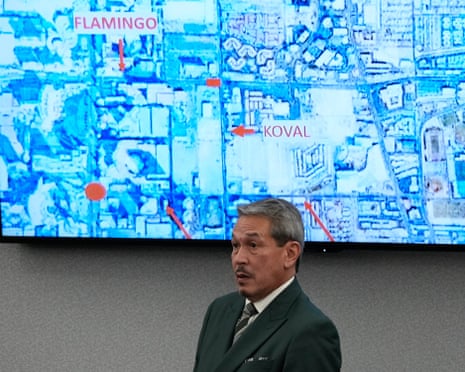
Heidmeyer he said he heard “three volleys” of gunfire, with “Three to four, maybe even five,” shots in each volley of gunfire.
He described looking down at the street, seeing a line of vehicles on Flamingo, heading east, including “a white Dodge Stratus at front, a Black BMW behind it….a white Chevy suburban behind that, and several more cars.”
There were a number of people standing outside vehicles, including one Black man who was visibily holding a pistol in his hand, Heidmeyer said. “He wasn’t pointing it in any direction, it was just off to the side.”
He described the Black man holding the pistol as “very young, well dressed, he was wearing a very bright white three-quarter sleeved shirt, black pants and a black dress vest.”
His conclusion at the time was that the man with the gun that he had seen was the suspect in the shooting, Heidmeyer testified. “That’s what I deduced at the time.”
Everyone on the street quickly got back in the cars and headed back towards Las Vegas Boulevard, Heidmeyer testified.
Former police detective Dean O’Kelley testifies that the ammunition cartridges found at the scene of the shooting suggests that the weapon used was a Glock.
Former Las Vegas police detective Dean O’Kelley, who responded to the scene of the shooting, described crime scene analyst Dan Ford, who also responded to the scene, as investigator who had responded to “countless” homicides during their overlapping Las Vegas careers.
“Dan had indicated that these [ammunition] cartridge cases were checked for fingerprints at the time, with negative results,” O’Kelley testified.
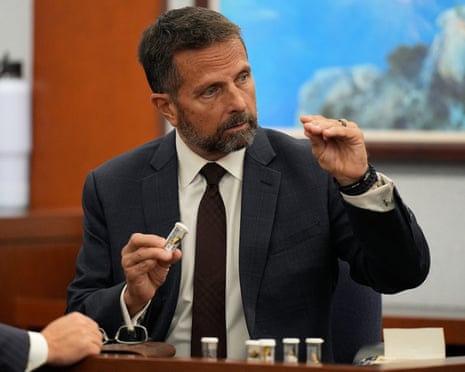
On the night of 7 September 1996, around 11:17 pm, former Las Vegas police detective Dean O’Kelley testified, he was conducting enforcement activity with gang members near the shooting and heard over the radio a police officer reporting shots being fired and requesting a “code red,” requesting radio traffic to be kept for a minimum. “It’s a sacred things, and you don’t break the code red.”
He responded to the intersection of Koval and Flamingo, at what was then called the Maxim hotel, now the Westin. When he arrived, normal traffic had resumed and people were “still just driving by” on the road, since “whatever had happened was several minutes before.”
A supervisor wanted to know where the shooting had taken place.
“We were able to look out on the street there on Flamingo, just west of Koval. I saw in the headlights just little glints of light,” he said. He recognized the glints of brass from his time at the firing range, O’Kelley said. “We were able to determine where several cartridge cases were located on the street.”
As they located the cartridge cases in the roadway, they placed traffic cones they were carrying on top of or over the cartridge cases, to protect the crime scene from the traffic. By the time he got there, some of the cartridge cases had already been run over by cars, he testified.
They also found one bullet fragment, he said.
With no further questions from either defense or prosecution for the former security guard, the next witness is Dean O’Kelley, a former Las Vegas Metropolitan police officer who worked as a cold case homicide investigator.
On 7 September 1996, the day Tupac Shakur was shot, O’Kelley was a “detective in the gang unit on one of the enforcement teams,” responsible for patrolling known gang areas.
O’Kelley is being asked about the changes about report-taking in the police department over time, and describing 1996 as a pre-digital era in the police department.
Defense attorney Michael Sanft is now questioning William Heidmeyer, a former security officer, about his exact location on the night of the shooting, and his precise vantage point on the aftermath of the shooting.
Sanft emphasizes what the security guard already testified: that he heard gunfire and then saw a young man standing in the street with a gun, but did not actually see that young man shoot his weapon.
The next witness is William Heidmeyer, a former security officer at the Maxim Hotel and Casino, now known as the Westin.
The night of Shakur’s killing in 1996, he was working with Las Vegas police officers to investigate the theft of some vehicles on the third floor of a Las Vegas parking garage.
“We just suddenly heard a lot of gunfire, and we ran to the barrier wall that was overlooking” Koval and Flamingo streets in Las Vegas.
Heidmeyer he said he heard “three volleys” of gunfire, with “Three to four, maybe even five,” shots in each volley of gunfire.
He described looking down at the street, seeing a line of vehicles on Flamingo, heading east, including “a white Dodge Stratus at front, a Black BMW behind it….a white Chevy suburban behind that, and several more cars.”
There were a number of people standing outside vehicles, including one Black man who was visibily holding a pistol in his hand, Heidmeyer said. “He wasn’t pointing it in any direction, it was just off to the side.”
He described the Black man holding the pistol as “very young, well dressed, he was wearing a very bright white three-quarter sleeved shirt, black pants and a black dress vest.”
His conclusion at the time was that the man with the gun that he had seen was the suspect in the shooting, Heidmeyer testified. “That’s what I deduced at the time.”
Everyone on the street quickly got back in the cars and headed back towards Las Vegas Boulevard, Heidmeyer testified.
Under cross-examination from defense attorney Michael Sanft, former Las Vegas police officer Kenneth Rios says that he does not recall where he wrote up the report about his interaction with Orlando Anderson, or the exact circumstances of why he wrote up the report.
Through the judge, a member of the jury asks retired officer Rios about why he stayed with the apparent victim of the fight in the MGM Grand rather than following those who had done the assault. Rios said that his role was to check if the victim needed medical assistance or two file ar report. “We had already radioed to other officers who were on scene and the MGM Security had radioed to officers up front….It was my responsibility to stay with the victim.”
Kenneth Rios, former Las Vegas police sergeant, identifies himself as one of the police officers in the surveillance footage from the MGM Grand.
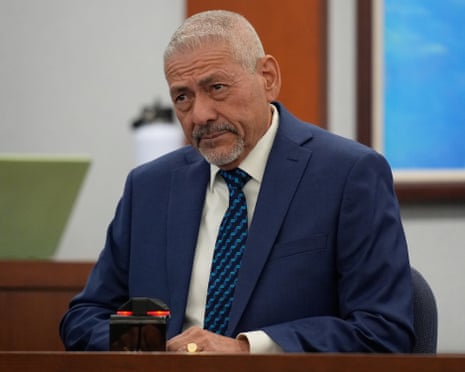
The footage shows Rios interacting with a man in a Dan Marino jersey football jersey, who was described as the victim in a fight in the hotel that night. Rios said the man was identified using a California driver’s license.
“I asked him if he needed medical assistance and he refused, he was fine…He told me basically that a couple of guys that he didn’t know jumped him…I asked him if he wanted to file a report, he said no,” Rios testified.
At that point he was released and allowed to go on his way, Rios said.
Later that night, after Rios learned about the shooting of Tupac Shakur, Rios was asked to write a report about his interaction with Orlando Anderson, prosecutor Marc DiGiacomo, said. He remembered the man’s first name as Orlando, Rios confirmed.
The court took a brief ten-minute morning recess, and has now returned.
The next witness to testify is Kenneth Rios, a retired Las Vegas police sergeant, who served in the department for 28 years, and was working patrol at the MGM hotel on the night of Shakur’s killing.
The evidence heard earlier this morning, including graphic images of Tupac Shakur’s body, has been difficult for members of Shakur’s family who are present in the courtroom, according to reporters on the scene. From the Associated Press:
Some members of Tupac Shakur’s family stepped out of the courtroom Tuesday before prosecutors showed photos from his 1996 autopsy…
Jurors were shown a photo of a green body bag at the beginning of her questioning, followed by a grisly photo of his body. His relatives who remained in the courtroom looked away. One woman got up to leave once the photos were shown.
As Gavin explained the autopsy photos, Duane Davis [who is charged in Shakur’s killing] sat still, looking at the screen in front of him. He occasionally whispered in his attorney’s ear.
A map of the MGM Grand was examined during the second day of the Tupac Shakur murder trial in Las Vegas, Nevada.
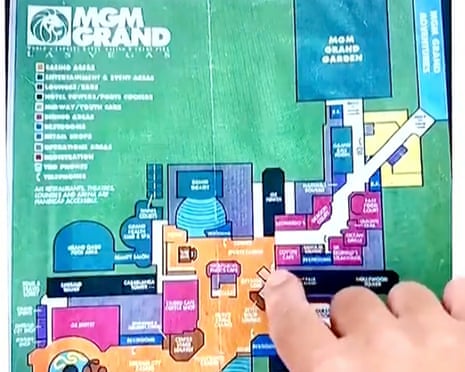
So far, the second day of the Tupac Shakur murder trial in Las Vegas has focused on authenticating some of the basic evidence in the case, with expert testimony from a Las Vegas medical examiner’s review of photographs and the autopsy report of Shakur’s body, followed by testimony from an MGM Grand surveillance expert about the surveillance footage from 1996 used in the case.
The MGM Grand surveillance footage is essential to the case because it establishes the motive for the shooting that killed Shakur nearly 30 years ago.
Prosecutors have charged Duane Davis, a 63-year-old former South Side Compton Crips gang leader, with orchestrating Shakur’s murder in Las Vegas in 1996, as revenge for the assault of his nephew, Orlando “Baby Lane” Anderson, in the MGM Grand.
“Let’s be clear, Duane Davis did not pull the trigger. But he did plan the shooting in retaliation of the beating of his nephew,” Chief Deputy District Attorney Binu Palal told jurors yesterday.
The evidence against Davis will include his own description of his role in the shooting in a 2019 memoir.
Davis’ defense attorney, Michael Sanft, has argued that Davis’ own statements about the killing were lies meant to inflate his reputation. Davis’ lawyers previously argued that his book should not be used as evidence that he and his co-author exaggerated what happened in an effort to “falsely place himself at the center of it all for personal gain”.
“At the end of the day you have to ask yourself: is what they are saying truth or fiction?” Sanft told the jury on Monday.
Sanft argued on Monday that while Davis spoke about the killing to different law enforcement agencies over the years, including the FBI, they did not follow up because, Sanft said, they did not believe what Davis said was credible.
The Associated Press contributed reporting
Michael Ingram, an investigator for MGM resorts in Las Vegas, is now testifying to authenticate the surveillance video from MGM resorts that is being used as evidence in the trial.
As the Associated Press noted, during the trial’s first day, “Jurors were shown video of Shakur’s entourage attacking Davis’ nephew Orlando ‘Baby Lane’ Anderson outside the boxing match at the MGM Grand in Las Vegas hours before the shooting on Sept. 7, 1996.”
Here’s the key video evidence from Monday:
The Guardian wp:paragraph
هلدینگ کاسپین استانبول | خرید ملک در ترکیه | صرافی معتبر ایرانی در ترکیه | خرید و فروش طلا در ترکیه | مهاجرت به ترکیه | واردات و صادرات در ترکیه | نیازمندیهای ترکیه | اخبار ترکیه | اخبار جهانی | توریست ایران | خدمات توریستی در ایران | تورهای گردشگری ایران | هلدینگ اول | خدمات کاریابی و فریلنسری و شغل | مرجع اطلاعات ایران (همه چیز در ایران) | کیف پول و خدمات مالی و پرداخت یار | اخبار ایران | تابلو زنده قیمت ارز در ترکیه و استانبول | صرافی آنلاین ترکیه | قیمت طلا و نقره در ترکیه | سرمایه گذاری در ترکیه | جواهرات در ترکیه | نرخ لحظه ای ارزها در استانبول | قیمت دلار امروز در ترکیه | قیمت دلار استانبول امروز | قیمت لحظه ای دلار | اخبار روز ترکیه استانبول | اپلیکیشن ISTEX | اپلیکیشن قیمت لحظه ای دلار و یورو و لیر و ارزها در ترکیه
/wp:paragraph wp:paragraph /wp:paragraph
About the Author