Home – CBSNews.com
Iranian Parliament Speaker Mohammad Bagher Ghalibaf argued Wednesday that any negotiations with the U.S. did not equate to retreat from the Islamic Republic’s principles and demands.
“Negotiation, in my view, has neither intrinsic value nor is it a taboo; it is neither absolutely good nor absolutely evil,” he wrote in a letter responding to criticism from Hossein Shariatmadari, the editor-in-chief of Iran’s hardline Kayhan newspaper, according to Iran’s state IRNA news agency.
Qalibaf said diplomacy did not mean abandoning resistance.
“If necessary, dialogue, too, according to this logic, is the same arena of struggle and resistance; neither a replacement for it nor a sign of retreat from it,” he said.
He argued that negotiations, when necessary, should be conducted from a position of strength while preserving Iran’s “dignity, wisdom and interests.”
Qalibaf said refusing to engage with an enemy would amount to Iranian authorities avoiding their responsibility.
Just less than a week ago, President Trump said there were no ongoing talks between the U.S. and Iran and none scheduled, but Iran has kept up a dialogue with Oman aimed at establishing a proposal to reopen the Strait of Hormuz and to reinstitute a ceasefire with the U.S.
Iran’s army said Wednesday that all of the country’s weapons systems damaged in the war with the U.S. and Israel had been “rebuilt,” and a claim that new systems had been brought into the country.
“Systems in all branches of the military, including those that were damaged, have been rebuilt, and new systems have also been imported,” army spokesperson Mohammad Akraminia was quoted as saying by Iranian state TV.
“New systems have come through the defense industry and the army, and some have also been imported from abroad, and this equipment has enhanced our combat capabilities,” he claimed, without naming any countries providing military hardware to the Islamic Republic.
President Trump has previously claimed that Iran’s military capabilities have been destroyed by U.S. strikes on the country, but experts have questioned that assessment, and Iran has demonstrated an ongoing capacity to launch attacks on ships and America’s Persian Gulf allies.
CBS/AFP
Iran’s president has not ruled out resolving the conflict with the United States through negotiations, despite the “economic pressure” being exerted on his country.
“Our foundation is understanding and resolving issues through interaction and negotiation, but at the same time, we will stand firmly against economic pressures, just as we have done so far,” Masoud Pezeshkian said during a three-hour meeting at Iran’s Central Bank on Tuesday.
Pezeshkian said Iran would continue pursuing dialogue while relying on measures prepared by the government’s economic institutions to withstand the U.S. sanctions, adding that Washington’s attempts at pressuring Iran would fail.
Iran called Tuesday on the United Nations Security Council to condemn U.S. sanctions and other “unilateral coercive measures” against the Islamic Republic.
Speaking at a Security Council meeting, Gholamhossein Darzi, Iran’s ambassador and deputy permanent representative to the U.N., said the council had failed to fulfill its responsibilities.
“The Security Council must firmly condemn and reject these unilateral coercive measures aimed at forcing sovereign countries to change their legitimate economic interests and foreign relations,” Darzi said.
He called the ongoing U.S. naval blockade of Iran’s ports and vessels, which has included several attacks on Iranian commercial vessels, violations of Iran’s sovereignty and freedom of navigation.
“The root cause of instability and disruption in maritime trade and shipping through the Strait of Hormuz is the war of aggression by the U.S. and Israeli regime against Iran,” Darzi said.
Israeli Prime Minister Benjamin Netanyahu has said a diplomatic deal is not possible with the “savages” who rule Iran, as he hailed President Trump’s new campaign of economic pressure against the Islamic Republic.
Recounting a recent meeting with Mr. Trump, Netanyahu said at an event late Tuesday that they had discussed the possibility of diplomacy with Iran and said: “I doubt, however, that an agreement can be reached with that group there, with those savages. I tell you, an agreement cannot be reached.”
Iran accused Israel of getting in the way of a previous ceasefire initiative by continuing operations in Lebanon, against Hezbollah, which it considered a violation of the terms of the agreement reached with Washington.
Israel insisted it was only responding to violations of the truce by Hezbollah, which is a powerful paramilitary and political force backed by Iran in Lebanon.
CBS/AFP
Iran’s deputy foreign minister insisted Wednesday that the Strait of Hormuz would not reopen until the U.S. lifts its naval blockade of Iranian ports and vessels, and the “termination of the war.”
Kazem Gharibabadi told Iranian state broadcaster IRIB “the blockade is not the only quid pro quo for the Strait of Hormuz.”
“Another issue is the termination of the war,” he said. “The termination of the war in a permanent and sustainable manner on all fronts, including Lebanon.”
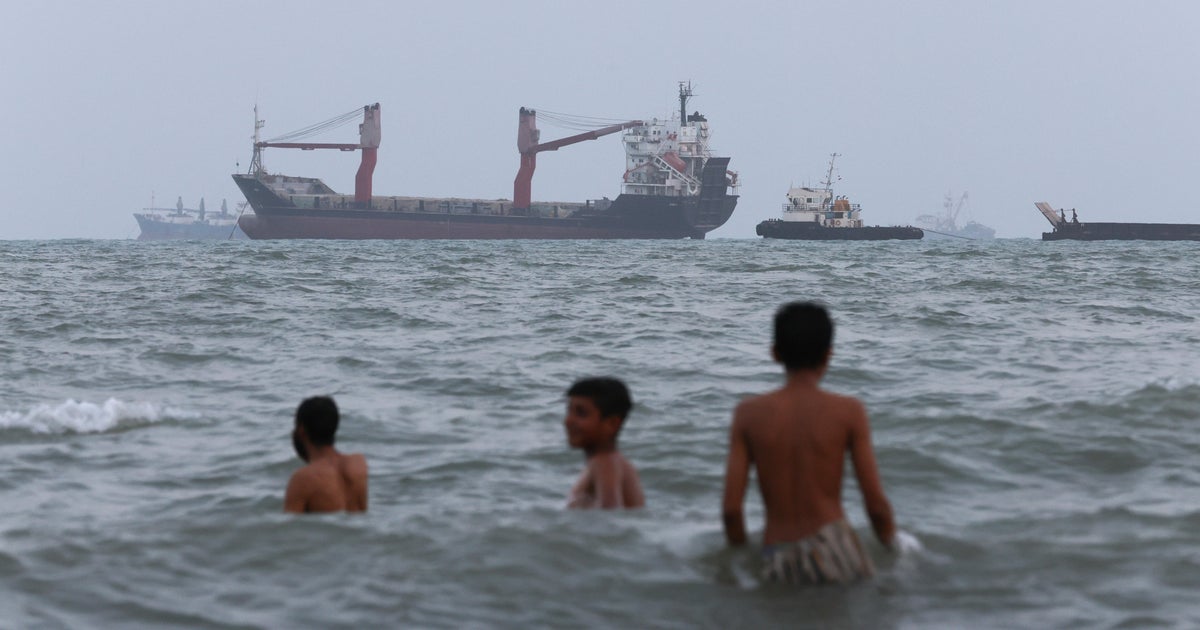
Iran and Oman, the two countries with coastline in the waterway, said in a joint statement Tuesday that they were discussing a proposal for a temporary route that would allow ships to transit through the Strait of Hormuz, as well as a plan to remove sea mines.
President Trump has said repeatedly that all mines have been removed from the strait.
Long lines formed at gas stations in Tehran Tuesday after the United States announced fresh sanctions aimed at pressuring Iran into submission.
Washington has turned to pulling economic levers six months into a war on Iran that has ground to a stalemate militarily, with peace talks stalled and most traffic through the crucial Strait of Hormuz blocked.
Treasury Secretary Scott Bessent on Monday laid out plans for the “economic asphyxiation” of Iran, saying the “objective is to sever every economic lifeline that sustains this tyrannical regime.”
Though Iran’s leaders have shrugged off the tough talk, having already endured sanctions for decades, some residents of the capital feared that they would feel the pinch.
“Naturally, sanctions affect people’s lives,” realtor Mehdi Yazdian, 55, who urged the authorities to control prices, told the AFP news agency. “People are being hurt, both those who are financially well-off and those who are financially weak.”
“Yes, these sanctions are having an effect,” he said. “But naturally, our people are resilient. These sanctions have been in place for 47 years.”
“I personally am not afraid of war at all because this is our land,” English teacher Kia Farahani, 45, said. “But I think that this war will be more economic and will cause people to feel a lot of pressure, and now maybe there will be protests again.”
Iran’s national police chief said Monday that the U.S. was “seeking to create unrest in a part of the country or throughout the country,” by imposing the additional economic pain.
CBS/AFP
Oman’s foreign minister said Tuesday he was “hopeful” a temporary route through the Strait of Hormuz would be announced “soon,” after meeting with Iran.
In a joint statement, Iran and Oman said they had discussed a proposal for a temporary reopening of the Strait of Hormuz which includes a specific route and a plan to clear mines.
The two countries have held regular meetings on the future management of the Strait of Hormuz as laid out in the memorandum of understanding signed in June.
“I am hopeful we will soon announce a temporary corridor for the Strait of Hormuz and practical arrangements to restore safe navigation,” Oman’s Foreign Minister Bdr Albusaidi said in a social media post. “Future management of the Strait and a permanent solution will follow in due course,” he added.
However, Iranian Deputy Foreign Minister Kazem Gharibabadi warned on Wednesday the United States would have to lift its blockade on the narrow waterway.
“Before any action is taken to reopen the Strait of Hormuz, the United States must fully implement all of the commitments it has violated,” he said.
President Trump said Tuesday that the U.S. was implementing a “Zero Tolerance” policy on any Iranian ships placing mines in the Strait of Hormuz, saying they would be “immediately and systematically destroyed.”
In a post on his Truth Social platform, Mr. Trump reiterated his claim that all mines have been removed or destroyed from the vital waterway, adding, “Iran has been notified that any ship or boat placing new mines will be immediately and systematically destroyed.”
He said the U.S. Space Force was “watching every square inch of the Strait” and that there is “a Zero Tolerance policy on mine placement in full force and effect.”
Quoting anonymous Iranian sources, the Financial Times reported last week that Iran would fire missiles at U.S. targets in Europe if Mr. Trump stepped up military pressure over the Strait of Hormuz.
China’s government on Tuesday dismissed any looming efforts by the U.S. to impose punishment for doing business with Iran as likely illegal, and warned Washington against taking such measures.
U.S. Treasury Secretary Bessent, in announcing new sanctions targeting Iran on Monday, said President Trump was making phone calls to world leaders warning them to cease interactions with the Iranian regime. He declined to name any of those leaders when asked by CBS News, and he didn’t get into a timeline or other specifics.
Asked whether Chinese banks that finance Iranian oil imports would be among those hit with the punishing financial measures, Bessent said, “no one is above the reach of U.S. sanctions.”
Speaking to reporters in Beijing, Foreign Ministry spokesperson Lin Jian said Tuesday that China has “repeatedly stated its firm opposition to illegal unilateral sanctions without the basis of international law and without authorization from the UN Security Council,” according to China’s state-run Xinhua news agency.
“Economic warfare and extreme pressure do not help solve problems; they only further intensify conflicts, cause risks to spill over, disrupt the global economic and financial order, and harm the legitimate rights and interests of other countries,” Lin said, adding that China’s cooperation with Iran has “always been conducted within the framework of international law and should not be disrupted or undermined.”
China “will take all necessary measures to firmly safeguard its own rights and interests,” he added.
wp:paragraph
هلدینگ کاسپین استانبول | خرید ملک در ترکیه | صرافی معتبر ایرانی در ترکیه | خرید و فروش طلا در ترکیه | مهاجرت به ترکیه | واردات و صادرات در ترکیه | نیازمندیهای ترکیه | اخبار ترکیه | اخبار جهانی | توریست ایران | خدمات توریستی در ایران | تورهای گردشگری ایران | هلدینگ اول | خدمات کاریابی و فریلنسری و شغل | مرجع اطلاعات ایران (همه چیز در ایران) | کیف پول و خدمات مالی و پرداخت یار | اخبار ایران | تابلو زنده قیمت ارز در ترکیه و استانبول | صرافی آنلاین ترکیه | قیمت طلا و نقره در ترکیه | سرمایه گذاری در ترکیه | جواهرات در ترکیه | نرخ لحظه ای ارزها در استانبول | قیمت دلار امروز در ترکیه | قیمت دلار استانبول امروز | قیمت لحظه ای دلار | اخبار روز ترکیه استانبول | اپلیکیشن ISTEX | اپلیکیشن قیمت لحظه ای دلار و یورو و لیر و ارزها در ترکیه
/wp:paragraph wp:paragraph /wp:paragraph
About the Author