The bodies continue to wash up. But the morgues have already run out of room.
Since the deadly floods coursed through the Himalayan valleys of Nepal and Tibet, the numbers of people killed have continued to rise. The bodies have surfaced in their hundreds and continue to be pulled from the thick, tar-like mud that engulfed everything after the flood waters had receded. By Sunday, the death toll stood at 797 in Nepal and Tibet.
Morgues across Nepal are already overflowing. Authorities say they are overwhelmed with the task of trying to identify the dead, many mangled beyond recognition and turning up miles from home. As places to safely store the victims run out, mass burials have begun in the district of Bharatpur.
DNA samples were taken from each body before it was given a tag and a location number, wrapped in a plastic bag and then placed in a shallow grave. The hope, said the police, was that these bodies will eventually be identified by loved ones through DNA and retrieved for proper funeral rites.
In Chitwan, about 100 miles downstream from the region worst hit by the flash floods and mudslides, more than 250 bodies have washed up along the riverbanks. But they are in such a disfigured state that only nine have been successfully identified. Many will now be buried, at least temporarily, in the forest on the edge of the city.
In a bid to speed up the identification exercise, local officials have adopted a macabre approach of simply asking people to go through pictures of the bodies and look for identifying features: a necklace, a wedding ring, a tattoo, a scar. Photos of those recovered have been placed on to PowerPoint slideshows, for relatives to sit patiently through, and have been uploaded to the Nepal police website. Outside the morgue in the capital, Kathmandu, photographs of the dead inside have been posted on the walls.
Yet with more than 3,000 still reported missing in Nepal and Tibet, there are fears that the numbers of dead may still rise exponentially. Many of the worst-hit areas, where entire villages were wiped clean away by the apocalyptic tidal wave of mud, water and debris, are still inaccessible except by army helicopter. Speaking on Sunday, the foreign secretary, Amrit Bahadur Rai, said the government had requested “more than 1,000 freezer units” for safe storage of the dead.
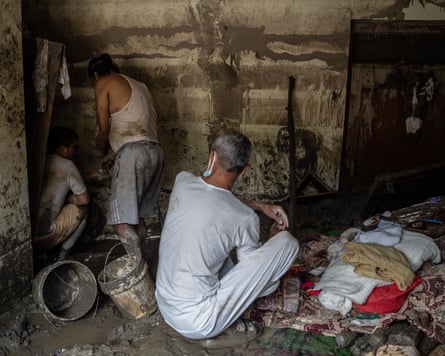
Even in areas lower down the river valley that were decimated by the floods but have remained accessible by road, search and rescue teams have struggled to retrieve all those killed and buried in the mud. On Sunday afternoon in Devighat, a sacred town on the Trishuli River that was left in ruins by the floods, police search and rescue teams prepared to pull another victim from the muddy ruins of a house. All that was visible through the thick mud was their feet.
“It is very tough work. We have retrieved 10 bodies from here so far, maybe there will be more,” said Amabadutta Bhatta, a police superintendent working as part of search and rescue in the city. “The floods destroyed the first and second storey of most homes here. When we finally clear all the mud, which may be many months, who knows what we might find.”
Those who survived the floods in Devighat have slowly come back to see the remains of their houses, many which were wiped away altogether. Standing next to the carcass of her house, reduced to a few concrete blocks and twisted metal, Usha Nepali, 49, wept for the home where she had raised her four children and then her three grandchildren.
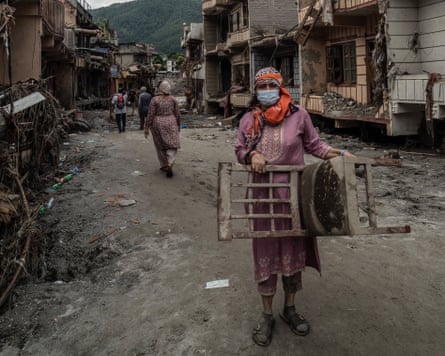
“I invested everything to build this house, so now I don’t know where to go and what to do,” said Nepali. “Nothing is left except this cloth on my back. I haven’t even been able to change clothes since the floods. How can we rebuild this house? This land is no longer safe but it’s the only land we have. The river has taken everything.”
The precariousness of living next to the Trishuli River was underlined on Sunday as the fast-moving waters again swelled dangerously high and rescuers urged people to get to higher ground quickly. Many in Devighat were packing up the few items they could find in their homes, never to return.
Jamuna Magar, 36, said her husband’s family had been living in Devighat for generations. She had come here when she got married and described it as “such a beautiful place”.
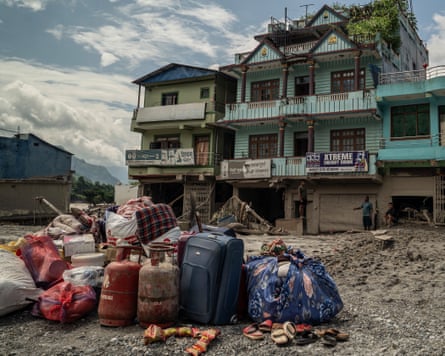
In the minutes after they got warning of the flood, she had time to grab her gold but nothing else. As she stood by the ruins of her house, clutching the only thing she had been able to retrieve so far – a plastic vat of vegetable cooking oil – she said she did not see how they could ever live in Devighat again.
“We had experienced flooding before, but we never knew a flood like this could come and take our house,” she said. “Everything we owned was on the ground floor of the house and now it’s all lost. Even our refrigerator washed away. I’m too worried about my life, about my children’s lives to stay here any longer.”
She feared it would take “decades before they can rebuild Devighat again”.
The Guardian wp:paragraph
هلدینگ کاسپین استانبول | خرید ملک در ترکیه | صرافی معتبر ایرانی در ترکیه | خرید و فروش طلا در ترکیه | مهاجرت به ترکیه | واردات و صادرات در ترکیه | نیازمندیهای ترکیه | اخبار ترکیه | اخبار جهانی | توریست ایران | خدمات توریستی در ایران | تورهای گردشگری ایران | هلدینگ اول | خدمات کاریابی و فریلنسری و شغل | مرجع اطلاعات ایران (همه چیز در ایران) | کیف پول و خدمات مالی و پرداخت یار | اخبار ایران | تابلو زنده قیمت ارز در ترکیه و استانبول | صرافی آنلاین ترکیه | قیمت طلا و نقره در ترکیه | سرمایه گذاری در ترکیه | جواهرات در ترکیه | نرخ لحظه ای ارزها در استانبول | قیمت دلار امروز در ترکیه | قیمت دلار استانبول امروز | قیمت لحظه ای دلار | اخبار روز ترکیه استانبول | اپلیکیشن ISTEX | اپلیکیشن قیمت لحظه ای دلار و یورو و لیر و ارزها در ترکیه
/wp:paragraph wp:paragraph /wp:paragraph
About the Author