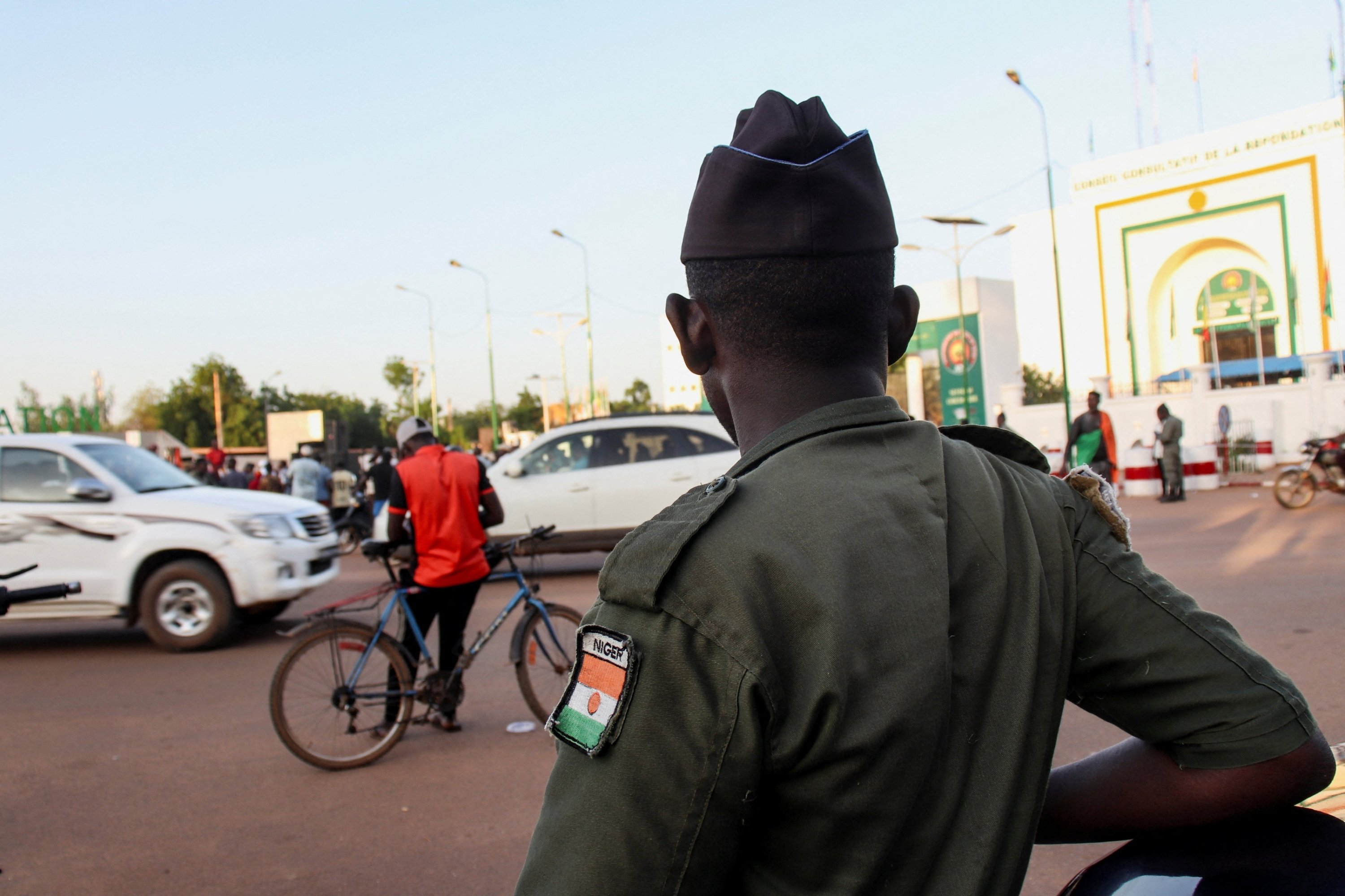
In the early hours of Aug. 29, heavy gunfire and explosions were heard across Niger’s capital, Niamey, around Diori Hamani International Airport, the adjacent Air Base 101, and the Plateau administrative district where the Presidential Palace stands. One security source described the attackers as “terrorists,” while other sources reported the incident as an attempt by mutinous soldiers. State broadcaster RTN suspended its live programming for a time and resumed transmission later in the morning. That weakened the initial claims that the station had been seized. Officials announced that control had been restored, that some of the attackers had been neutralised and that others had fled.
The truth is that the nature of the incident is still not settled. The difference between an “extremist raid” and a “military mutiny” is no minor detail. It will shape the path Niger takes in the months ahead. But it is worth noting that in the Sahel these two categories are increasingly blurring into one another.
Pressure from 3 axes
First, security attrition. According to the Armed Conflict Location and Event Data (ACLED) data, conflict-related deaths have risen by roughly 55% since the July 2023 coup, reaching 4,620. Of these, 3,371 are in the Tillabéri region alone. Information attributed to security sources indicates that in June 2026 alone, at least 223 soldiers and civilians were killed nationwide, 161 of them again in Tillabéri. That same month, the Islamic State in the Greater Sahara announced it had captured the Banibangou camp. In an attack on the military camp at Inatès, some 70 Nigerien soldiers were reported killed. In September 2025, armed groups encircled the town of Tillabéri and looted part of it.
The critical point is that the area around Niamey’s airport has now been the scene of a serious security incident for the third time this year. In other words, what happened that night may be less an anomaly than the latest link in a rising curve.
Second, the new phase of resource nationalism. On Aug. 21, the Council of Ministers reallocated two uranium permits. The In Azaoua site at Arlit was awarded to Teloua Safeguarding Uranium Mining Company (TSUMCO), the state company created to replace SOMAIR, which had been taken over from French company Orano. The Madaouela I permit was transferred to Madaouela Mining Company (MAMICO), the new Nigerien subsidiary of the Australian firm Atomic Eagle. Under the agreement reached, the project will be 60% owned by the company and 40% by the state. That permit had earlier been withdrawn from the Canadian company GoviEx, which then went to arbitration. Orano, for its part, has filed suit in several commercial courts. So while Niamey is fighting a legal battle with French and Canadian investors at the same time, it is inviting a new kind of partner into its mining sector.
Third, the shift in the energy file. In mid-August, a build-operate-transfer agreement was signed with Canada’s Zimar Group and the U.S. firm Hightech for a $1.9 billion refinery and petrochemical complex at Dosso, with a capacity of 100,000 barrels per day. On Aug. 18, officials from the Ministry of Petroleum met the U.S. Embassy’s chargé d’affaires and invited American companies into exploration, drilling and oil field services. For a government that maintains its military partnership with Russia, opening an economic door to Washington is less a one-way alignment than a search for a multi-directional balance. But every search for balance shrinks someone’s share at home.
Possible scenarios
Discontent within the army: Niger’s armed forces, numbering between 25,000 and 33,000, have been in a defensive posture for three years. In an army sustaining losses on this scale, fractures at the junior and mid-levels are to be expected. Even if such an attempt fails, the wave of purges that follows would thin out an already exhausted command structure. It is worth remembering that the 2023 coup itself grew out of a dispute over a dismissal.
A hybrid picture, the most likely in the Sahel: internal discontent noticed and then fed by external actors. The armed opposition in northern Niger entered a process of reorganization after Patriotic Liberation Front (FPL) leader Mahamoud Sallah was released in Libya on June 22, 2026, by forces loyal to Khalifa Haftar.
In the following weeks, groups including the FPL, MPLJ, FPJ, FAL, MADP and later the MPN stepped up their coordination under the umbrella of the Coordination des Forces Libres du Niger (CFLN). Following this consolidation, the MPLJ, one of the CFLN’s components, attacked positions held by Nigerien security forces at Séguédine, near the Libyan border, on Aug. 15, 2026. Camps were looted and set on fire, vehicles, weapons and ammunition were seized, and some soldiers were taken prisoner.
Separately, on July 25, the group staged a show of force at Ahahi, in the Niger-Libya-Chad triangle, with around 100 fighters and 18 vehicles. Many sources claim to see the logistical support of the Haftar family behind this. That link has not been independently verified. It is therefore a claim to be treated with caution. Even so, the activity north of Agadez, combined with the pressure in Tillabéri, splits the army across two fronts.
A crisis turned into an opportunity. Every failed attempt hands the government a legitimate pretext for purges and mobilization. In his speech of July 25, Tiani accused France and some Western states of attempting to destabilize the Sahel. It would be no surprise to see a similar framing constructed again.
Three indicators will be decisive in the coming days. First, how quickly Tiani appears before the cameras, together with the ranks of the officers detained and the units they belong to. This is the clearest evidence that will confirm or refute the mutiny thesis. Second, whether the uranium and oil files are interrupted. Third, whether a wave of opportunistic attacks follows in Tillabéri and the northeast. Turmoil in the capital has historically served as an invitation to armed groups in the provinces.
From Ankara’s perspective
During Tiani’s visit to Ankara on June 4, 2026, four agreements were signed with Türkiye in trade, health and defense. A protocol in force since April also allows Turkish instructors to be sent to the Nigerien Armed Forces. On that visit, Tiani explicitly emphasized the role of Turkish-made equipment in bringing the threat under control. Every wave of instability in Niamey is therefore a direct agenda item for Ankara.
The distinguishing feature of Türkiye’s approach to the Sahel has been that it ties partnership to institutions rather than to a single name. What is being tested in Niger today is precisely the durability of institutions rather than individuals. What the Sahel has taught over the past three years is that governments that come to power by coup are not immune to coups. In Niger, lasting stability appears to depend, before any redistribution of uranium and oil revenues, on the security apparatus rebuilding trust within its own ranks.
DAILYSABAH
هلدینگ کاسپین استانبول | خرید ملک در ترکیه | صرافی معتبر ایرانی در ترکیه | خرید و فروش طلا در ترکیه | مهاجرت به ترکیه | واردات و صادرات در ترکیه | نیازمندیهای ترکیه | اخبار ترکیه | اخبار جهانی | توریست ایران | خدمات توریستی در ایران | تورهای گردشگری ایران | هلدینگ اول | خدمات کاریابی و فریلنسری و شغل | مرجع اطلاعات ایران (همه چیز در ایران) | کیف پول و خدمات مالی و پرداخت یار | اخبار ایران | تابلو زنده قیمت ارز در ترکیه و استانبول | صرافی آنلاین ترکیه | قیمت طلا و نقره در ترکیه | سرمایه گذاری در ترکیه | جواهرات در ترکیه | نرخ لحظه ای ارزها در استانبول | قیمت دلار امروز در ترکیه | قیمت دلار استانبول امروز | قیمت لحظه ای دلار | اخبار روز ترکیه استانبول | اپلیکیشن ISTEX | اپلیکیشن قیمت لحظه ای دلار و یورو و لیر و ارزها در ترکیه
About the Author