Home – CBSNews.com
Add CBS News on Google
Washington — As legal battles over the U.S. Postal Service’s new regulations for mail ballots move forward, state and local election officials are raising concerns about the logistical hurdles they will have to surmount to implement the requirements just weeks before the November elections.
Mail ballots will go out to voters in several states in mid-September — and by Friday in one — leaving election officials with little time to make the changes that the Postal Service is calling for, if the rule is allowed to take effect. In Wisconsin, clerks in two municipalities have already sent out ballots, since state law allows them to do so as soon as the results of the primaries are certified.
The Trump administration has said the rule imposes “modest informational requirements” on states and localities, and “should not prevent a single voter from voting by mail.”
But numerous top election officials are warning that it would be difficult, if not impossible, to satisfy the new requirements, saying they would impose significant financial costs and strain resources.
“The bottom line is that it is effectively impossible for these requirements to be implemented in advance of 2026 without causing mass disenfranchisement and ballot delays,” Anna Baldwin, director of voting rights litigation at the Campaign Legal Center, told CBS News. “There are 10,000 local jurisdictions in the country that administer elections. When we think about this as a rule imposing requirements on the states, that’s true. But more importantly, it’s a rule that imposes requirements on every jurisdiction that actually does the mechanics of absentee balloting.”
The states’ concerns over the new processes have been detailed in remarkable court filings in the ongoing legal battle. One official in New York said that adding voters to a new portal would require more than 10 years’ worth of cumulative work by state and local employees. Another from California said that based on Postal Service estimates, scanning individual ballots for every voter in the state would take roughly 43 years, underscoring the huge logistical hurdles that states are facing.
What the new rule does
The new rule was published by the Postal Service on Aug. 21. A federal judge overseeing a lawsuit brought by 24 states led by Democrats and the District of Columbia has temporarily barred the agency from implementing key aspects of the measure for the Nov. 3 elections. The judge, Indira Talwani, is considering whether to grant the states longer-term relief.
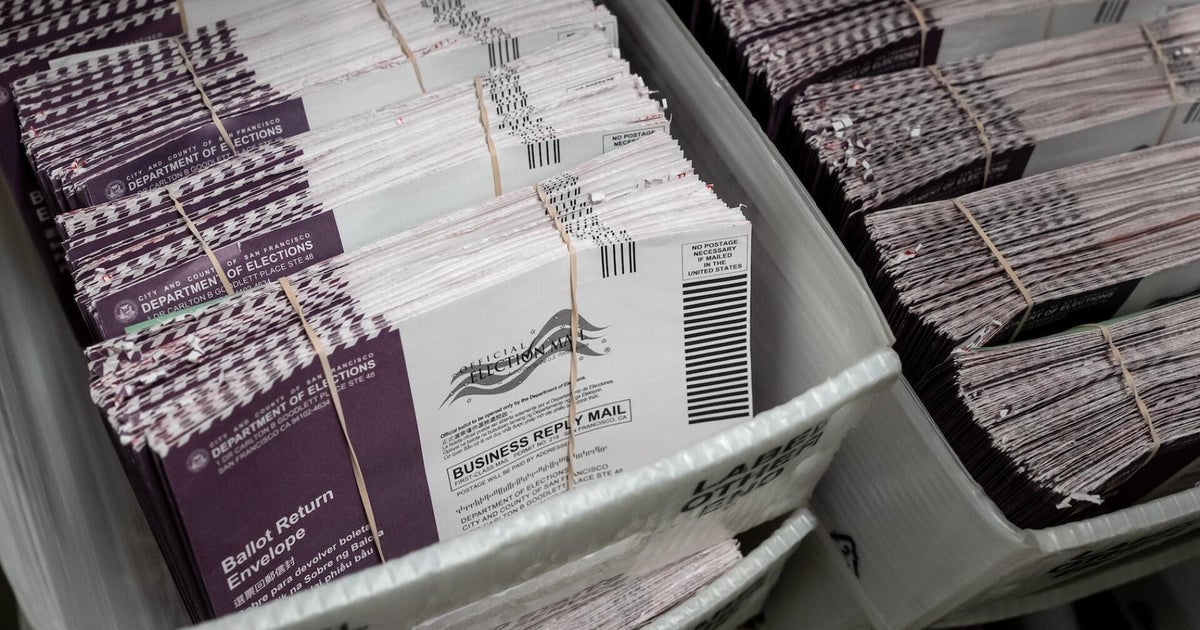
Under the rule, states must include specific design elements on mail ballot envelopes, including barcodes that are unique to each voter. State or local election officials must also submit certain voter information into an online portal, including their names, addresses and barcodes. Those voters will be enrolled with the Postal Service and included on state-specific “Mail-In and Absentee Participation Lists.”
The rule requires postal workers to review and verify ballot mail being sent to voters by states and localities. Any ballot mailings that don’t comply with the requirements “will not be accepted and will be returned” to the election offices, the Postal Service said.
The court submissions from election officials highlight not only the difficulties with adhering to the Postal Service’s new regulations, but also the varying procedures and rules that govern each state’s elections, a reflection of the Constitution’s command that states are responsible for setting the “times, places and manner” of elections.
“Deciding whether to have a mail voting program, when to say everybody’s eligible to receive a mail ballot or only some people who have an absentee excuse who are sick or out of the jurisdiction, that is the variability that states have defined and it’s their power to do that under the Constitution,” Baldwin said. “The idea is that state governments get to create those powers and those laws because they’re in touch with their voters and they’re responsive to their constituents.”
Separate from the concerns of election officials, a whistleblower has warned of “potentially catastrophic problems” with the Postal Service’s system. The agency’s new mail ballot portal is “untested” and its development “rushed,” the whistleblower said in a disclosure provided to Congress. The anonymous official also warned that the Postal Service’s new verification process could keep significant numbers of mail ballots from being delivered.
Paper shortages and already-printed envelopes
In declarations submitted to the federal court in Boston, numerous election officials from different states said that in order to adhere to the ballot design requirements, they would have to scrap envelopes that have already been paid for and printed.
Scott Nago, Hawaii’s chief election officer, said in a filing that the state would have to throw out the envelopes used by voters to return their ballots, since they were printed with a static barcode for each of its four county clerks. Those already-ordered return envelopes cost the state $79,000, Nago said.
He also warned that “it may not be possible to get new orders of [those] envelopes delivered to Hawaii from the continent on such short notice.”
In Colorado, which expects to mail more than 4 million ballots to voters for the upcoming election, two of its vendors have said that they would have to get rid of a combined 1.3 million already-printed ballot return envelopes because they don’t contain individualized barcodes.
Reprinting those envelopes “would impose significant costs on Colorado counties and may not even be possible depending on how widespread an issue this is and whether the vendors can procure sufficient paper,” Hilary Rudy, the deputy state elections director, said in a filing.
Vendors for Washington state have also poured cold water on their ability to reprint ballot envelopes to meet the Postal Service’s design rules. The state anticipates sending ballots to 5.1 million voters for the upcoming election. But one of three vendors used by Washington counties to print election materials indicated it couldn’t reprint ballot envelopes after Aug. 27, while a second indicated it didn’t have the capacity to print new envelopes at all, Director of Elections Stuart Holmes said.
Even still, the state estimates reprinting all ballot envelopes would cost $1.9 million.
“This would be catastrophic for Washington elections because Washington is an entirely vote-by-mail state and the State no longer has the infrastructure to accommodate a last-minute reversion to in-person voting,” Holmes said.
Potential paper issues are also plaguing Oregon’s ability to reprint envelopes.
The state’s vendors “do not have a stockpile of paper,” said Oregon Elections Director Dena Dawson. “Post-pandemic paper supply shortages mean that paper suppliers may not be able to timely supply our vendors with the paper they need” to provide new envelopes.
But even adding the unique, voter-specific barcodes required on ballot envelopes presents issues for states and municipalities, election officials said.
In Massachusetts, state law does not require envelopes to include the specific barcodes mandated by the Postal Service, so its 351 municipalities would have to obtain new computer software to create and apply the codes. Doing so would be a costly endeavor for some of Massachusetts’ smaller municipalities who don’t mail large numbers of ballots to voters, said Michelle Tassinari, who leads Massachusetts’ elections division.
“To require these municipalities to purchase equipment capable of applying an Intelligent Mail barcode would likely deplete their municipal budgets,” she said in a filing.
In Colorado, 14 of its 64 counties do not use the barcodes required by the Postal Service on ballot mail, and most of its counties do not include those markings on return envelopes.
Adopting the unique barcodes depends in part on population size, Rudy, the deputy state elections director said: 71% of the counties that do not use the barcodes have a population of less than 10,000 active registered voters.
“These counties typically employ a single individual to administer elections and often manually print ballots, stuff envelopes, and mail ballots by hand,” she wrote. “These counties likely would be unable to comply with the IMb requirement, and by extension, Colorado’s requirement that they mail a ballot to every active voter.”
In Maryland, voters can opt to access their ballot online through a secure email link, and the state expects roughly 72,000 ballots will be delivered by email and returned through the mail. Those voters either print the return envelope or hand address it using a state-provided template. But these return envelopes don’t have unique barcodes, and the Maryland State Board of Elections “has not identified a technical or manual way to do this,” said Melissia Dorsey, the state’s assistant deputy administrator for election policy.
“As a result, this rule potentially disenfranchises all mail-in voters who are signed up to receive mail-in ballots via secure email link,” she said in a declaration.
The mail ballot portal
The Postal Service’s new regulations require state or local elections officials to submit specific data to the “Federal Ballot Mail Portal” before mail ballots can be sent to voters. Initial lists of voters who will receive mail ballots must be entered at least 30 days before the election, though states can add, change or remove data from the portal to account for new voters, new requests for mail ballots or other changes.
But state officials warned that the process of enrolling their voters into the portal will be time intensive.
Don Millis, a Republican who chairs the Wisconsin Election Commission, said the Postal Service has not issued instructions on how to use the portal or how to authorize users. He warned in a filing that it would be “virtually impossible” to ensure that each mail voter in Wisconsin is enrolled through the portal.
“As a practical matter it’s not feasible given the decentralized nature of this. It’s going to be a very challenging environment if the stay is lifted,” he told CBS News, referring to the judge’s order temporarily blocking the rule.
Wisconsin’s elections are administered by 1,850 municipal clerks, and more than 2,500 employees can make changes to voter records on the state’s voter registration system, he said. As a result, those 2,500 workers would need to be trained on how to use the portal, be granted access to it and then enter voters’ data before Sept. 17, when clerks are required under state law to send out mail ballots.
“I think it’s good to do what you can to prevent noncitizens from voting, but I think many people at the national level have this incorrect view of mail-in ballots,” he said. “It’s not the first time that Republicans at the national level have shot themselves in the foot.”
New York’s co-executive director of the state Board of Elections, Kristen Zebrowski Stavisky, estimated that it will take roughly an additional minute per voter to include them on the Postal Service’s list and address any issues. Across the state’s 58 local boards of elections, she said that amounts to 20,000 additional hours of effort, or 533 work weeks.
Paul Linnell, Minnesota’s elections director, said it will take roughly 8,500 hours for elections staff to become authorized users of the portal and enroll voters. Linnell said barcode information is not included in the state’s voter registration system and will need to be added manually to the new federal portal.
“Even assuming the data verification, entry, and submission process takes only 1 minute per voter, this adds up to a significant amount of staff time that must be diverted from other critical activities,” he said.
On its end, the Postal Service has estimated it should take mail workers less than a minute to scan a ballot’s barcode, so the verification process for large mailings should take “no more than a few hours.”
But the states said that under that time frame, it would take the Postal Service 43 years to scan mail ballots from all of California’s 23 million registered voters, if they all cast their ballots by mail. For the 2024 general election, 16 million mail ballots were cast, according to data from the secretary of state.
wp:paragraph
هلدینگ کاسپین استانبول | خرید ملک در ترکیه | صرافی معتبر ایرانی در ترکیه | خرید و فروش طلا در ترکیه | مهاجرت به ترکیه | واردات و صادرات در ترکیه | نیازمندیهای ترکیه | اخبار ترکیه | اخبار جهانی | توریست ایران | خدمات توریستی در ایران | تورهای گردشگری ایران | هلدینگ اول | خدمات کاریابی و فریلنسری و شغل | مرجع اطلاعات ایران (همه چیز در ایران) | کیف پول و خدمات مالی و پرداخت یار | اخبار ایران | تابلو زنده قیمت ارز در ترکیه و استانبول | صرافی آنلاین ترکیه | قیمت طلا و نقره در ترکیه | سرمایه گذاری در ترکیه | جواهرات در ترکیه | نرخ لحظه ای ارزها در استانبول | قیمت دلار امروز در ترکیه | قیمت دلار استانبول امروز | قیمت لحظه ای دلار | اخبار روز ترکیه استانبول | اپلیکیشن ISTEX | اپلیکیشن قیمت لحظه ای دلار و یورو و لیر و ارزها در ترکیه
/wp:paragraph wp:paragraph /wp:paragraph
About the Author