Home – CBSNews.com
The U.S. Treasury said on Wednesday its Financial Crimes Enforcement Network had convened a meeting of global financial institutions to advance Operation Economic Outcast, its recent push to isolate Tehran and limit its ability to fund the war in the Middle East.
“The event armed financial institutions with the information they need to shut down revenue streams and procurement networks tied to the Iranian regime,” Treasury said in a statement.
The Treasury said the event was done to give insight into the facilitators that provide Iran with access to banking relationships.
“”Treasury continues to sever every economic lifeline Tehran has left,” Treasury Secretary Scott Bessent said in a statement. “Financial institutions are in lockstep with the U.S. government in support of Operation Economic Outcast, and we will continue to work closely with the private sector in the fight against the murderous Iranian regime.”
Following the meeting, the U.S. said soon “there will be no space for the Iranian regime to rebuild its capacity to inflict terror against America and the world.”
AFP/CBS
The Houthi attacks on critical oil infrastructure are the first test of a new defense pact among Saudi Arabia, NATO member Turkey and nuclear power Pakistan. But officials from Turkey and Pakistan told The Associated Press they have not received a Saudi request for support in response to the Houthis’ escalation.
The Turkish official said efforts to “institutionalize” the alliance need to be completed before the pact becomes operational. The officials spoke on condition of anonymity because they were not authorized to speak publicly on the issue.
Amid the condemnation of the attempted attack on Mecca, Pakistani Prime Minister Shehbaz Sharif said his country and the Saudis stand “unwaveringly, shoulder to shoulder.” Turkey’s foreign minister expressed solidarity and said no country can “remain indifferent,” state-run Anadolu Agency reported.
Criticism also came from the Organization of Islamic Cooperation, representing over 57 Muslim states, which said the attempt violates the “sanctity of holy sites.”
The Houthis immediately denied the claims of targeting Mecca.
“The false claims of the Saudi regime regarding Yemen targeting Mecca are a desperate attempt to rally the peoples,” Houthi leader Mehdi Al-Mashat told Al-Masirah TV, which is owned by the Houthis.
This was the second attempted attack by the Houthis against Mecca after the rebels fired a ballistic missile toward the city in 2017, according to Col. Turki al-Maliki, spokesperson for the Saudi-led military coalition fighting the rebels.
AP/CBS
Yemeni government forces, backed by Saudi Arabia, clashed with Houthi fighters near the Saudi border, with AFP footage showing soldiers in armored vehicles and trucks pushing across desert terrain under the crackle of machine gun fire.
The Houthis also released footage on Wednesday of the fighting in the northwestern Al-Jawf area, as well as a video purporting to show the downing of a fighter jet belonging to Saudi Arabia, the group’s longtime foe and the Yemeni government’s main backer.
The group has recently made major gains in a lightning offensive that Saudi airstrikes have failed to roll back, leaving the Yemeni government scrambling to respond.
“The First Division Emergency Forces are advancing on the Al-Labanat front and, God willing, will reach Houthi positions,” Waleed Al-Mahajeri, operations commander of the government’s Fifth Brigade, told an embedded AFP journalist on Tuesday.
AFP footage showed the soldiers firing heavy machine guns, artillery and RPGs at distant targets, as well as the bodies of Houthi fighters and entrenchments the government forces said the group had abandoned as they fell back.
“Al-Masariya Hill has been liberated, as has Al-Labanat camp, and the advance is continuing,” said soldier Abu Mithaq.
Mahan Air, Iran’s largest airliner, has canceled flights to Ankara, Turkey, and vice versa beginning Sept. 21, while flights from Tehran to Muscat, Oman, are canceled starting Sept. 17, according to state-owned ISNA News Agency.
The flights were canceled indefinitely, though ISNA said other airlines were flying those routes as normal.
Mahan Air was hit by devastating sanctions as part of the so-called Operation Economic Outcast program launched by the U.S. The sanctions were announced by Treasury Secretary Scott Bessent in July.
“”Those who provide financial services, logistics, or commercial support to the IRGC or Mahan Air are helping sustain a terrorist enterprise,” Bessent said in a statement at the time. “Treasury will continue to identify them, expose them, and cut them off from the U.S. financial system.”
The U.S. announced sanctions on all of the remaining Iranian airlines last week.
Vice President JD Vance said the world would be plunged into an energy crisis if the U.S. decides to end its involvement with the war in Iran and leave the region.
“What I would say to anybody who’s frustrated right now is the alternative here, which is the United States effectively says to the Middle East, ‘You’re on your own,’ would mean necessarily a worldwide energy crisis, so long as the Iranians keep on shooting at shipping, which we know that’s exactly what they would do,” Vance said when calling in Wednesday morning to the All-In Summit, a convention for “thinkers, investors, founders and leaders,” according to the group.
Iran began targeting ships in the Strait of Hormuz only after the U.S. and Israel began their bombing campaign on Feb. 28. The strait was free to transit up until that point with the Iranian government retaliating against the strikes by effectively closing traffic through the chokepoint for 20% of the world’s oil and gas.
“I think the president is taking the responsible course of action,” Vance said. “He’s protecting America’s assets in the region while also ensuring that world energy markets continue to get a supply of oil and natural gas.”
Oil and natural gas prices have spiked since the U.S. war with Iran began. Brent crude, the international standard for oil, reached $107 a barrel on Wednesday after falling to $87 on Aug. 25. The price for a barrel had risen to $120 in the early weeks of the war.
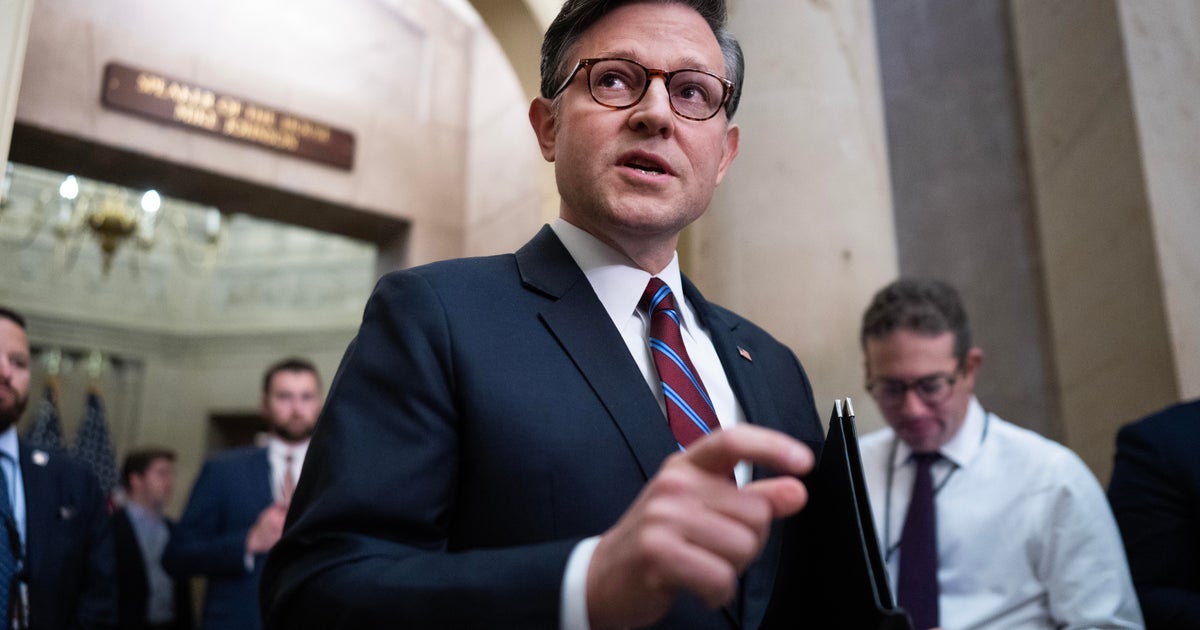
The speaker of the House, Mike Johnson, said Wednesday the issue of Iran getting a nuclear weapon is “taken care of” and now they need to get gas prices down. He also simultaneously blamed Democrats and former President Biden for the high prices.
“Iran will not have a nuclear weapon. That was an important objective of American foreign policy for the last half-century,” he said during a press conference where he announced the House would go home until the midterm elections after today. “That’s taken care of, and now we got to get gas prices down. But I want to remind you as well: There’s another big factor of why gas prices are high. This is the result of bad Democrat policy.”
The price for a gallon of regular gas currently costs $4.37, about 30 cents more than a month ago and well over the $3.19 a gallon from a year ago, according to AAA.
“[The Democrats] want to squeeze production of U.S. oil and gas, and that is a disaster for the American people,” Johnson said. “And so you have to keep the right people in charge to make sure that your fuel prices come down.”
The average price for gas in January 2025, Biden’s last month in office, was $3.08, according to the Bureau of Transportation Statistics.
Sweden expelled an Iranian official Wednesday, the Svenska Dagbladet newspaper reported, after summoning Iranian Ambassador Hojatollah Faghani.
The official was expelled because of activities that were deemed “not compatible with the Vienna Convention on Diplomatic Relations,” the paper quoted the Swedish government as saying in a press release.
According to the newspaper, Justice Minister Gunnar Strömmer said Iran had, for a long period, conducted security-threatening activities in and against Sweden, including targeting dissidents, as well as various Jewish and Israeli interests in the country.
Neither the identity nor the role of the expelled individual was revealed by the report.
Videos posted online appear to show debris from a Chinese-made Dongfeng DF-15A short-range ballistic missile found in Yemen for the first time, raising questions over the possible use of Chinese weapons in the war between the Iran-backed Houthi rebels and Yemen’s Saudi-backed government forces.
Videos circulating on social media Wednesday show debris with “DF-15A” markings purportedly found in Raghwan district, in Marib province – inside Houthi-controlled territory about 105 miles from Yemen’s Houthi-controlled capital, Sanaa.
The DF-15A is an advanced version of China’s DF-15 short-range ballistic missile, which has a range of up to 500 miles. There have been no confirmed previous reports of the system being exported to any specific Middle Eastern nation.
There was no comment Monday by authorities in Saudi Arabia, China or Yemen about the videos or any use of the Chinese missile in the region.
Saudi Arabia has a history of acquiring Chinese ballistic missiles, but not the DF-15A.
CBS News could not independently verify the videos, which, if confirmed, could reveal a previously undisclosed element of Saudi Arabia’s missile arsenal, and mark the first known combat use of a Dongfeng missile in the Middle East.
Borrowing is likely to get more expensive for Americans, and soon, according to economists. The Federal Reserve was expected to raise its benchmark interest rate Wednesday for the first time in more than three years, as the central bank battles stubborn inflation fueled by the Iran war pushing energy prices up.
Some Wall Street forecasters also pencil in one or two additional rate hikes over the next several months.
Despite President Trump’s repeated calls for lower interest rates, many economists predict that Fed officials will raise the federal funds rate by 0.25 percentage points at its Wednesday meeting.
With little progress toward ending the Iran war, some economists predict high energy prices will linger for months, which could push the Fed to further tighten monetary policy as it seeks to curb inflation.
Read the full story here.
Houthi military spokesman Brig. Gen. Yahya Saree said Wednesday that the group had carried out two military operations against Saudi Arabia targeting a facility belonging to the Saudi state energy giant Aramco in the Red Sea port city of Yanbu, and an air base in the southwest city of Khamis Mushait.
Saree said the operations were carried out in response to what he described as a Saudi escalation against the Houthis. He claimed Saudi forces had conducted more than 450 airstrikes across Yemen in the past week alone.
In a video statement, Saree claimed the strikes on Yanbu – a vital export terminal for Saudi energy products – were “accurate and direct” and caused “large fires and extensive destruction.”
He said the second operation “targeted Khamis Mushait air base with a number of ballistic missiles,” adding, “the strike was accurate.”
Saudi Arabia and the Arab League both condemned an alleged attempted attack by Yemen’s Houthi rebels on Wednesday targeting the holy city of Mecca in Saudi Arabia.
The Saudi foreign affairs ministry called it a “cowardly terrorist attack toward the Holy Land,” saying it was the second time the Houthis had targeted the city, the first being in July 2017.
“Compromising the security of Mecca and the sanctity of Islamic holy sites is a matter of extreme gravity,” Arab League Secretary General Nabil Fahmy said in a statement, applauding the Saudi air force’s thwarting of the purported attack.
He warned that escalating Houthi attacks on Saudi territory “threaten the region’s security and stability.”
The Iran-backed Houthis have denied targeting Mecca, which is the holiest site in Islam.
CBS/AFP
U.S. officials met with representatives of Yemen’s Iran-backed Houthi rebels over the weekend, the Reuters news agency reported Wednesday, citing sources familiar with the matter.
The meeting reportedly happened in the U.S. Embassy in Muscat, Oman, after the rebel group launched a rapid offensive, seizing strategic ground along Yemen’s coast near the Bab el-Mandeb Strait, a crucial waterway for Saudi Arabia’s oil and gas exports.
The offensive boosted the Iranian proxy group’s effective control over the waterway, allowing it to exert greater pressure on Saudi oil exports, which had already been disrupted by the U.S.-Iran war hindering tanker traffic through the nearby Strait of Hormuz.
In the meeting, the Houthis told U.S. officials they had no intention of attacking American or Israeli vessels, only those belonging to Saudi Arabia, sources told Reuters. That would represent a continuation of the Houthis’ public vow to enforce a blockade of Saudi Red Sea ports, but not an escalation against wider commercial traffic.
Analysts have noted, however, that even if the Houthis continue to target only Saudi ships, the attacks greatly increase the perception of risk to maritime operations in the Red Sea, and that kept traffic to virtually nothing in August.
During a trip to Ireland on Saturday, President Trump told reporters the Houthis had told the U.S., “they don’t want to fight with us,” and “they don’t want us to go after them.”
Jordan’s Ministry of Foreign Affairs condemned an alleged attempt by Iran-backed Houthi rebels to target the holy city of Mecca in Saudi Arabia with a drone, calling it a violation of Saudi Arabia’s sovereignty and a threat to its security and territorial integrity.
“The Ministry of Foreign Affairs and Expatriates condemns the attempt to target Mecca with a drone launched by the Houthi militia, as a blatant violation of the sovereignty of the sisterly Kingdom of Saudi Arabia, a threat to its security, stability and territorial integrity, a flagrant breach of international law, and an unacceptable attack that represents disregard for the status and sanctity of Mecca and an affront to the sentiments of Muslims,” the statement said.
Ministry spokesman Ambassador Fouad Al-Majali affirmed Jordan’s “absolute solidarity” with Saudi Arabia and its support for all measures Riyadh takes to protect its security, stability, citizens and residents.
The Houthis rejected the accusation that they had targeted Mecca.
Iran’s Oil Minister Mohsen Paknejad said Wednesday that energy infrastructure damaged during the war with the U.S. was being rebuilt at a satisfactory pace, with some of Iran’s lost production capacity expected to come back online by the end of the year, and the rest in the first half of 2027.
In remarks reported by Iranian state news agency IRNA, Paknejad said reconstruction of four gas refineries and liquid fuel storage and loading facilities in Tehran was progressing well.
In August, sources told CBS News the U.S. and Israel were planning a bombing campaign targeting the country’s energy infrastructure, before calling it off.
Iran’s powerful Islamic Revolutionary Guard Corps (IRGC) said Wednesday that it had intercepted and destroyed another U.S. MQ-9 Reaper drone.
In a statement, the IRGC said “the drone was shot down at 2:29 a.m. local time by an advanced air-defense system operated by the IRGC Aerospace Force and integrated into Iran’s national air-defense network.”
It said the drone was downed over Iran’s Qeshm Island, which sits off the Iranian coast in the Strait of Hormuz.
The statement claimed it was the 52nd U.S. MQ-9 to be destroyed by the IRGC. There was no immediate comment from the U.S. military’s Central Command.
A report by a Pentagon watchdog released Monday said that between Feb. 28 and June 30, as many as 30 MQ-9 drones were damaged or destroyed as part of Operation Epic Fury, the Defense Department’s previous name for the war with Iran. The report said the conflict had cost the U.S. $33.4 billion during that period.
Depending on the variant, a single Reaper drone can cost over $30 million.
An Iranian army spokesman said the ongoing war has shown the U.S. can no longer present itself as a legitimate superpower, arguing that the longstanding global order is shifting toward a new “post-American” and “post-Western” system.
Speaking at an Arabic Calligraphy Conference hosted by Pakistan’s ambassador in Tehran, Brigadier General Mohammad Akrami-Nia said “the war with Iran proved that America cannot appear in the position of a legitimate superpower,” adding that Washington faced “serious challenges” in both military capabilities and its international standing.
He said the conflict had exposed what he described as contradictions between U.S. claims about human rights and democracy and its conduct in past wars, while arguing that Washington had become an “aggressive” and “illegal” actor seeking to preserve its hegemony.
The U.S. Embassy in Saudi Arabia issued an advisory Wednesday urging Americans to reconsider any plans to travel to the kingdom.
The warning was issued “due to risk of Iranian drone and missile targeting of American interests, armed conflict, terrorism, exit bans, and local laws regarding social media activity.”
Threats have intensified recently after Yemen’s Iran-backed Houthi rebels launched an offensive against Saudi-backed government forces.
Saudi Arabia has also blamed Iran-backed militias in Iraq for a drone attack last week that has taken the kingdom’s vital East West Crude Oil Pipeline offline for at least several weeks, pushing up global oil prices.
Kuwait’s foreign ministry condemned on Wednesday an alleged attempt by Yemen’s Iran-backed Houthi rebels to target the holy city of Mecca with drones.
In a statement released Wednesday, the ministry joined the Saudi government in blaming the Houthis for the attempted attack, calling it a “cowardly and reprehensible act” and “an affront to the sentiments of Muslims.”
The Houthis quickly rejected the accusation that they had targeted Mecca, the holiest site in Islam, which draws hundreds of thousands of Muslim pilgrims every year. In a statement, the group called the allegation a “worn-out lie.”
China’s Foreign Minister Wang Yi said Wednesday that Beijing was willing to “safeguard” Iran’s “rights and interests” during talks with his Iranian counterpart.
“China is also willing to strengthen dialogue and cooperation with Iran, and safeguard Iran’s legitimate rights and interests,” Wang told Iran’s Foreign Minister Abbas Araghchi as they met in the Chinese capital.
“We encourage Iran and the U.S. to stay rational and restrained,” Wang added.
His comments are the latest evidence that Beijing has no intention of backing U.S. attempts to force Iran to concede in the six-month war by heaping economic pressure on Tehran’s allies and trade partners.
In August, the U.S. Treasury announced a raft of new sanctions aimed at choking Tehran financially.
Chinese purchases of Iranian crude oil amounted to nearly 45% of the Iranian government’s budget last year, according to a U.S. government report released in March, and the trade ties are considered a vital economic lifeline for the Iranian regime.
China reacted at the time to the U.S. announcement by voicing firm opposition to what it called “illicit unilateral sanctions” and vowing to “do everything necessary to firmly safeguard its [China’s] rights and interests.”
Asked last month whether Chinese banks would be among those hit by the new measures, Treasury chief Scott Bessent said “no one is above the reach of U.S. sanctions.”
CBS/AFP
Saudi Arabia accused Yemen’s Iran-backed Houthis on Wednesday of targeting the holy city of Mecca, sparking outrage across the Muslim world.
Saudi Arabia’s military spokesperson Maj. Gen. Turki al-Malki said its air defense forces intercepted and destroyed a drone Tuesday evening before it entered the airspace over Mecca. The security of the holy city is “a red line,” he said, adding that Saudi forces will not hesitate to act against “hostile and terrorist behavior.”
The Houthis swiftly rejected the claim that Saudi forces had shot down a drone from the rebels heading towards Mecca, which attracts millions of pilgrims each year.
“The claims about targeting Mecca are a worn-out lie that has been used before and no longer fools anyone,” Hazem al-Assad from the Houthis’ politburo wrote on X.
Pakistan’s Prime Minister Shehbaz Sharif on Wednesday condemned “in the strongest possible terms the dastardly and heinous” attack on Mecca.
“The people of Pakistan are saddened and perturbed by this outrageous act,” he said on X. The Houthis have denied attacking Islam’s holy city.
CBS/AFP
South Korea’s top diplomat is set to meet his U.S. counterpart in Washington this week, officials said Wednesday, where they will discuss a possible deployment to the Strait of Hormuz.
Foreign Minister Cho Hyun is due to depart on Thursday for a trip where he is expected to discuss trade with Secretary of State Marco Rubio, as well as the possibility to deploy South Korean troops to the Strait of Hormuz.
In August, President Trump announced he would scale back military exercises with the Asian nation, saying the country had declined to join the U.S. military efforts in Iran.
CBS/AFP
Yemen’s Iran-backed Houthis on Wednesday said they shot down a Saudi fighter jet, claiming a locally made munition was used to target the warplane.
“The Yemeni Armed Forces, with Allah’s aid and grace, succeeded in shooting down a Saudi F15 fighter jet while it was carrying out hostile operations in support of its military mobilisations in the airspace of Marib province, using a locally made air-to-air missile,” a spokesman for the Houthis said on social media, while accusing Saudi Arabia of launching 450 strikes.
Oil prices stabilized early Wednesday after rising on Tuesday as tensions dragged on between the U.S. and Iran, and as Saudi Arabia’s crucial East-West oil pipeline closure added pressure on global oil supply.
Brent crude, the international standard for the price of oil, was 0.5% lower at $108.18 a barrel, but still well above the around $72 per barrel level before the start of the war in late February.
Benchmark U.S. crude fell 0.8% to $104.94 a barrel.
Coast Guard personnel and FBI agents boarded a Texas-bound commercial oil tanker last month before it could arrive at a port after determining the ship’s network may have been compromised by a foreign actor as it was crossing the Atlantic, the Coast Guard said Tuesday.
On Aug. 21, a specialized team of Coast Guard law-enforcement personnel, a vessel inspector, Coast Guard Cyber Protection Team members and FBI Cyber Action Team operators boarded an inbound foreign-flagged commercial vessel, the Coast Guard said. The team examined both the vessel’s operational technology and information-technology systems, working with the crew and the ship’s corporate operators to oust the threat.
“Currently, there are no reports of operational disruptions, vessel instability, physical danger to crews, or environmental impacts,” the Coast Guard said Tuesday.
The U.S. has so far not attributed the potential breach to a specific actor, but Iranian state media amplified the story in the weeks following the breach.
The House for a third time voted to block President Trump from taking further military action against Iran, with seven Republicans breaking with the president.
The Tuesday evening vote ended in a 220-204 tally, marking a symbolic rebuke of the president over the largely unpopular war.
It’s unclear whether the Senate plans to take up the measure in its last two scheduled weeks of session before the November elections. A war powers resolution that cleared the House in July has yet to see any movement in the Senate. Both chambers adopted another resolution in June, though the White House has argued against its validity.
Tuesday’s resolution drew more GOP support than the previous two efforts to limit Mr. Trump’s war powers in June and July.
Three new Republicans voted yes — Rep. Nancy Mace of South Carolina and Reps. Mariannette Miller-Meeks and Zach Nunn of Iowa — in addition to the four who supported the prior resolutions: Reps. Tom Barrett of Michigan, Brian Fitzpatrick of Pennsylvania, Warren Davidson of Ohio and Thomas Massie of Kentucky.
New photos obtained exclusively by CBS News reveal for the first time the widespread damage and destruction of buildings and vehicles at multiple U.S. positions across the Middle East, as a result of Iranian missile and drone attacks.
The images were sent to CBS News by active service members on condition of anonymity because of rigid media restrictions within the military.
“This is major damage to our bases that hasn’t been communicated to the American public,” one deployed service member told CBS News. “We’re standing there with our eyes closed getting punched in the face.”
One photo, taken at Prince Sultan Air Force Base in Saudi Arabia, shows a direct hit on the back half of a Boeing E-3 Sentry four-engine aircraft, its tail severed from the charred fuselage that also supported a rotating radar that is essential for collecting midair intelligence.
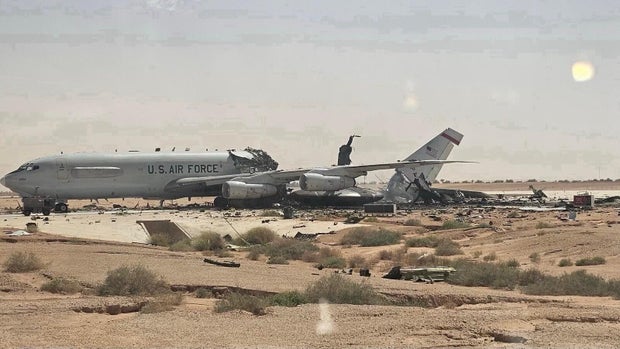
Other photos taken from the base show hollowed-out buildings and barracks whose shells ironically stand next to unaffected cement “T-wall” structures, which were once regarded as critical fortifications against grenade and mortar attacks but proved critically ineffective against an aerial assault.
The war with Iran could cost approximately $2 billion to $3 billion per month for as long as it continues, according to a report released by the nonpartisan Congressional Budget Office on Tuesday. The report estimates those costs could rise when there are tit-for-tat exchanges of fire with Iran.
The office estimated the war between Feb. 28 and Aug. 1 has directly cost the U.S. about $38 billion, a figure that does not include repairing U.S. bases in the region damaged during the conflict. The CBO noted that replacing munitions used in the war accounts for most of the total cost.
In particular, the CBO said the large expenditure of interceptor missiles used to defend against incoming missiles leaves behind a “reduced inventory of interceptors for several years.”
Attorney General Todd Blanche said he didn’t agree with calling the conflict between Iran and the U.S. a war.
“I disagree with that characterization, as does most of Congress,” Blanche said in response to a reporter’s question about the war during a White House press briefing Tuesday.
The attorney general said Congress had determined that President Trump and Defense Secretary Pete Hegseth hadn’t done anything wrong in their handling of the war. In June, during a ceasefire between the U.S. and Iran, Congress passed a measure that was largely a symbolic rebuke of how the administration had been conducting the war.
Attorney General Todd Blanche said Defense Secretary Pete Hegseth was “doing a phenomenal job” after articles of impeachment against him were introduced in the House, in part because Congress didn’t provide authorization for the war.
The nation’s top law enforcement official made the comment when he was asked about the impeachment effort during a White House press briefing on Tuesday.
“Secretary Hegseth is doing a phenomenal job, and the secretary of war doesn’t just go off and do things, so he follows the law,” Blanche told reporters.
“The DOJ plays a role in that, and we play an active role in making sure the laws are complied with,” Blanche said.
A Republican congressman from Kentucky introduced articles of impeachment Tuesday against Defense Secretary Pete Hegseth in part because of the Iran war.
“By engaging in hostilities in Iran for more than 90 days without congressional authorization, Secretary Hegseth is breaking the law and must be held accountable,” Rep. Thomas Massie said in a statement.
Massie said he would force a vote in the House on Hegseth’s impeachment.
An effort to rebuke President Trump over the war passed the Republican-controlled House and Senate in June. The Trump administration at the time argued that the U.S. wasn’t engaged in hostilities with Iran.
Massie has been in the House since 2012, but lost his primary bid earlier this year to a challenger who was endorsed by Mr. Trump.
Iran’s Fars news agency has highlighted a government-backed initiative presented as a public reporting and intelligence platform for identifying Iranians living abroad who Iranian authorities accuse of acting against the country’s national interests.
In its report, Fars portrays the initiative, called Alaj, as a response to Iranians abroad who allegedly supported attacks on Iran, celebrated Israeli strikes, advocated for further sanctions or military action, or circulated what it describes as false information during the conflict.
The report argues that such activity on social media should no longer be treated as having no legal consequences.
According to the Fars report, Alaj describes its mission as protecting Iran’s national security and the interests of the Iranian people against what it calls “anti-national,” terrorist and separatist groups, as well as supporters of sanctions and military intervention.
It says alleged acts of “betrayal” can carry legal consequences, including the seizure of assets, suspension of consular services and restrictions on financial and media access.
The platform seeks to encourage members of the public to submit information about alleged offenders through the Alaj website and dedicated channels on Iran’s Bale and Eitaa messaging platforms. The report said the identities of people submitting reports and other public sources will be kept confidential and encrypted.
A spokesperson for the Iran-backed Houthi rebels accused Saudi Arabia of continuing its “aggressive raids” against Yemen, saying Saudi forces had carried out more than 350 airstrikes in a matter of days, targeting public and private property and causing civilian casualties.
“We hold the Saudi regime responsible for its continued violation of Yemen’s sovereignty and its targeting of people and their property,” Houthi spokesperson and chief negotiator Mohammed Abdel Salam said on social media.
He warned that the escalation would not achieve Saudi Arabia’s objectives, arguing that Riyadh had already tried the military option and “achieved nothing but failure.”
“The return to a failed option reflects an aggressive mentality that does not believe in dialogue or peace,” he said.
Iraqi authorities are still working to determine what group or individuals launched a drone attack on Saudi Arabia last week, from Iraq, that took the kingdom’s vital East-West Crude Oil Pipeline offline — likely for weeks.
Saudi Arabia blamed Iran-backed militias in Iraq for the attack.
Iraq does not allow attacks against countries in the region from its territory and investigations to identify those responsible for launching the attack drones at Saudi Arabia are ongoing, the head of the Iraqi government’s Security Media Cell, Lieutenant General Saad Maan, said Tuesday in a statement conveyed by public broadcaster INA.
Maan said an intelligence committee had identified the drone launch platform inside Iraqi territory that was used in the attack, but the investigation, using intelligence and technical capabilities as well as forensic evidence including fingerprints and other details, was still underway to identify the perpetrators.
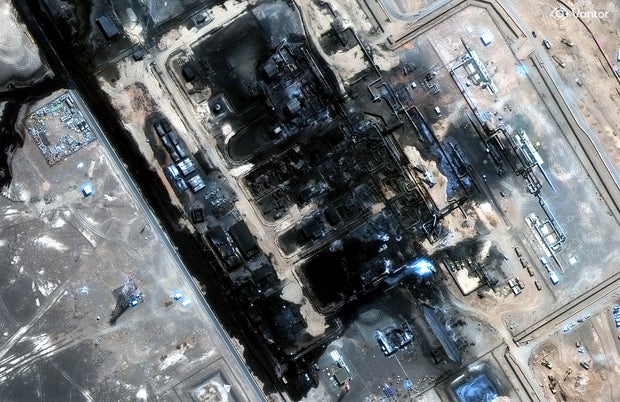
Satellite image (c) 2026 Vantor
Iraq has adopted “a new vision and a new approach” to ensure no one can “drag Iraq into what we do not want,” he said, without offering any further detail.
Iran backs a number of Shiite Muslim militias in Iraq, as well as its larger proxy groups Hamas in Gaza, Hezbollah in Lebanon and the Houthis in Yemen.
The Iran-backed Houthi rebels’ latest attacks on commercial vessels in the Red Sea and the Gulf of Aden most likely amount to war crimes in at least three cases, the New York-based Human Rights Watch organization said Tuesday.
The attacks on ships followed the Houthis’ announcement on July 20 that they would blockade Saudi Arabia’s Red Sea ports in response to what the group claimed was a Saudi sea and air blockade of their territory in Yemen.
The attacks targeted at least two Saudi-flagged vessels, a Tanzania-flagged vessel and a Dominica-flagged vessel, all with links to Saudi Arabia.
Under international law, attacks on civilians or civilian objects committed recklessly or with deliberate intent can constitute war crimes.
“The Houthis are once again putting seafarers’ lives at deadly risk through their attacks on commercial ships, this time as part of their hostilities with the Saudi-led coalition,” said Niku Jafarnia, a Yemen and Bahrain researcher at HRW, in the group’s statement. “Whatever the geopolitics, attacks on civilian crews carried out deliberately or recklessly are war crimes.”
The United Nations Security Council will hold a meeting Tuesday on the situation in the Bab el-Mandeb Strait, the Reuters news agency said Tuesday, citing two unnamed French diplomats.
There was no immediate confirmation of a meeting specifically on the strait from the U.N., but the Security Council’s website listed a 3 p.m. Eastern Tuesday meeting on the “situation in the Middle East.”
The Bab el-Mandeb Strait is the southern gateway to the Red Sea — a shipping lane that has become vital to energy giant Saudi Arabia’s ability to export its gas and oil to international markets as the nearby Strait of Hormuz remains severely impeded by the U.S.-Iran war.
The Iran-backed Houthi rebels in Yemen have seized control of virtually all of the country’s coastline along the Bab el-Mandeb, declared a blockade of Saudi Arabia’s Red Sea ports, and launched attacks on Saudi-owned vessels in the area.
Qatar’s government warned Tuesday that a wider closure of the Bab el-Mandeb would be “catastrophic for the entire world,” noting the impact on global energy prices already inflicted due to restrictions on traffic through the Strait of Hormuz.
Kuwait’s government on Tuesday condemned the Iran-backed Houthi rebels in Yemen for attacking Saudi Arabian cities with missiles and drones, calling it a “flagrant violation of the Kingdom’s sovereignty and a breach of international law and international humanitarian law.”
In a statement, Kuwait’s Ministry of Foreign Affairs voiced “condemnation and strong denunciation of the Houthi militia’s attacks on civilian facilities and civilians,” which it said had resulted in “injuries to a number of civilians and material damage to a number of residential homes and vehicles.”
The ministry said Kuwait remained in “absolute solidarity” with Saudi Arabia.
Saudi officials earlier said Houthi attacks the previous day on the cities of Khamis Mushait, Abha and Taif wounded 13 civilians and damaged seven houses and two vehicles.
The Houthis have engaged in renewed fighting with Saudi-backed Yemeni government forces since the group declared a maritime blockade of Saudi Arabia’s Red Sea ports and began targeting its ships in the Red Sea.
The Houthis acknowledged attacking Khamis Mushait, claiming the strike had targeted a Saudi military base there.
Qatar on Tuesday warned against closing the Bab el-Mandeb Strait, after a months-long blockade of the Strait of Hormuz and recent Houthi gains on the Red Sea coast.
“The world is suffering enough with the closure of the Strait of Hormuz, so we cannot also afford to add the Bab el-Mandeb into that equation,” Qatar foreign ministry official Ibrahim Al Hashmi told reporters.
He said a closure of the southern entrance to the Red Sea would be “catastrophic for the entire world. And we are already seeing the consequences … so Qatar is pushing for diplomacy, dialogue.”
Oman’s Maritime Security Center (MSC) said Tuesday that the country’s navy had evacuated 23 people from an oil tanker that caught on fire in the Gulf of Oman, just east of the entrance to the Strait of Hormuz.
The Panama-flagged vessel was being towed toward an Omani port when a fire broke out in its engine room, according to the MSC statement, which did not provide any more details.
Iran has repeatedly attacked tankers in the region, accusing them of attempting to transit the strait via a U.S.-designated shipping lane close to Oman’s coast in violation of its demand for all vessels to coordinate with the Iranian military.
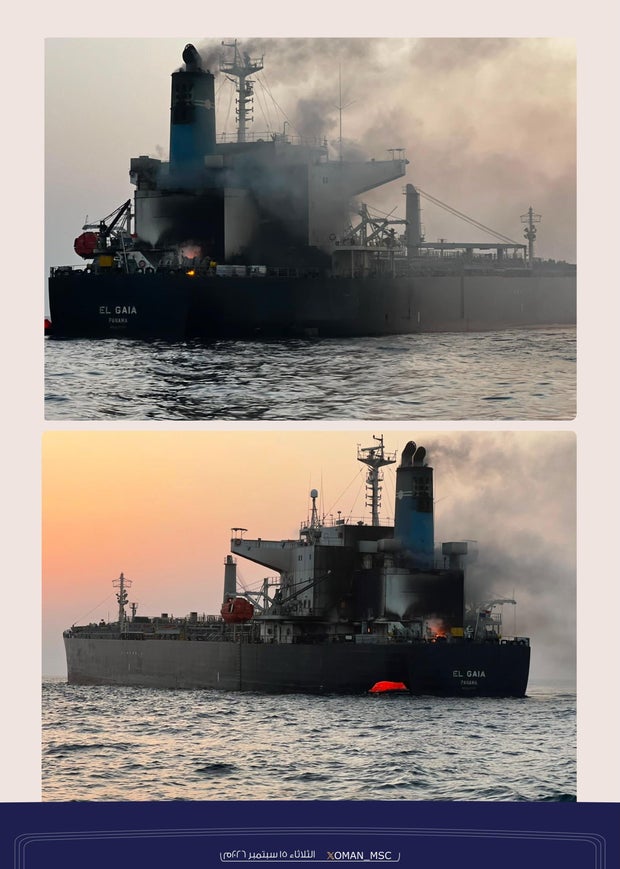
@OMAN_MSC
Saudi Arabia vowed Tuesday to respond “firmly” to attacks by Yemen’s Houthi rebels after accusing the Iran-backed group of wounding 13 people with a ballistic missile and drone attack.
The Saudi government said Tuesday that Houthi attacks the previous day on the cities of Khamis Mushait, Abha and Taif wounded 13 civilians and damaged seven houses and two vehicles.
The Houthis have engaged in renewed fighting with Saudi-backed Yemeni government forces since the impoverished nation’s civil war reignited in July, when the group declared a maritime blockade of Saudi Arabia’s Red Sea ports and began targeting its ships in the Red Sea.
A Houthi strike in western Yemen on Monday killed eight government soldiers, according to two military sources speaking to AFP. The group also claimed a new large-scale attack using “dozens of ballistic missiles and drones” against the King Khalid airbase in Khamis Mushait, in southern Saudi Arabia.
The Houthis seized control of virtually all of Yemen’s Red Sea coast and the crucial Bab el-Mandeb Strait last week, shipping lanes that have become vital to Saudi energy shipments as the wider U.S.-Iran war disrupts traffic in the Strait of Hormuz.
The Houthis and other Iran-backed groups have also targeted oil infrastructure in Saudi Arabia, the world’s leading crude exporter.
CBS/AFP
The head of Iran’s Supreme National Security Council insisted Monday that there would be no negotiations to end the war with the U.S. until Tehran’s conditions are met, dismissing a comment by President Trump earlier in the day, who said he was open to the “concept” of talks.
“Don’t get distracted by the U.S. president’s mixed signals — from ‘no negotiations’ to ‘we’re ready to talk,'” Mohsen Rezaee said in a social media post Monday evening.
“The stakes around oil and the straits have changed,” he added, appearing to refer to Iran’s claimed control over vital shipping lanes in the Strait of Hormuz and its influence, through its Houthi allies in Yemen, over the Bab el-Mandeb Strait.
“No talks until Iran’s conditions are met. Period!” he said. Iran’s government has called repeatedly for the U.S. to return to the principles of the memorandum of understanding signed by Mr. Trump and his Iranian counterpart in mid-June. Iran accused the U.S. of violating the agreement soon after it was signed by leaving in place the military blockade of Iran’s ports and associated vessels, and the agreement – and the ceasefire it put in place – fell apart by early July.
Mr. Trump said in a Truth Social post earlier Monday that Iran wanted to “make a deal, quickly and badly,” adding that he would “determine whether or not the U.S.A. will choose to engage – The concept of which we are open to.”
The Defense Department’s inspector general released estimates Monday on the cost of the Iran war in its first four months, tallying up the cost of expended munitions, damage to U.S. diplomatic facilities and destroyed equipment.
The Iran war cost the Defense Department an estimated $33.4 billion as of June 29, the report said. That includes $22.3 billion for expended munitions and $3.7 billion in lost equipment, along with $7.4 billion in incremental costs, mostly to fund the military’s day-to-day operations.
The $33.4 billion price tag does not include the cost of repairing U.S. bases that were damaged by Iranian counterattacks, the government watchdog said. Military facilities were damaged in Kuwait, Bahrain, Qatar, the United Arab Emirates, Saudi Arabia, Iraq, Oman and Jordan.
The expended munitions have “resulted in strategic inventory shortfalls and revealed industrial base bottlenecks for munitions resupply,” the report said, citing the Defense Department’s Office of the Under Secretary for Acquisition and Sustainment. Concerns that the Iran war has depleted U.S. munitions stockpiles have circulated for months.
Egypt’s President Abdel Fattah al-Sisi is set to welcome Saudi Crown Prince Mohammed bin Salman on Tuesday, the Egyptian presidency said, against the backdrop of fighting between Iranian-backed Houthi rebels and Yemen’s Saudi-backed government.
The presidency said there would be a bilateral meeting between the two leaders. The visit comes after a weeklong Houthi offensive that culminated in the group capturing Yemen’s Red Sea coast, cementing their hold on the Bab el-Mandeb Strait, through which Saudi oil transits.
Earlier, Egypt rejected a proposal from the Houthis for direct talks to coordinate maritime traffic through the waterway and the Red Sea, according to Qatari media outlet Al-Araby Al-Jadeed.
CBS/AFP
Escalating fighting between Yemen’s Iran-backed Houthi rebels and Saudi Arabia, and attacks by other Iranian proxy forces on Saudi infrastructure, are increasing the threat to tanker traffic in the Middle East and driving up global fuel costs more than six months after the U.S. and Israel launched their war on Iran.
Direct clashes between the U.S. and Iran have severely reduced shipping traffic through the Strait of Hormuz since the war began, but the Houthi-Saudi tension, and attacks on Saudi infrastructure blamed on other Iran-backed groups, are also squeezing global fuel supplies in the nearby Red Sea.
President Trump called for countries to reimburse the U.S. for helping oil shipments make it through the Strait of Hormuz.
“Oil is flowing through the Hormuz Strait. The Countries of the World, which have been no help to us whatsoever, should, and will, reimburse the United States of America when this SCAM Confligration [sic] is all over,” Mr. Trump said on his Truth Social platform Monday. “We are doing it much more for others, than we are for ourselves, and we have been for Generations!”
Earlier Monday, Energy Secretary Chris Wright told reporters that the number of oil shipments escorted by the U.S. Navy through the key waterway was increasing on average, according to the Reuters news agency.
President Trump said Monday the U.S. was open to engaging with Iran on a deal.
“The failing Nation of Iran wants to make a deal, quickly and badly. I will determine whether or not the U.S.A. will choose to engage — The concept of which we are open to,” Mr. Trump said on his Truth Social platform.
Earlier this month, Vice President JD Vance told reporters the U.S. wouldn’t negotiate with Iran while ships were being attacked in the Strait of Hormuz.
Before that, President Trump said in an Aug. 18 post on his Truth Social platform that there were “no talks or conversations going on, or scheduled, with the Islamic Republic of Iran.”
Iran’s Atomic Energy Organization has described the reported prevention of its head Mohammad Eslami from attending the U.N. nuclear watchdog’s ongoing conference as a “dangerous precedent” for all countries.
Spokesman Behrouz Kamalvandi said the International Atomic Energy Agency and its member states should stand against what he described as U.S. “bullying and political pressure.”
He warned that allowing political pressure to determine which officials can attend the agency’s meetings could establish a precedent affecting other member states.
The comments came after Eslami was reportedly prevented from attending the IAEA General Conference, which runs Monday through Thursday.
Kamalvandi called on the agency and its members to resist U.S. pressure and defend the rights of member states to participate in the organization’s proceedings.
Saudi Crown Prince and Prime Minister Mohammed bin Salman met Admiral Brad Cooper, the head of U.S. Central Command, in Jeddah on Monday, according to the Saudi Press Agency.
The meeting covered bilateral relations between Saudi Arabia and the United States, as well as the latest developments in the region, SPA reported.
Saudi Minister of State and national security adviser Musaed bin Mohammed Al-Aiban also attended the meeting.
The meeting comes days after a crucial Saudi oil pipeline came under attack, which the kingdom blamed on Iranian-backed militias in Iraq.
Bin Salman last week asked President Trump to bomb positions held by Iranian-backed Houthi troops, according to Axios, but he declined to do so.
The Iranian body established by the Islamic Republic regime to exert control over the Strait of Hormuz, the Persian Gulf Strait Authority (PGSA), said Monday that it had updated its list of vessels deemed to be violating its regulations, warning maritime insurers and other industry bodies against providing services to the ships.
In a post on X, the authority said insurers should refrain from providing services to the listed vessels in order to protect themselves from potential financial impacts.
The PGSA issued its list as U.S. Energy Secretary Chris Wright said the rolling weekly average of oil shipments transiting the Strait of Hormuz under U.S. Navy escort was rising and would continue to do so, according to the Reuters news agency.
Iran insists that all ships wishing to transit the strait do so in coordination with the PGSA, and it has repeatedly targeted vessels that ignore that advice and try to get through via a southern route close to Oman’s coast, through which the U.S. military has been escorting vessels.
Egypt has rejected a proposal from Yemen’s Iranian-backed Houthis for direct talks to coordinate maritime traffic through the Bab el-Mandeb Strait and the Red Sea, according to Qatari media outlet Al-Araby Al-Jadeed.
The proposal was reportedly conveyed by a Houthi official to the International Chamber of Shipping (ICS) in London, seeking discussions with Egyptian authorities over new arrangements to protect shipping and ensure the safety of vessels transiting the strategic waterway.
The ICS subsequently contacted Egypt’s maritime chamber regarding the Houthis’ request to establish rules governing navigation and security in the Bab el-Mandeb.
A senior Egyptian source told Al-Araby Al-Jadeed the request was rejected outright by Suez Canal Authority Chairman Osama Rabie, who argued that responding to the Houthis could amount to granting implicit recognition to a group not internationally recognized as Yemen’s legitimate government.
The source said Egyptian authorities instead referred the proposal to security agencies to handle the issue outside the country’s official institutions.
Egypt’s goal, according to the source, is to prevent attacks on vessels transiting the Bab el-Mandeb, restore freedom of navigation and ensure the safety of crews regardless of nationality, while avoiding any arrangement that could allow the Houthis or another party to assert authority over the strait.
A crucial Saudi oil pipeline that was struck in an attack last week will likely be largely out of service for weeks as the damage is repaired, two regional officials told The Associated Press news agency.
The East-West Pipeline, which runs across the kingdom, is key to Saudi Arabia’s strategy of shifting its oil exports to the Red Sea to avoid the Persian Gulf’s Strait of Hormuz, where Iranian attacks have stifled shipping. The 745-mile pipeline can carry up to 7 million barrels of oil a day from eastern Saudi Arabia to its Yanbu Port on the Red Sea.
A drone attack that Saudi Arabia blamed on Iranian-backed militias in Iraq forced the shutdown of the pipeline on Thursday.
The officials, who have been briefed on the matter, told the AP that repairing the damage could take three to five weeks, including at a major pumping facility. One of the officials said the line may work partially while teams carry out the repairs.
Saudi state oil company Aramco, which operates the pipeline, didn’t immediately respond to a request for comment. The government-run Center for International Communication, which oversees foreign media in the kingdom, said it was looking into an AP inquiry about how long it would take to repair the pipeline.
Iran’s foreign minister denied on Monday any involvement by the country in the attack on the pipeline.
CBS/AP
The rolling weekly average of oil shipments getting through the Strait of Hormuz under U.S. Navy escort is rising and will continue to do so, U.S. Energy Secretary Chris Wright said Monday, according to the Reuters news agency.
“The trend in that seven-day rolling average has been going up and will continue to go up,” he told reporters at a meeting of the U.N. nuclear watchdog, adding that on Sept. 1 there was a peak of 18 million barrels passing through on a single day.
Oman’s government said Monday that a meeting scheduled in its capital, Muscat, with officials from Iran and other regional countries on future control of the strategic waterway, was being postponed “in the interests of consensus.”
Iran on Monday condemned the exclusion of the head of its Atomic Energy Organization from the annual gathering of the United Nations nuclear agency in Vienna, saying it constitutes “a serious breach” of Tehran’s rights as a member nation.
“By obstructing our full and effective participation, the denial of access contravenes both the letter and the spirit of the legal framework” governing attendance at meetings of the International Atomic Energy Agency, Iran’s ambassador to the agency, Reza Najafi, told delegates at its general conference.
Najafi criticized Austria, the host country of the IAEA, as well as other U.N. organizations, saying that Vienna’s decision not to grant a visa to Mohammad Eslami, “violates the host country’s obligation.”
The U.S. ambassador to the U.N. in Vienna, Preston Wells Griffith, said Austria’s request for an exemption to standing international sanctions, which would have enabled Eslami to attend, was denied after Washington lodged an objection with the IAEA committee.
“While we are focused on a diplomatic solution to the challenges posed by Iran’s nuclear program, we could not allow a U.N. designated official to travel … without any meaningful cooperation on nuclear safeguards,” Griffith said.
CBS/AP
Iranian Foreign Ministry spokesman Esmaeil Baghaei said Monday that Saudi Arabia had demanded the cancellation of a meeting that had been planned for Monday for Iranian, Omani and other regional delegations to discuss control of the Strait of Hormuz, “for the time being.”
Baghaei called the now-postponed meeting, which was to be hosted by Oman in Muscat, a “proper opportunity” to restore security in the region.
He said an agreement between Iran and Oman on the Strait of Hormuz had been finalized and would be announced later.
Saudi Arabia had submitted amendments to the agreement, citing concerns it could have lasting implications for the Strait of Hormuz that would negatively impact other Gulf Cooperation Council countries, a regional official familiar with the matter told The Associated Press.
CBS/AP
Yemen’s Iran-backed Houthi rebels captured more strategic territory near the Bab el-Mandeb Strait, government and Houthi officials said Monday.
Houthi rebels deployed fighters to the Hanish islands, 100 miles north of the entrance to the strategic strait, after Yemeni government forces withdrew from the territory, according to two government officials and a Houthi official who spoke on the condition of anonymity.
The capture of the islands came after the Houthis expanded their control over the Bab el-Mandeb Strait late last week with the capture of the port city of Mokha.
The capture of the islands of Greater and Lesser Hanish came as Saudi-backed Yemeni government forces attempted to fight back over the weekend following the rebels’ swift advances around the strait.
The Bab el-Mandeb is a crucial alternative to the Strait of Hormuz for Saudi Arabian energy exports, but attacks on Saudi infrastructure and ships in the Red Sea by the Houthis and other Iranian proxy forces have severely impeded shipments through the waterway.
The Houthi-Saudi escalation adds pressure on global oil supplies and prices, which could give Iran greater leverage in its war with the United States.
CBS/AP
Iran’s foreign minister denied on Monday any involvement by the country in the attack on Saudi Arabia’s East-West pipeline last week, which forced the crucial piece of infrastructure to shut down.
When asked about Iran’s response to the claim that the Islamic Republic regime played a role in orchestrating the attack on the pipeline from Iraqi territory, Foreign Ministry Spokesman Esmail Baghaei accused the U.S. of producing “false news.”
“The fact that, under these circumstances, the U.S. keeps fabricating a lie in order to exacerbate divisions between the countries of the region is one of the consequences of the issues that exist in our region,” Baghaei told reporters in his weekly press briefing.
No group claimed responsibility for the attack, but Saudi Arabia has previously accused Iran-backed militias in Iraq of attacking its oil infrastructure.
The conflict in Yemen intensified on Sunday as government forces launched attacks against Iran-backed Houthi rebels along the Red Sea coast, and the Houthis fired into neighboring Saudi Arabia, which supports Yemen’s government.
Yemen’s government vowed to send more forces to the Red Sea coastal region as one official conceded a “painful” defeat last week as the Houthis captured the port city of Mokha and an island on the Bab el-Mandeb Strait. The strait is the southern gateway to the Red Sea, making it a crucial alternative shipping route for Saudi energy products with the Strait of Hormuz severely impeded by the U.S.-Iran war.
The escalation between the Houthis and the Saudi military has ratcheted up pressure on global oil supplies, pushing crude prices up toward four-month highs as it threatens to further choke Saudi Arabia’s oil exports.
CBS/AP
Oman’s foreign minister said the country had to postpone a meeting Monday in Muscat with Iran and other regional countries to discuss the Strait of Hormuz.
Iran had said foreign ministers from regional countries would meet in Oman to discuss efforts by Iran and Oman, located on the other side of the strait, to manage shipping on it. Omani Foreign Minister Badr Albusaidi said late Sunday in a post on X, however, that the meeting had been postponed “in the interests of consensus.”
Iran and Oman agreed to postpone the talks “at the request of some regional countries,” said Mohammad Ali Bak, an official in Iran’s foreign ministry who was quoted by IRNA on X.
Saudi Arabia has submitted amendments to the Iran-Oman agreement, citing concerns that the emerging deal could have lasting implications for the Strait of Hormuz that could negatively impact other Gulf Cooperation Council countries, according to a Gulf official familiar with the matter who was not authorized to comment publicly and spoke on the condition of anonymity.
Iran, Oman and mediating nation Pakistan had voiced optimism a couple weeks ago that the two states with coastline in the strait were poised to announce agreement on a new mechanism to control commercial traffic through the vital waterway.
CBS/AP
Oil prices moved higher early Monday as U.S.-Iran tensions remained escalated while Iran-backed Houthi rebels stepped up attacks on Saudi Arabia.
Brent crude, the international standard, rose 3.2% to $107.94 per barrel. It was at roughly $72 a barrel before the start of the war in Iran in late February.
Benchmark U.S. crude was also up 3.2% to $103.26 per barrel.
Iran and the United Arab Emirates, whose relations have deteriorated since the start of the Middle East war, want to “turn the page,” the Iranian president claimed on Sunday.
“For the first time since the war and the incidents that occurred in the Persian Gulf, we had a constructive exchange with the crown prince of Abu Dhabi,” President Massoud Pezeshkian said a day after a meeting with Sheikh Khaled Bin Mohamed Bin Zayed Al Nahyan in India on the sidelines of the BRICS summit. “It was agreed that we would turn the page, look to the future and build it together.”
After the U.S. and Israel sparked the Middle East war by launching joint strikes on Iran at the end of February, Tehran retaliated against America’s allies in the region, with the UAE bearing much of the brunt.
In August, the UAE announced it was suspending trade and financial exchanges with Iran.
Dubai, the UAE’s largest city, is home to a deeply rooted Iranian community and is a vital economic lifeline for Iran, which is struggling under the weight of U.S. and international sanctions.
CBS/AFP
wp:paragraph
هلدینگ کاسپین استانبول | خرید ملک در ترکیه | صرافی معتبر ایرانی در ترکیه | خرید و فروش طلا در ترکیه | مهاجرت به ترکیه | واردات و صادرات در ترکیه | نیازمندیهای ترکیه | اخبار ترکیه | اخبار جهانی | توریست ایران | خدمات توریستی در ایران | تورهای گردشگری ایران | هلدینگ اول | خدمات کاریابی و فریلنسری و شغل | مرجع اطلاعات ایران (همه چیز در ایران) | کیف پول و خدمات مالی و پرداخت یار | اخبار ایران | تابلو زنده قیمت ارز در ترکیه و استانبول | صرافی آنلاین ترکیه | قیمت طلا و نقره در ترکیه | سرمایه گذاری در ترکیه | جواهرات در ترکیه | نرخ لحظه ای ارزها در استانبول | قیمت دلار امروز در ترکیه | قیمت دلار استانبول امروز | قیمت لحظه ای دلار | اخبار روز ترکیه استانبول | اپلیکیشن ISTEX | اپلیکیشن قیمت لحظه ای دلار و یورو و لیر و ارزها در ترکیه
/wp:paragraph wp:paragraph /wp:paragraph
About the Author