New polling shows that margins in Texas and Michigan’s key Senate races remain razor-thin, with Democrats just narrowly in the lead.
The new poll from Emerson College and The Hill puts James Talarico, the Democratic challenger in Texas, up by just one percent against Republican nominee Ken Paxton.
The prospect of flipping a Senate seat in deep-red Texas has long seemed a Democrat pipe dream. The last meaningfully competitive Senate race in the state was 6 years ago, when former Texas congressman Beto O’Rourke came within three percentage points of ousting Republican senator Ted Cruz.
But it’s seemed closer to becoming a reality ever since Paxton, the scandal-plagued Texas attorney general, unseated incumbent John Cornyn in a primary race with President Trump’s backing.
In Michigan, the poll found that progressive firebrand Abdul El-Sayed is faring slightly better against Republican Mike Rogers, a former congressman, with El-Sayed winning 48 percent of respondents’ support compared to Rogers’ 46 percent. Rogers, the poll found, wins out with non-college educated voters and older Michiganders, while El-Sayed is ahead with independents.
The Texas poll found that Democrats haven’t won over as many voters in the state’s race for governor, with challenger Gina Hinojosa lagging sitting governor Greg Abbott by 3 percent.
Maria Elvira Salazar, a Republican congresswoman from South Florida, made a rare public break with President Trump in a new ad, pushing back against Trump’s hardline immigration policy.
“Mr. President, some of your immigration enforcement efforts have gone too far,” Salazar said, speaking directly into the camera.
Salazar’s ad, framed as a personal message to Trump, highlights the large percentage of people recently detained by ICE who had no criminal record – part of Trump’s aggressive mass deportation campaign that voters have increasingly soured on.
“Be careful what your advisors are telling you about immigration policy,” Rep. Salazar told Trump, looking directly into the camera. “The same Hispanics who helped you get to the White House in 2024 feel betrayed today.”
Salazar continued: “You can be for immigration what Lincoln was for slavery and Reagan was for communism. I’m not talking about giving them amnesty. I’m talking about giving them a dignified life in this promised land.”
Salazar’s rebuke comes as Trump is making every effort to make the midterm elections a referendum on his second term in office, a prospect that has worried some Republicans concerned about the president’s waning popularity dragging down their odds.
New polling shows that margins in Texas and Michigan’s key Senate races remain razor-thin, with Democrats just narrowly in the lead.
The new poll from Emerson College and The Hill puts James Talarico, the Democratic challenger in Texas, up by just one percent against Republican nominee Ken Paxton.
The prospect of flipping a Senate seat in deep-red Texas has long seemed a Democrat pipe dream. The last meaningfully competitive Senate race in the state was 6 years ago, when former Texas congressman Beto O’Rourke came within three percentage points of ousting Republican senator Ted Cruz.
But it’s seemed closer to becoming a reality ever since Paxton, the scandal-plagued Texas attorney general, unseated incumbent John Cornyn in a primary race with President Trump’s backing.
In Michigan, the poll found that progressive firebrand Abdul El-Sayed is faring slightly better against Republican Mike Rogers, a former congressman, with El-Sayed winning 48 percent of respondents’ support compared to Rogers’ 46 percent. Rogers, the poll found, wins out with non-college educated voters and older Michiganders, while El-Sayed is ahead with independents.
The Texas poll found that Democrats haven’t won over as many voters in the state’s race for governor, with challenger Gina Hinojosa lagging sitting governor Greg Abbott by 3 percent.
A group of Democratic senators is demanding information from the Trump administration about what’s being done with massive oil revenues funneled to the US from Venezuela, The Washington Post reported Thursday.
The Post reported that three senators – Ron Wyden, Elizabeth Warren and Sheldon Whitehouse – directed a letter on the subject to Marco Rubio, the Secretary of State and a key architect of US policy toward Venezuela, and Scott Bessent, the Treasury Secretary.
The senators said that the Trump administration has kept Americans in the dark about where the money is going and what measures – if any – are in place to prevent its misappropriation.
American forces arrested Venezuela’s longtime dictator, Nicolás Maduro, in a surprise night raid back in January. Since then, the US has struck a deal with a new, more pliant regime led by Maduro’s former vice president to route a share of the nation’s oil sales to the US.
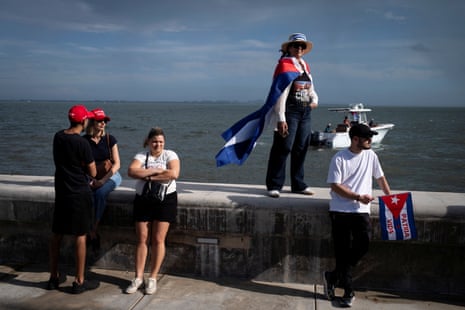
Even as the Trump administration seeks to force regime change in Cuba through withering economic isolation, allies of Trump and Marco Rubio, his secretary of state, are angling to get rich off the island’s collapse.
Reporting for The Guardian, Lee Schlenker and Ed Augustin found that business interests connected with Trump and Rubio, the architect of current US designs on Cuba, are jostling to fill the void left by companies squeezed out of the island by the latest barrage of US sanctions.
A few key takeaways:
-
A pair of Trump-friendly Texas business magnates are fighting to take over a Canadian company’s stake of Cuba’s mineral wealth.
-
Sources close to the matter say that Trump Organization leaders, operating under a company closely tied to the president’s family, have traveled to Cuba to explore hotel deals after a pair of Spanish hotel chains fled the island.
-
And Franklin Graham, a close ally of Trump on the evangelical right and head of the evangelical aid organization Samaritan’s Purse, recently won a $40m federal contract to oversee the distribution of humanitarian assistance on the island Trump is pushing toward collapse.
One source with decades of background in Cuba policy put it succinctly: “If I had done during the Biden administration what Trump’s friends have done now, I’d have been put in jail.”
The Trump administration has taken an especially severe stance toward Cuba since the start of Trump’s second term. Rubio, the child of Cuban immigrants, has led that campaign, seeking to bring about his long hoped-for goal of collapsing Cuba’s communist leadership and seeing a new US-friendly government in its place.
The goal of regime change in Cuba has echoes of the Trump administration’s playbook in Venezuela, where Rubio helped orchestrate the toppling of a leftist dictator and the funneling of the country’s oil revenues to US coffers.
Speaking to EU officials in Strasbourg on Thursday, Canadian Prime Minister Mark Carney seemed open to a proposal to grant his country a new “associate member” status within the bloc – even as details remained thin on what, exactly, that would entail.
“We welcome this ambition,” Carney said of the proposal. “Canada and Europe should secure our strategic autonomy through deep cooperation in the full range of strategic capabilities, including critical minerals, defense industrial capacity, AI and compute, energy security, space, and payments.”
Ursula von der Leyen, president of the European Commission, first raised the possibility of making Canada an associate member in an address on Wednesday. Her surprise suggestion to grant Canada – notably not in Europe – a heretofore unheard-of special status within the union appeared to catch member states off-guard.
The same was true for President Trump, who slammed the proposal as “laughable” and as a “hostile act” and went on to threaten sweeping tariffs against Europe if it follows through.
Carney tried to articulate what exactly deepened ties between the EU and Canada might look like, saying he was “not proposing a third bloc in order to become a great-power rival – only with better manners.”
“We do not seek power to dominate others,” Carney continued. “On the contrary, we are pursuing resilience so that no one can control our open markets, impair our sovereignty, threaten our territorial integrity, or undermine our freedoms, our democracies, our rule of law.”
The US congresswoman Ilhan Omar is set to introduce a bill that would make federal immigration agencies “pay the price” for terrorising vulnerable communities, blocking nearly $140bn in funding and redirecting it to local recovery efforts, the Guardian has learned.
The Make ICE Pay Act, due to be introduced on Thursday, targets funding previously designated for Immigration and Customs Enforcement (ICE) and Customs and Border Protection (CBP) under Donald Trump’s “One Big Beautiful Bill”.
It would send the money instead to states, local government authorities, nonprofit organisations and small businesses left reeling by Trump’s immigration enforcement crackdowns.
“For over a year, ICE has been tearing through our nation, leading racist terror campaigns that have caused devastating damage to our cities, to our businesses, and to the lives of our constituents,” said Omar, who represents Minnesota’s fifth congressional district, covering the city of Minneapolis and surrounding suburbs.
Beginning last December, thousands of federal immigration agents descended on Minneapolis and surrounding areas, resulting in nearly 4,000 total arrests and the fatal shooting of two US citizens, Renée Good and Alex Pretti. The mood of fear and isolation also had a profound effect on commerce.
Omar added: “In Minneapolis, Operation Metro Surge cost our community nearly $700m. We have a moral responsibility to end this abuse of power. Our bill will force ICE to pay the price for the damage they’ve left in their wake and ensure that these devastating operations can never be repeated.”
A UN fact-finding mission on Iran said it had reasonable grounds to believe the United States was behind two military strikes on a school and sports facility in Iran in February, and that these constituted war crimes.
It also found that Iranian authorities committed crimes against humanity during their deadly crackdown on anti-government protests.
The findings in a new report by the Independent International Fact-Finding Mission on Iran, to be submitted to the UN Human Rights Council in Geneva, examined the US’s conduct during the Iran war that began in February and the Iranian government’s response to nationwide unrest that begun in late December.
The Iranian and US permanent missions in Geneva did not immediately respond to Reuters requests for comment.
US officials have previously said military operations are conducted in accordance with the law of armed conflict, while Iran has consistently rejected allegations of systematic rights violations.
A key Senate Democrat has asked secretary of state Marco Rubio to ensure that US diplomats are involved in a Pentagon-led review of America’s military presence in Europe that has alarmed Nato allies.
In a letter addressed to Rubio, who is also the national security advisor, senator Jeanne Shaheen, the top Democrat on the Senate Foreign Relations Committee, wrote that diplomats, including US ambassadors in potentially affected countries, are being kept out of the loop. The letter was first shared with Reuters.
The review, which began in June and is due to conclude by the end of the year, is part of a push by the Trump administration to have Europe rely less on the United States and instead take more responsibility for its own defense. The US has around 80,000 troops stationed in Europe.
“The Department of State, which is responsible for managing our bilateral relationships, has traditionally played a substantial role in reviews of this kind,” read the letter.
“Yet what we are hearing through our own conversations, travel across Europe and engagement with our Allies tells a different story. US ambassadors and chiefs of mission in affected countries have been excluded from consultations.“
The unprecedented spate of mid-decade redistricting for the US House has changed the congressional districts for one-tenth of Americans and significantly altered the makeup of at least one-fifth of districts, according to a new study.
A report by Protect Democracy found that 34.8m people – about one in 10 Americans – now live in a different district than they did during the 2024 election cycle.
And about one-fifth of all Americans now live in a district where more than a quarter of voters are new to the district compared with the last election cycle, AP reported.
The findings display the stark overhaul that partisan redistricting fights kicked off by president Donald Trump last year have caused for Americans across the country.
“If this trend continues, it really brings into question whether or not elected officials are really representing their constituents anymore, or if the voters are being randomly picked by mapmakers to squeeze out partisan advantage,” said Ben Raderstorf, a policy advocate at Protect Democracy and one of the paper’s co-authors.
Hello and welcome to the US politics live blog.
House Democratic leader Hakeem Jeffries said the Russia sanctions bill had “so many loopholes” as Congress passed the sweeping bill to give Donald Trump the power to raise tariffs on top buyers of Russian energy.
The Lindsey O Graham Sanctioning Russia and Iran Act of 2026 passed in a 262-159 vote on the last day before Congress goes on recess ahead of the midterm elections. Graham, who died earlier this year, co-authored and submitted the bill more than a year and a half ago.
But Jeffries said the legislation had so many loopholes that sanctions harming Russia might not be applied.
“What this legislation will do is give Donald Trump, perhaps, unfettered authority to unleash tariffs on the American people,” the New York lawmaker said as he announced he would vote no.
He added:
Why in the world would this Congress give this president additional authority to visit that kind of economic harm on the American people?
The bill would mandate new sanctions on Russian political and military officials, and foreign networks helping to supply Russia’s war machine and evade existing sanctions. It would also target Russia’s so-called fleet of “shadow tankers”, which have allowed the country to continue to ship crude around the world despite sanctions on its energy exports.
It would also allow Trump to impose tariffs of up to 100% on the top purchasers of Russian energy, including China, as well as other countries helping the Kremlin evade sanctions.
Democratic staffers supporting the bill said that it offered a “last chance” to increase sanctions on Russia before Ukraine entered a “long winter”. Russia has improved the drone technology it has used to strike Ukrainian infrastructure as Kyiv has suffered a shortage of anti-air missiles, leaving the country in a dire position.
Don Bacon, a Nebraska Republican supporting the bill, called it the US Congress’ “Churchill vs Chamberlain Moment on Russia”.
Read our full report here:
In other developments:
-
Donald Trump responded to the Federal Reserve’s unanimous decision on Wednesday to raise its benchmark interest rate by a quarter-percentage point, to a range of 3.75% to 4%, by demanding a massive cut in rates.
-
Asked why it is so important to him to have his name inscribed on the Kennedy Center, a memorial to another president, Trump said he deserves “recognition” for saving the venue. If not, Trump said, “It’ll end up being ripped down.
-
Congresswoman Joyce Beatty, a Democrat and Kennedy Center trustee, has filed a motion for an emergency hearing on the performing arts venue’s apparent closure.
-
Mitch McConnell, the former Republican Senate majority leader who returned to work this week after a months‑long absence, had to be prompted by colleagues as to how to vote near the start of a televised meeting of the Senate agriculture committee on Wednesday.
-
The House speaker, Mike Johnson, cancelled votes currently scheduled for Thursday, meaning that lower chamber lawmakers will now head back to their districts for the midterm recess a day early. The change to schedule means that the House will avoid voting on Republican congressman Thomas Massie’s resolution to impeach the defense secretary, Pete Hegseth.
-
Speaking in North Carolina, Trump explicitly compared his effort to blame Democrat Roy Cooper, the former governor and Senate candidate, for the brutal killing of a young Ukrainian refugee, Iryna Zarutska, last year, by using false information, on the infamous 1988 Willie Horton ad.
The Guardian wp:paragraph
هلدینگ کاسپین استانبول | خرید ملک در ترکیه | صرافی معتبر ایرانی در ترکیه | خرید و فروش طلا در ترکیه | مهاجرت به ترکیه | واردات و صادرات در ترکیه | نیازمندیهای ترکیه | اخبار ترکیه | اخبار جهانی | توریست ایران | خدمات توریستی در ایران | تورهای گردشگری ایران | هلدینگ اول | خدمات کاریابی و فریلنسری و شغل | مرجع اطلاعات ایران (همه چیز در ایران) | کیف پول و خدمات مالی و پرداخت یار | اخبار ایران | تابلو زنده قیمت ارز در ترکیه و استانبول | صرافی آنلاین ترکیه | قیمت طلا و نقره در ترکیه | سرمایه گذاری در ترکیه | جواهرات در ترکیه | نرخ لحظه ای ارزها در استانبول | قیمت دلار امروز در ترکیه | قیمت دلار استانبول امروز | قیمت لحظه ای دلار | اخبار روز ترکیه استانبول | اپلیکیشن ISTEX | اپلیکیشن قیمت لحظه ای دلار و یورو و لیر و ارزها در ترکیه
/wp:paragraph wp:paragraph /wp:paragraph
About the Author