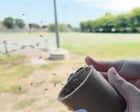
The box arrived in the San Gabriel Valley, just east of Los Angeles, filled with more than two dozen paper tubes about the size of toilet paper rolls.
“All 25 tubes are here,” said Tristan Hallum, who oversees scientific programs for the San Gabriel Valley mosquito and vector control district.
He held one of the tubes up to his ear and listened closely. “What I’m listening for is the sound of 600 adults flying around,” he said.
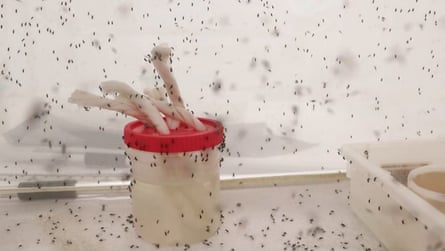
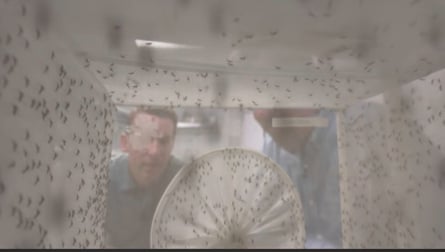
Inside each tube were 600 Aedes aegypti mosquitoes, shipped overnight from Kentucky. Hallum was not trying to get rid of them. He was about to release them.
All buzz, no bite
The plan is to release roughly 30,000 mosquitoes every week, nearly half a million in all. They are all males and male mosquitoes do not bite.
“I tell people it’s the opposite of the human species. It’s the females that cause trouble in the mosquito world,” said Stephen Dobson, a professor and president of MosquitoMate, the Kentucky company breeding the insects.
The mosquitoes carry a naturally occurring bacterium called Wolbachia. When these males mate with certain wild females, the resulting eggs do not hatch. “And when they do, those females are then sterile for the rest of their lives,” Dobson said.
The strategy is to flood an area such as a park or neighborhood with male mosquitoes that can mate with wild females but cannot produce viable eggs. “If enough of the females are not producing any offspring then the population goes down,” Dobson said.
Instead of trying to kill every mosquito, scientists are trying to stop them from producing the next generation.
Why California is calling
The need is becoming more urgent in places where mosquitoes once seemed a relatively minor threat.
In 2023, Pasadena and Long Beach recorded the first locally acquired cases of dengue fever ever identified in California. The following year, Los Angeles county saw another cluster. A CDC investigation identified 14 locally acquired cases between August and November 2024, six of which resulted in hospitalization.
Dengue is still overwhelmingly a disease acquired by Americans traveling abroad. But local transmission requires three things: a person carrying the virus, a mosquito capable of transmitting it and the right conditions for that mosquito to survive and reproduce.
California now has the mosquito, and the climate is becoming more favorable to it.
Climate crisis affecting mosquito calendar
Mosquitoes are the world’s deadliest animal, not because of the bite itself but because some species transmit diseases including dengue, West Nile, Zika and yellow fever.
Climate Central found that nearly 95% of the US cities it analyzed now have more days each year with temperatures suitable for some of the country’s most common disease-spreading mosquitoes than they did in the early 1970s. The increase averages 18 days a year.
That may sound like a small change. For mosquitoes, it can mean several additional weeks to feed, reproduce and potentially spread disease.
Hallum has watched that shift change the work of mosquito-control agencies.
“What we would use to refer to as the mosquito season would only be say May to September but now we have individuals treating for mosquito control activity all year long,” he said.
Climate crisis is also expanding the map for where mosquitoes can survive.
“The general trend is they’re moving northward into places that historically have been too cold,” Dobson said.
Temperature is only one part of the equation. Rainfall, humidity and drought can all affect mosquito populations and the transmission of disease. But warmer conditions can extend mosquito activity and, for some species, speed up their development and reproduction.
For Aedes aegypti, Dobson said, warmer and more humid conditions are particularly favorable.
“It’s exactly what they like. A nice warm humid environment.”
Climate crisis is not the only reason mosquito-borne diseases are spreading. Urbanization, international travel and population growth all play a role.
But a warmer climate can give mosquitoes more opportunities to survive and more time to find people to bite.
The mosquito factory
That is where Dobson comes in.
At MosquitoMate in Lexington, his team breeds Aedes aegypti in a laboratory and ships the males to mosquito-control agencies around the country, including the San Gabriel Valley.
The technique does not involve genetically modifying the mosquitoes.
“This is a naturally occurring bacterium,” Dobson said. “We’re just moving the bacterium from one mosquito to another.”

The Environmental Protection Agency has approved mosquito-control products using Wolbachia-infected males, and field studies have found substantial reductions in Aedes aegypti populations.
Similar approaches are being used internationally. The World Mosquito Program has released Wolbachia-carrying mosquitoes in countries where dengue is a major public health threat, and studies have found significant reductions in dengue transmission.
The objective is not to eradicate mosquitoes. It is to reduce populations of the mosquitoes most capable of making people sick.
Measure of success
Back in southern California, Hallum will not know whether the strategy is working by counting the mosquitoes he releases.
He will know by counting the mosquitoes he catches.
His team will monitor traps for female Aedes aegypti, the mosquitoes that bite and can spread disease. If their numbers fall, the males will have done their job.
“In total we’re going to be releasing just under half a million mosquitoes,” Hallum said.
Previous studies have reported reductions of 80% to 95% in some release areas, although results can vary depending on local conditions.
For Hallum, the experiment is a test of whether this unusual form of mosquito control can work in a place where the insects are already established and where a changing climate could give them an increasingly favorable home.
“I love the dudes but the females they can get out of here,” Hallum said.
-
Climate Central is an independent group of scientists and communicators who research and report the facts about our changing climate and how it affects people’s lives
The Guardian wp:paragraph
هلدینگ کاسپین استانبول | خرید ملک در ترکیه | صرافی معتبر ایرانی در ترکیه | خرید و فروش طلا در ترکیه | مهاجرت به ترکیه | واردات و صادرات در ترکیه | نیازمندیهای ترکیه | اخبار ترکیه | اخبار جهانی | توریست ایران | خدمات توریستی در ایران | تورهای گردشگری ایران | هلدینگ اول | خدمات کاریابی و فریلنسری و شغل | مرجع اطلاعات ایران (همه چیز در ایران) | کیف پول و خدمات مالی و پرداخت یار | اخبار ایران | تابلو زنده قیمت ارز در ترکیه و استانبول | صرافی آنلاین ترکیه | قیمت طلا و نقره در ترکیه | سرمایه گذاری در ترکیه | جواهرات در ترکیه | نرخ لحظه ای ارزها در استانبول | قیمت دلار امروز در ترکیه | قیمت دلار استانبول امروز | قیمت لحظه ای دلار | اخبار روز ترکیه استانبول | اپلیکیشن ISTEX | اپلیکیشن قیمت لحظه ای دلار و یورو و لیر و ارزها در ترکیه
/wp:paragraph wp:paragraph /wp:paragraph
About the Author