
As budgets allocated to artificial intelligence reach record levels globally this year, the corporate agenda is also changing rapidly.
According to Gartner’s latest report, worldwide AI spending will reach $2.59 trillion in 2026, up 47% year-over-year. A significant share of this investment is now being driven by companies themselves, namely businesses outside technology giants and cloud providers.
But as investment grows, a new question is emerging: Are companies really getting a return on these investments?
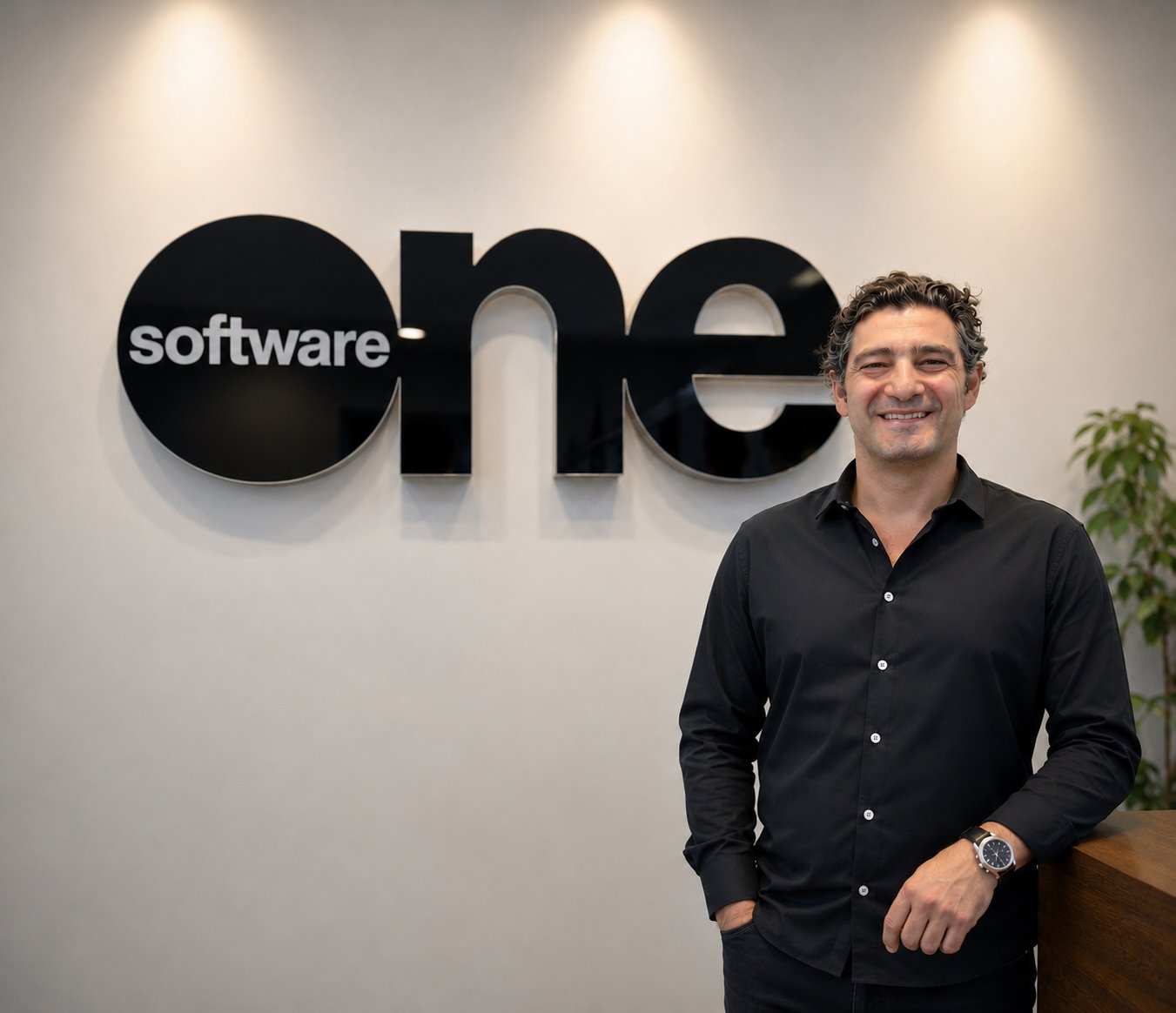
Hürol Berber, CTO of SoftwareOne Türkiye, says companies have only recently begun looking for an answer.
The company traces its roots to DataServ, established in 1997-1998, followed by Comparex and, in 2019, SoftwareOne. After merging with Crayon in 2025, it became a group with 13,000 employees serving more than 70,000 customers in over 70 countries. Today, it is one of Microsoft and Amazon’s largest global partners.
Investment not slowing
“Companies have started measuring AI usage today, but we are still at the beginning of the journey when it comes to linking usage with the business value generated,” Berber says. According to him, the new agenda in the AI world can be summarized under two headings: security and optimization.
Companies are no longer asking whether they should use AI, but how securely, efficiently and sustainably they are using it. With the spread of agentic AI, he predicts that issues such as identity, authorization, access and audit trails will become a governance matter addressed jointly not only by CIOs, but also by security, finance, legal and human resources departments.
Berber points out that as AI scales, a new cost layer is emerging in cloud bills. Items such as model and API usage, computing power, storage and data movement are growing rapidly. In his view, the issue is not that the cloud is expensive, but that uncontrolled consumption becomes expensive.
“AI’s first bill was the license bill. Its second bill will be the consumption bill.”
According to international research, a significant proportion of employees use AI tools without corporate approval and may transfer company data to those tools.
Business value must be put on table
Berber says what makes Shadow AI more critical than traditional Shadow IT is that employees are not only using an unauthorized application; they may also be transferring company data into it.
When a customer contract, financial information, source code, or an internal corporate document is uploaded to an uncontrolled generative AI tool, the issue moves beyond cybersecurity into the areas of data governance, personal data, intellectual property and compliance.
“You cannot solve Shadow AI simply by banning it; you need to offer a secure and manageable alternative,” Berber says. In his view, AI is no longer a single technology expense. On one side are cloud and model consumption; on the other are software as a service (SaaS) and user licenses, with security, data and compliance layers sitting above them.
For this reason, he says companies need to address FinOps – cloud financial management – and Software Asset Management, or SAM, together.
“To manage the AI economy, cost, usage and business value need to be put on the same table.”
Following its merger with Crayon in 2025, SoftwareOne has been positioned by Gartner and IDC as a leader in software asset management services for six consecutive years.
Berber emphasizes that the company is not a “vendor,” but a business partner focused on consulting and cloud services. He says the real value comes not from selling products, but from the service layer that ensures technologies are used correctly.
Türkiye’s high growth potential
Assessing the Turkish market, Berber says hyperscaler-based public cloud usage in the country still has room to develop, creating a significant growth opportunity.
He notes that economic conditions such as currency fluctuations affect technology investments, but can also create certain opportunities.
According to Berber, Türkiye’s geographic location, cost advantages and skilled workforce could turn the country into an important technology hub if hyperscaler investments increase. However, he says the pace of this transformation will depend largely on regulatory clarity.
Advantage now about management, not usage
Berber’s conclusion is clear: Going forward, competitive advantage will not come from being the company that uses AI the most. It will come from being the company that knows which uses create value, optimizes costs, manages risks and sustains all of this through a scalable governance model.
“Using AI will no longer be a differentiator; managing AI correctly will be.”
PEAKUP turns AI products into ventures, with IPO in sight
PEAKUP is scaling its artificial intelligence-focused solutions as independent ventures, accelerating its global expansion with an initial public offering in its sights. The company plans to go public in 2030 and generate more than half of its revenue from international markets.
With more than 15 years of experience spanning cloud infrastructure and AI integrations, PEAKUP has reached an important milestone in its transformation into a global AI-focused technology company.
Investment in human resources lies at the heart of PEAKUP’s success story. Established in 2012, when cloud technologies were still in their early stages in Türkiye, PEAKUP Akademi was founded through night classes held at the laboratories of Istanbul Technical University’s (ITÜ) Faculty of Mines. These programs formed the company’s first core team.
Ahmet Toprakçı, PEAKUP’s founder and CEO, said the company had grown rapidly by offering “down-to-earth” AI solutions for corporate processes and had placed a global initial public offering, or IPO, at the center of its ambitions.
Leading companies’ digital transformation with solutions focused on AI, cloud and data management, PEAKUP increased its revenue by 124% in the first half of 2026, expanding its scale in global markets.
Under the leadership of Toprakçı, the company is structuring its own software products as independent ventures. It aims to generate more than half of its revenue internationally and crown its growth with an IPO.
Founded with 100% domestic capital and approaching its 15th year, PEAKUP is reinforcing its strong position in Türkiye while rapidly expanding its presence in global markets. The company, which holds Microsoft’s “Frontier Partner” title – the technology giant’s third such partner globally and its first in Türkiye – serves more than 1,000 corporate customers in over 20 countries with its cloud computing, data management and AI solutions.
Financial leap, IPO
PEAKUP achieved notable growth momentum with its performance in the first six months of 2026. Having ended the 2025 financial year with revenue of TL 307 million, the company reached TL 620 million in revenue in the first half of 2026, surpassing its total for the previous year.
PEAKUP expects to exceed the TL 1 billion threshold in annual revenue. It has set a revenue target of TL 1.5 billion for the first half of 2027 and plans to reach a volume of between TL 1.5 billion and TL 2 billion by the close of its July-June financial year.
Rather than seeking external investment, the company has made going public its strategic priority. It manages its financial structure through monthly recurring revenue, or MRR, models and long-term cash-flow projections.
The company’s current revenue distribution consists of 45%-50% from consulting and technical services, 40%-50% from license sales and 20% from its own value-added products.
Products focused on startup-speed growth
Scaling its internally developed software through independent venture structures is a critical part of PEAKUP’s global vision. The company’s email-signature solution SIGNandGO has reached more than 200 customers on its own.

Together with PassGate and its corporate communications platform Velocity, PEAKUP’s products are actively used by more than 300 organizations.
Adding more than 250 new customers to its portfolio in the first half of 2026, the company now works with 650 organizations in total and has doubled its number of international customers.
PEAKUP exports to markets including the United Kingdom, Germany, the United States, Australia, Singapore and the United Arab Emirates (UAE). In the coming period, it aims to further strengthen its presence in the Baltic countries, Azerbaijan, the Adriatic region, including Serbia and Slovenia, and Qatar.
The company has increased the international share of its total revenue to 18%-20% and aims to raise this figure above 50% in the medium term.
Value-generating AI solutions
At a time when Türkiye’s information and communications technologies market has exceeded TL 2.1 trillion and the software sector has grown by 124%, PEAKUP increased its AI-generated revenue by nearly 80%.
Rather than focusing on abstract promises, the company concentrates on projects that deliver concrete cost advantages and business value to the corporate world.
Before beginning a project, PEAKUP conducts detailed gap analyses to identify companies’ shortcomings and needs. It also observes operations directly in the field before developing solutions:
- TAV Airports: Apron and tower operations at Adnan Menderes Airport are being automated through AI agents following a four-day field study and a 120-page analysis.
- Pegasus: An enterprise AI model that protects information security and generates accurate responses was developed for the airline, contributing to its vision of becoming an “AI-focused airline.”
- Eczacıbaşı / Vitra: A voice-based technical support desk operating 24/7 in German and Russian was introduced, alongside a 56-day internal AI training program.
- Yıldız Holding / Şok Markets: AI agents automatically verify the accuracy of e-Government and personnel documents used in recruitment processes.
- CEVA Logistics: AI solutions identify tax numbers and other critical information from delivery notes in different languages, including Thai, and transfer the data into the system.
- Nestle & Borusan: More than 30 digital business processes, including flexible benefits and facility-tracking applications, were automated on the Power Platform infrastructure.
- Swiss banking sector: Know-your-customer, or KYC, and credit-risk analysis processes are being carried out using AI models.
Türk Telekom takes its digital bridge to Central Asia
One of Türkiye’s leading telecoms and technology companies, Türk Telekom plans to expand its submarine cable investments as it takes its technology capabilities into Central Asia.
Türk Telekom International (TTI), the company’s international subsidiary, brought together leading operators and technology companies from the region at the Global Carrier Community Meeting (GCCM 2026) in Almaty, Kazakhstan.
During the event, the company signed a memorandum of understanding (MoU) with Kazakhstan-based Akashi Data Center covering the interconnection of data centers and the joint use of infrastructure.
Operating across a broad geography spanning Europe, the Middle East and Asia, TTI provides end-to-end connectivity solutions, cybersecurity, cloud computing, wholesale voice and mobile roaming services. Its international fiber network, which also includes submarine cable systems, extends for approximately 50,000 kilometers, while the number of its points of presence in 24 countries has exceeded 135. TTI has more than 200 business partners operating over this network.
Expansion of submarine cable network
At GCCM 2026, TTI held talks with operators from various countries, particularly Azerbaijan, Kazakhstan, China and India, to assess new traffic and capacity opportunities from Türkiye to Central Asia, the Caucasus, the Turkic republics, Iran, Iraq and the Far East.
The discussions covered potential partnerships to expand the submarine cable network, strengthen fiber infrastructure and increase the number of digital points of presence.

Yavuz Yıldırım, general manager of Türk Telekom International, said the company had assumed the role of technology carrier not only for Türkiye but also for the wider region through its national technology expertise, investments and engineering workforce.
Yıldırım said TTI was building a strategic digital bridge stretching from Europe to the Middle East and from the Turkic republics to Central Asia and Asia. He emphasized that the Turkic republics and Central Asia offered significant potential due to Türkiye’s historical, economic and strategic ties with the region.
He said the company was focusing on evaluating opportunities in data centers, cloud computing, cybersecurity, artificial intelligence and next-generation connectivity technologies.
He described the agreement with Akashi Data Center as a concrete reflection of this vision, noting that the partnership aims to interconnect data centers, enable the joint use of infrastructure and develop next-generation products and services.
Cooperation efforts to expand
The TTI executive added that they did not view regional cooperation as being limited to telecommunications infrastructure.
Yıldırım said developing opportunities for joint work at international events such as Formula 1, held in Azerbaijan’s capital Baku, was also among the important areas of regional cooperation.
As the international arm of the Türk Telekom Group, TTI continues to represent Türkiye’s digital vision on the global stage through its role in regional data traffic.
DAILYSABAH
هلدینگ کاسپین استانبول | خرید ملک در ترکیه | صرافی معتبر ایرانی در ترکیه | خرید و فروش طلا در ترکیه | مهاجرت به ترکیه | واردات و صادرات در ترکیه | نیازمندیهای ترکیه | اخبار ترکیه | اخبار جهانی | توریست ایران | خدمات توریستی در ایران | تورهای گردشگری ایران | هلدینگ اول | خدمات کاریابی و فریلنسری و شغل | مرجع اطلاعات ایران (همه چیز در ایران) | کیف پول و خدمات مالی و پرداخت یار | اخبار ایران | تابلو زنده قیمت ارز در ترکیه و استانبول | صرافی آنلاین ترکیه | قیمت طلا و نقره در ترکیه | سرمایه گذاری در ترکیه | جواهرات در ترکیه | نرخ لحظه ای ارزها در استانبول | قیمت دلار امروز در ترکیه | قیمت دلار استانبول امروز | قیمت لحظه ای دلار | اخبار روز ترکیه استانبول | اپلیکیشن ISTEX | اپلیکیشن قیمت لحظه ای دلار و یورو و لیر و ارزها در ترکیه
About the Author