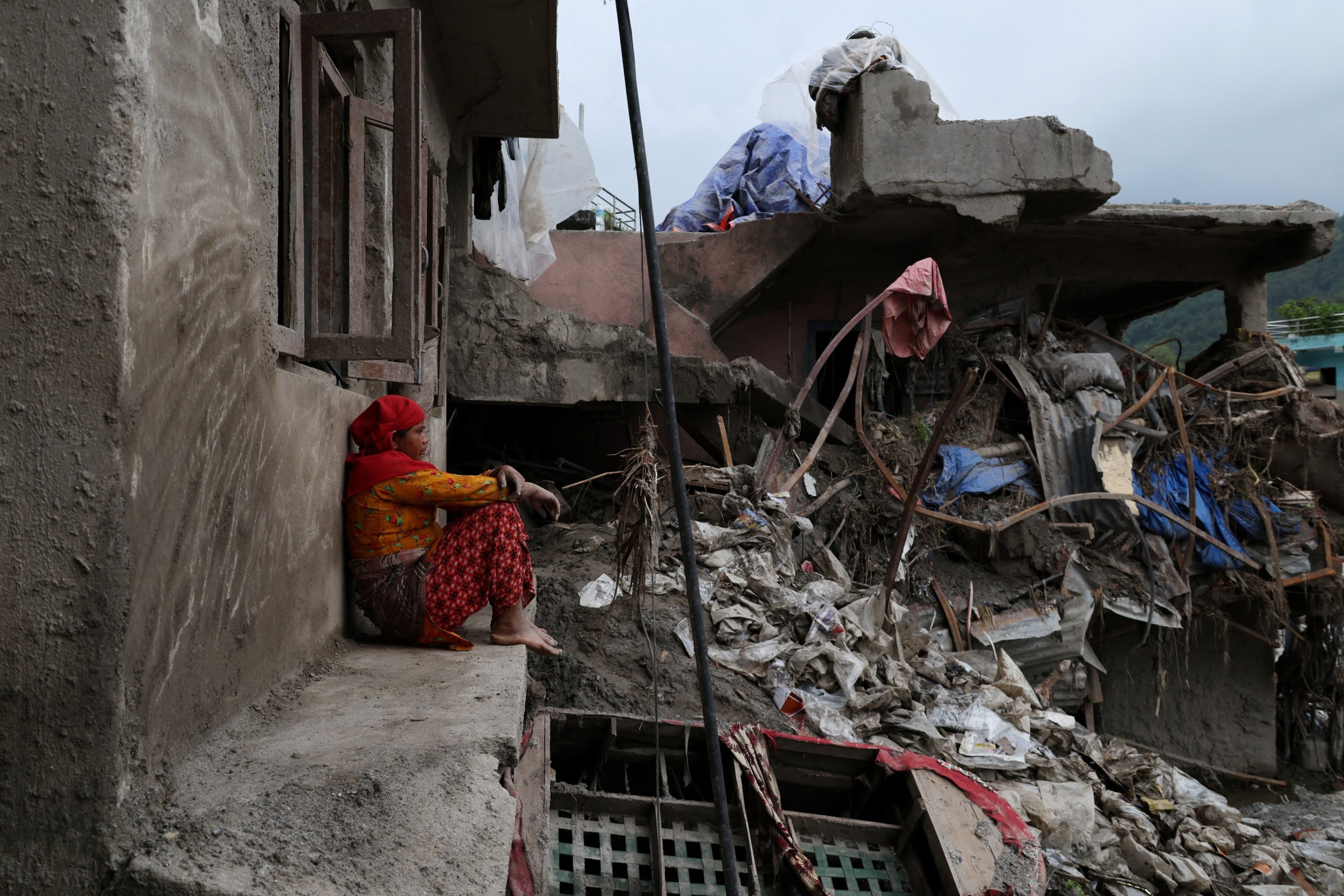
When Anusa Thapa Magar rushed back to Nepal from her job in the Maldives after hearing about the devastating floods, she hoped to find her grandmother alive.
Instead, she found neither her grandmother nor the two-story family home where she had lived.
There was barely a town left to return to.
Betrawati, once a bustling settlement, has been reduced in places to a vast stretch of hardened gray silt after torrents of water, mud and rocks swept down from the mountains last month following a glacial collapse near the Nepal-China border.
For Magar, 23, the destruction has left a painful question: Could her grandmother, who could barely walk and was last seen resting on her bed, still be buried beneath the ground?
“If my house is buried underneath, that means my Aama is still here underneath too, right?” Magar said, using the Nepali word for mother.
Magar is among scores of survivors who make the daily journey from temporary tent camps on a hillside above Betrawati to the ruins below. They walk about half a kilometer to search through the wasteland for anything that might connect them to the lives they lost.
Some look for household possessions. Others search for pieces of their homes or businesses. Many are looking for relatives who remain missing.
At least 1,386 people have died in Nepal in the disaster, while 5,130 remain missing, according to authorities. More than 13,700 people have been rescued, but the search continues as families wait for news of those who have disappeared.
A trail of panic
The road connecting Bidur with Betrawati has been buried beneath thick layers of mud left behind by the swollen river.
Getting to what remains of the town now means climbing a steep hillside, crossing a narrow ridge and descending into a landscape that bears little resemblance to the community that stood there before.
Abandoned shoes and slippers lie along the route, reminders of the panic that erupted as residents tried to outrun the flood.
A school building sits partly buried in debris. Children’s shoes, school ties and backpacks are scattered across the mud.
The flood was so powerful that the torrent slammed into the base of a hill before surging back across the valley, carrying homes, businesses and everything else in its path.
Residents said warnings began circulating only minutes before the flood arrived. Friends and relatives farther upstream called to urge people to flee, but few understood how quickly the disaster was approaching or how much destruction it would bring.
Kalpana Thapa Magar, 43, who owns a garment business, recalled receiving a frantic phone call from a friend.
“Run! Run!” the friend told her.
“I just ran. When I looked back, everything was gone, even the people who had been running behind me,” she said.
Farther downstream in Devighat, fragments of homes still stand amid the devastation. Residents pick through the remains, salvaging whatever they can, even as many acknowledge they may never return.
Madhav Ghimire, 42, still carries the keys to the six-room house he shared with Ambika Aryal, 38.
But the destruction is so complete that he can no longer determine where the house once stood.
“Though I lost everything, I have still carried the keys of my home. It gives me a sense that I have everything,” he said.
Nothing left to rebuild
For many survivors, the floods brought another devastating chapter to lives already marked by disaster.
Nepal lost nearly 9,000 people in the 2015 earthquake, which destroyed homes and communities across the country.
Sita Thapa Magar, 45, a teacher and Kalpana’s older sister, said that even after the earthquake, families could recover possessions from the rubble and eventually rebuild on their land.
This time, there is little left.
The two houses she owned with her husband were swept away, while their farmland was buried beneath debris.
“This time, we have lost everything,” she said.
Shanti Dangol, 61, stood on a single broken tile, one of the only visible remnants of the home she once knew.
In her hands was a photograph of the three-story lodge that had stood there.
Dangol remembered Betrawati as a thriving town serving pilgrims and trekkers. In recent years, residents had become more prosperous, building larger homes, renting rooms and investing in their children’s education.
“Economically, people here had started doing well. Now, nothing remains,” she said.
For the survivors returning each day, the search is about more than recovering possessions. They are trying to find pieces of a life that disappeared in minutes, while families continue to wait for answers about thousands of missing loved ones.
In Betrawati, even finding the place where a home once stood has become difficult.
DAILYSABAH
هلدینگ کاسپین استانبول | خرید ملک در ترکیه | صرافی معتبر ایرانی در ترکیه | خرید و فروش طلا در ترکیه | مهاجرت به ترکیه | واردات و صادرات در ترکیه | نیازمندیهای ترکیه | اخبار ترکیه | اخبار جهانی | توریست ایران | خدمات توریستی در ایران | تورهای گردشگری ایران | هلدینگ اول | خدمات کاریابی و فریلنسری و شغل | مرجع اطلاعات ایران (همه چیز در ایران) | کیف پول و خدمات مالی و پرداخت یار | اخبار ایران | تابلو زنده قیمت ارز در ترکیه و استانبول | صرافی آنلاین ترکیه | قیمت طلا و نقره در ترکیه | سرمایه گذاری در ترکیه | جواهرات در ترکیه | نرخ لحظه ای ارزها در استانبول | قیمت دلار امروز در ترکیه | قیمت دلار استانبول امروز | قیمت لحظه ای دلار | اخبار روز ترکیه استانبول | اپلیکیشن ISTEX | اپلیکیشن قیمت لحظه ای دلار و یورو و لیر و ارزها در ترکیه
About the Author