
Iran is ready to reopen the strait of Hormuz within seven days if the US eases military pressure and lifts its blockade on Iranian ports, a senior Iranian official has told the Reuters news agency.
There is no more immediate detail on how exactly this reopening would work in practice and the US hasn’t commented on the report, which we have not been able to independently verify.
The official also told Reuters that the Iranian delegation to the UN General Assembly has full authority to revive diplomacy with US officials.
Visible traffic through the strait of Hormuz has dwindled to a trickle, but some tankers are continuing exporting oil by travelling with their transponders off to avoid detection.
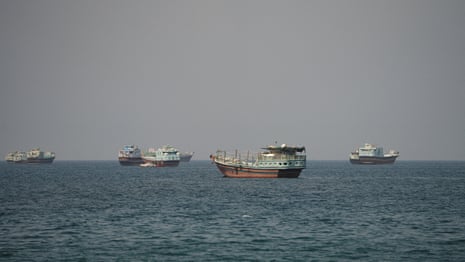
A total of 17 commodity vessels transited the strait over the weekend, down from 37 a week earlier, shipping data showed on Monday. Before the war, an estimated 120 vessels crossed the strait each day.
Despite the reduction in journeys through the strategic waterway, oil prices fell for a fourth consecutive session yesterday amid fresh prospects for renewed diplomacy.
As we mentioned earlier in the blog, Tehran and Washington exchanged threats on Sunday, although the US president, Donald Trump, said he would be open to meeting his Iranian counterpart, Masoud Pezeshkian, who is travelling to New York for the UN meeting.
Among Iran’s previous conditions to reopen the strait included an and to the war on “all fronts” – referring to Israel’s assault on Lebanon – and the release of frozen funds.
Here is some more analysis from our diplomatic editor, Patrick Wintour:
A fortnight ago Iran said it had reached agreement with Oman for a new agreed temporary route for commercial shipping through the strait of Hormuz that would then be lodged with the International Maritime Organisation. The bulk of the route goes through Iranian waterways in the north of the strait.
But the meeting planned for the Gulf States to endorse the route was cancelled by Saudi Arabia after what it regarded as Iranian-induced attacks on Saudi Arabia by Houthi forces in Yemen. Saudi Arabia also wanted to be a signatory and authoriser of the route, but Iran insisted the route had to be endorsed only by the two countries in which the strait’s waterways passed: Iran and Oman.
Iran had also said the waterway would not be opened even after the route was agreed until seven other conditions were met largely related to lifting the sanctions, asset freezes and broader US aggression towards Iran. Only after that could the issue of Iran’s nuclear program be considered.
The US has been countering this week by trying to impose an aerial blockade on Iran, threatening third countries not to allow Iranian civilian planes to fly in and out of Iran from their airports. The US treasury secretary, Scott Bessent, said all Iranian planes will stop flying worldwide from Wednesday.
Tehran appears to have relaxed its preconditions for reopening the strait of Hormuz, saying it is prepared to do so within seven days so long as the US takes reciprocal steps to ease the pressure on Iran.
Previously Iran had set seven onerous pre-conditions for lifting the blockade including “an end to war on all fronts” and a commitment by the US to cease all aggressive actions against Iran including sanctions.
The new position emerged ahead of backstage negotiations at the UN General Assembly in New York this week and was briefed by an Iranian official in Tehran to the Japanese news agency Kyodo.
The official claimed the position had been approved by the Supreme leader Mojtaba Khamenei, and the Supreme National Security Council.
The Islamic Revolutionary Guards Corps (IRGC) in a statement not directly referring to the report said there was no contradiction in staging negotiations and waging war at the same time, a position echoed by Iran’s chief negotiator Mohammed Ghalibaf in remarks delivered online to the Iranian parliament this week.
Iran, the Japanese news agency reported from Tehran, was seeking signs from Washington that it is prepared to return to negotiations and take steps toward an end to the US military blockade of Iranian ports and a halt to military operations related to the strait of Hormuz.
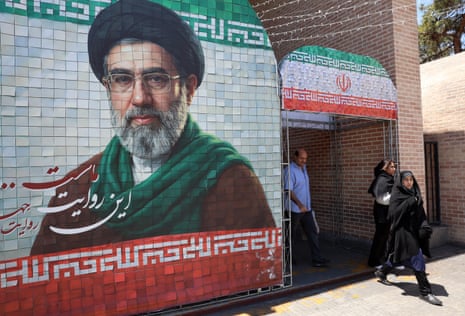
If such steps are taken, Iran is prepared to reopen the strategic waterway within seven days and return to the negotiating table, according to the official. These preconditions are less stringent than those issued by other authoritative figures in the previous 48 hours. It is sometimes the case that initially appealing offers from Iran emerge to be more complex once the small print is examined.
But Tehran is under growing pressure due to US engineered restrictions on the exports of its oil playing having havoc with its currency reserves and domestic inflation.
The official insisted there was no chance that Iran’s president, Massoud Pezeshkian, will meet the US president while in New York. Pezeshkian has not been directly involved in the negotiations with the US and does not have the independent authority to make concessions to the US.
As broadly a reformist, he is also not fully trusted by the IRGC and hardline politicians in Tehran. Some hardliners oppose negotiations with the West as a matter of principle. Others argue that Iran holds the upper hand as energy markets come under further pressure worldwide.
We are seeing reports that the Houthis have said that strikes carried out by Saudi Arabia in the northwest of the country killed at least two civilians.
“A mother and child were killed, while her husband and two of her other children were wounded in strikes carried out by the Saudi enemy in the Al-Batin area of Al-Hazm, in Al-Jawf province,” the Iranian-backed militia’s news agency said, citing the Houthi health ministry.
Iran is ready to reopen the strait of Hormuz within seven days if the US eases military pressure and lifts its blockade on Iranian ports, a senior Iranian official has told the Reuters news agency.
There is no more immediate detail on how exactly this reopening would work in practice and the US hasn’t commented on the report, which we have not been able to independently verify.
The official also told Reuters that the Iranian delegation to the UN General Assembly has full authority to revive diplomacy with US officials.
Visible traffic through the strait of Hormuz has dwindled to a trickle, but some tankers are continuing exporting oil by travelling with their transponders off to avoid detection.
A total of 17 commodity vessels transited the strait over the weekend, down from 37 a week earlier, shipping data showed on Monday. Before the war, an estimated 120 vessels crossed the strait each day.
Despite the reduction in journeys through the strategic waterway, oil prices fell for a fourth consecutive session yesterday amid fresh prospects for renewed diplomacy.
As we mentioned earlier in the blog, Tehran and Washington exchanged threats on Sunday, although the US president, Donald Trump, said he would be open to meeting his Iranian counterpart, Masoud Pezeshkian, who is travelling to New York for the UN meeting.
Among Iran’s previous conditions to reopen the strait included an and to the war on “all fronts” – referring to Israel’s assault on Lebanon – and the release of frozen funds.
The UK has agreed to provide defensive air support to Saudi Arabia to help counter Houthi fighters and restore stability in the Middle East while driving down the cost of living at home, Andy Burnham has said, ahead of his first meeting with Donald Trump.
The prime minister said he had agreed to a request for air-to-air refuelling of Saudi jets to defend energy infrastructure against the Iran-backed rebels and help keep oil flowing from the Gulf to ease global economic turmoil.
Burnham also revealed he will use his first meeting with Trump on Tuesday to urge the US president to de-escalate the conflict in Iran, warning that “dark clouds of global instability” are directly affecting people’s lives all over the world.
The turmoil in the Middle East has pushed up global energy prices, putting the UK economy under intense inflationary pressure and increasing government borrowing costs to multi-year highs just weeks before a crucial first budget for the new government. You can read the full story here:
Iranian foreign minister Abbas Araghchi has already arrived in New York. He said Iran’s main objective is to “defend the legitimacy, rights and interests” of the Iranian people at the UN general assembly, which he describes as “a major international platform”.
He said the gathering comes at a time when Iran is still defending itself against a “cowardly” war waged on it by the US and Israel that has resulted in many deaths.
Araghchi referred to the 156 civilians, including 120 children, who were killed by a US strike on the Shajarah Tayyebeh elementary school in Minab on the opening day of the war as among the victims of the war.
In his comments to journalists, which were published on Araghchi’s official Telegram channel, the Iranian foreign minister picks up on the title of this year’s theme of the UN general assembly: “Restoring trust, managing transformation: a United Nations that delivers for all”.
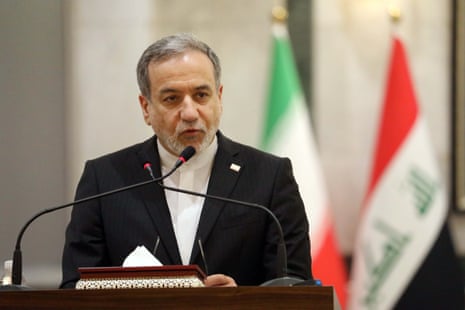
He said the title “shows that all countries acknowledge that there is no longer any trust and confidence in this organization has been lost, and this is unfortunately due to its ineffectiveness in establishing international peace and security.”
He went on to say that a number of countries act as if they are above international law, condemning the west as hypocritical for pretending to care about human rights while remaining “silent” when Israel, for example, is allowed to “do whatever it wants”. Araghchi said Israel has been committing crimes across Lebanon, Gaza, Palestine and Iran without any “serious condemnation”.
“Therefore, it is natural that no trust remains in an organization that is influenced by these countries, so the discussion of restoring trust is an important discussion and provides an opportunity to talk to the world about how trust in the UN has been lost and how it can be restored,” Araghchi said.
The statement comes ahead of the first debate of the annual UN General Assembly in New York, where representatives from 193 countries are gathering for an intense period of high-stakes diplomacy.
The debate opens on Tuesday, runs through to Saturday, and concludes on Monday, because no sessions are held on Sunday.
Today’s morning session (from 1300 GMT time) is due to be kicked off by an address from the Brazilian president, Luiz Inácio Lula Da Silva, and will be followed by a speech from the US president, Donald Trump.
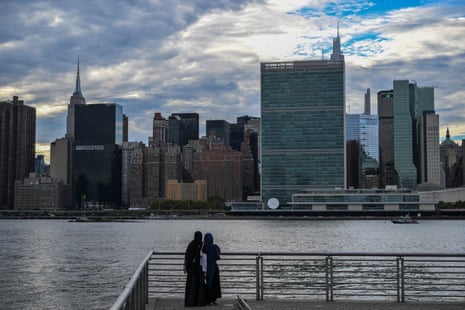
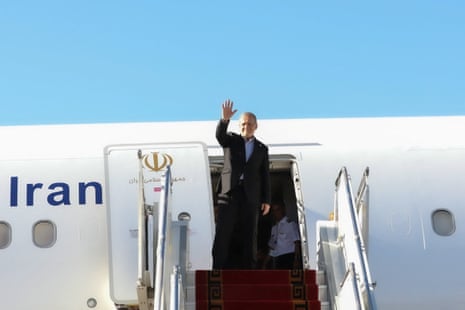
Iran’s president Masoud Pezeshkian is due to speak at the UN meeting tomorrow. On his way to New York this morning, he vowed to “firmly defend” his country’s positions.
“We emerged with our heads held high, and this is a source of dignity and pride for all of us. Therefore, we will firmly defend our positions in international forums,” he said.
“We will make the best possible use of this opportunity to convey Iran’s plight to the international community. We will firmly tell our adversaries that, despite all the unfairness and injustices, the Iranian people have stood their ground,” he said.
Pezeshkian will be the highest-ranking Iranian official to set foot on American soil since the start of the US-Israel war on Iran, which began on 28 February 2026.
In a joint statement, the Group of Seven (G7) foreign ministers called on Iran to end military support to Houthi forces in Yemen.
The ministers representing Canada, France, Germany, Italy, Japan, the UK and the US said “we call on the Houthis to immediately cease all military actions”.
“All threats and attacks against civilian shipping, and to return to the political process in good faith,” it added.
They also called on Iran “to end its arming of and support for the Houthis,” alleging Tehran is in violation of past UN security council resolutions.
Iran denies arming the Houthis, which would violate a UN embargo, and has said it only supports the group politically.
However, smuggled Iranian weapons have been seized from shipments bound for Yemen, and a report by UN experts in 2024 documented extensive military ties between the Houthis, Iran and its other allies.
According to a report in the New York Times, the US president, Donald Trump, has wavered for weeks over whether to act on appeals from Saudi Arabia for military help in fighting the Houthis.
On Wednesday, the president had reportedly met with advisers and said he did not favour strikes.
But the following day, his close ally, Saudi Arabia’s Crown Prince Mohammed bin Salman, called Trump again to ask for his help to halt the Houthi’s rapid advance, the outlet reported, citing administration officials.
After this phone call, Trump reserved his position and told the Pentagon to prepare for airstrikes against the Houthis, according to the report. But by Sunday, Trump had changed his mind again and said there would be no US airstrikes against the Iranian-backed rebel group, at least for now.
The US bombed the Houthis for two months in early 2025, but Trump called off those strikes after reaching a ceasefire with the group, as it agreed to stop targeting shipping in the Red Sea. The US has directly kept out of the conflict ever since.
Fighting in Yemen between the Houthis and government forces supported by Saudi Arabia has killed 154 people in the past two days, military sources told theAFP news agency, and has sparked a refugee crisis.
“The death toll from Saudi airstrikes, clashes and artillery fire in the governorates of Taiz, Al-Jawf, Marib and Saada stands at 118,” Houthi military sources said, while government sources reported 36 killed in their “ranks”, according to AFP.
Yemen has been devastated by a civil war that started in 2014, when the Houthis ousted the internationally recognised government from Sanaa, the country’s capital, driving it south towards Aden.
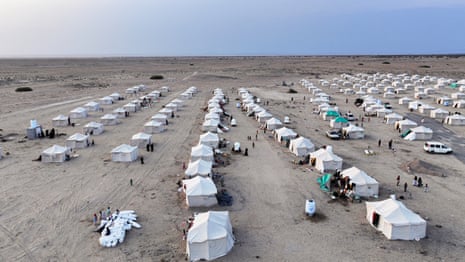
A Saudi-led coalition of Arab states subsequently intervened on behalf of the ousted government, with a mostly aerial campaign that was condemned for its deadly impact on the civilians of Yemen.
Neither side was able to gain much ground in Yemen’s mountainous terrain, and the Houthis remained in control over the northwest, where most of the population lives.
The two sides agreed to a UN-brokered ceasefire in 2022, which, despite some skirmishes, largely held until July, when a Saudi airstrike hit the runway of the airport in Sanaa, preventing the landing of an Iranian flight carrying a high-ranking Houthi delegation.
The already shaky UN-brokered ceasefire has since completely collapsed, with the two sides exchanging missiles, drones and air strikes.
Iran’s Revolutionary Guard Corps warned it would “change the geography of the war” if the US escalates the conflict, after Donald Trump issued fresh threats against the Islamic Republic.
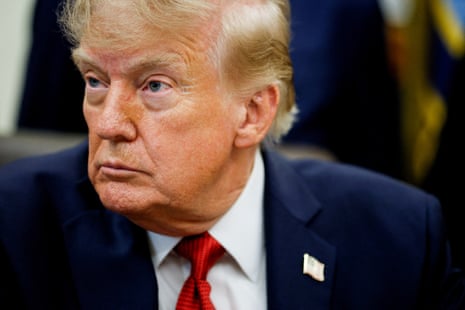
In an interview with Fox News on Sunday, Trump said “very big things are going to be happening in the not-so-distant future”, adding that the options he was considering were “wiping Iran out, letting them rot economically or making a deal”.
A spokesperson for the IRGC, Hossein Mohebbi, responded with a warning that if the US were to launch fresh attacks against Iran, Tehran would use “new weapons with capabilities into the battle”. “If a new aggression takes place, we will definitely change the weapons and geography of the war,” Mohebbi was quoted as having said.
“Our targets will no longer necessarily be the same as before,” he said, according to the Islamic Republic of Iran Broadcasting, adding that Iran has targets that have not yet been struck.
The comments come as the US and Iran remain locked in an impasse over the strait of Hormuz and after attacks on the Saudi capital, Riyadh, by Yemen’s Iranian-backed Houthi rebels.
The Houthis, who operate independently of Iran’s instructions, have seized territory along the country’s Red Sea coastline, including near the Bab al-Mandab Strait, a vital shipping route that links Asia to Europe via the Red Sea and Suez canal. Saudi Arabia has used it as an alternative route for oil exports bypassing disruption in the strait of Hormuz.
The Houthis have also attacked oil facilities and other types of infrastructure in Saudi Arabia, in response for Saudi airstrikes on Houthi-controlled areas of Yemen. The attacks have further disrupted energy markets, pushing up global fuel prices, including in the US, where consumers have been hit hard.
Iran hugely benefits from the Houthis fighting Saudi Arabia, as the Saudis are more likely in turn to put pressure on the US to relent over Iran, which has insisted it will not allow the reopening of the strait of Hormuz until all its conditions have been met.
With diplomatic negotiations stalled, traffic in the strait continues to be severely disrupted, with Iran firing on commercial ships and demanding it first approve passage along its authorised route.
In response, the US, which started the war on Iran alongside Israel in February, is maintaining a counter-blockade of Iranian ports while intensifying economic pressure. The US has also fired on commercial shipping in the region and has killed Iranian civilians in its strikes.
The Guardian wp:paragraph
هلدینگ کاسپین استانبول | خرید ملک در ترکیه | صرافی معتبر ایرانی در ترکیه | خرید و فروش طلا در ترکیه | مهاجرت به ترکیه | واردات و صادرات در ترکیه | نیازمندیهای ترکیه | اخبار ترکیه | اخبار جهانی | توریست ایران | خدمات توریستی در ایران | تورهای گردشگری ایران | هلدینگ اول | خدمات کاریابی و فریلنسری و شغل | مرجع اطلاعات ایران (همه چیز در ایران) | کیف پول و خدمات مالی و پرداخت یار | اخبار ایران | تابلو زنده قیمت ارز در ترکیه و استانبول | صرافی آنلاین ترکیه | قیمت طلا و نقره در ترکیه | سرمایه گذاری در ترکیه | جواهرات در ترکیه | نرخ لحظه ای ارزها در استانبول | قیمت دلار امروز در ترکیه | قیمت دلار استانبول امروز | قیمت لحظه ای دلار | اخبار روز ترکیه استانبول | اپلیکیشن ISTEX | اپلیکیشن قیمت لحظه ای دلار و یورو و لیر و ارزها در ترکیه
/wp:paragraph wp:paragraph /wp:paragraph
About the Author