Mahmoud Abbas, the longtime president of the Palestinian Authority, is now addressing the gathering. He is delivering his speech via a pre-recorded video for the second year in a row, after the Trump administration refused to grant him a visa.
He said:
For the second consecutive year, the Palestinian delegation was denied the entry visas required to reach New York and participate in the meetings of the United Nations General Assembly in person. We reject these unlawful punitive measures, and we reject the accusations and justifications on which they were based.”
The state department said in a statement that the Palestinian Authority and the Palestine Liberation Organisation had “failed to live up to their commitments”, accusing the groups of “taking actions to internationalise the Israeli-Palestinian conflict including through the international criminal court and international court of justice” and of “glorifying terrorism” among other allegations.
Abbas denied the accusations, saying:
We affirm that we have fulfilled our obligations, carried out a comprehensive national reform programme, and upheld our commitment to international law, to shunning violence and terrorism, and to the two state solution and to peace on the basis of resolutions of international legitimacy.”
The vice president of Colombia José Manuel Restrepo is on the podium. Reading the words of Colombian president, Abelardo de la Espriella, he begins by speaking about the major earthquake which hit Colombia in August – the strongest to hit the country this century, and which left over 300 dead and thousands without homes.
He says the disaster highlighted Colombia’s resilience and the power of the international community. He goes on to outline the problems posed by organised crime, affecting Colombia, but related to international demand for illicit drugs.
“Drug trafficking is a transnational criminal enterprise,” he says. “Its networks operate across numerous countries. I will do everything necessary to combat that scourge.” But he says it also requires an international response to stamp out this issue, one which provides a solid base for economic growth, and calls for greater investment in the country.
Costa says Russia’s escalation of war has been “unacceptable”.
Human rights and international law apply everywhere – in the Middle East, in Ukraine and in Africa, he says.
“This was a war chosen by Russia, the consequences of which are worldwide in scope.”.
“It is unacceptable that over the last 12 months that Russia has on several occasions threatened the security of several European Union member states. Russia must bring an end to this escalation,” he adds.
He goes on to say the international community “must do their utmost to bring an end to this war”.
“This war must end. The same goes for the Middle East.”
“The two state solution is the only one that can ensure lasting peace in the Middle East,” he says.
The president of the European Council of the European Union, António Costa, is now speaking about the role the UN can play in the future.
Multilateralism is the only way to deal with the numerous problems the world faces, he says, including tackling the climate crisis, global health concerns and the risks posed by AI.
The UN “must remain at the centre of the multilateral system,” he says, adding that he recognises that the UN is under pressure from “geopolitical polarisation, financial constraints and institutional shortcomings, and calls for reform and re-investment.
On the international challenge posed by AI he adds: “We need an AI that serves humanity, not controls it.” And it should not be controlled by a handful of large companies. The UN should play a major role in setting “global standards” on AI governance, he suggests.
President of Hungary András Baka uses his address to warn about Russia’s invasion of Ukraine.
“A lasting peace must respect Ukraine’s sovereignty,” he tells delegates. “If taking territory by force becomes an accepted way of settling disputes, every smaller country will have reasons to worry about its own future.”
Speaking about the Middle East, he outlines Hungary’s support for international law.
“We call for full respect for humanitarian law and for aid to reach those who need it safely and without interruption,” he says. “Israelis and Palestinians must be able to live in security and dignity. A lasting peace must give their families reasons to believe that their children can grow up without the fear that has marked so many lives. For people forced from their homes by war or persecution, protection may mean first finding safety in another country. Hungary’s own history gives us reason to understand that need.”
A video showing an exchange between the Ukrainian president Volodymyr Zelenskyy and a Russian journalist is making the rounds on social media.
In the clip, the journalist repeatedly asked Zelenskyy in Russian when he will visit Moscow as the Ukrainian president walked with security guards along a street in New York, where he attended the UN general assembly.
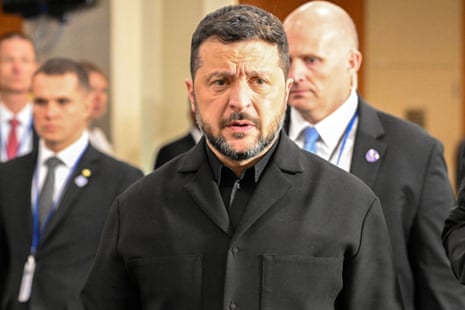
According to a report by the independent Russian news outlet Meduza, Zelenskyy replied over his shoulder “on a rocket”, before apparently adding an obscenity which cannot be heard clearly in the recording.
Meduza reported that the journalist was Valentin Bogdanov, a correspondent for the Russian state broadcasting company VGTRK.
It caught the attention of Kremlin spokesperson Dmitry Peskov, who responded to the incident during a briefing today. “Zelenskyy didn’t refuse to come to Moscow; at least, I haven’t heard that,” Peskov said, according to the Russian Tass news agency.
Plans to set up a global UN body on inequality modelled on the Intergovernmental Panel on Climate Change (IPCC) are likely to be proposed to a meeting of the UN general assembly in the coming months.
Speaking at an event on the sidelines of the general assembly in New York, left-leaning leaders from Brazil, Norway and Spain claimed momentum was building behind calls for a standing international panel on inequality that would recognise the issue as a global challenge threatening world security. Two G7 countries – Germany and Japan – have given public backing.
Joseph Stiglitz, the Nobel prize-winning economist, recommended the establishment of the new body in a report commissioned by South Africa for its G20 chairing last November. The dislocation caused by inequality was also the focus of the 2024 G20 meeting, chaired by Brazil.
But the proposal is likely to make little political headway during this year’s G20, to be led by Donald Trump, and some countries are wary of talk about new globally imposed taxes, or assertions that economic analysis can be compared to climate science.
Read more:
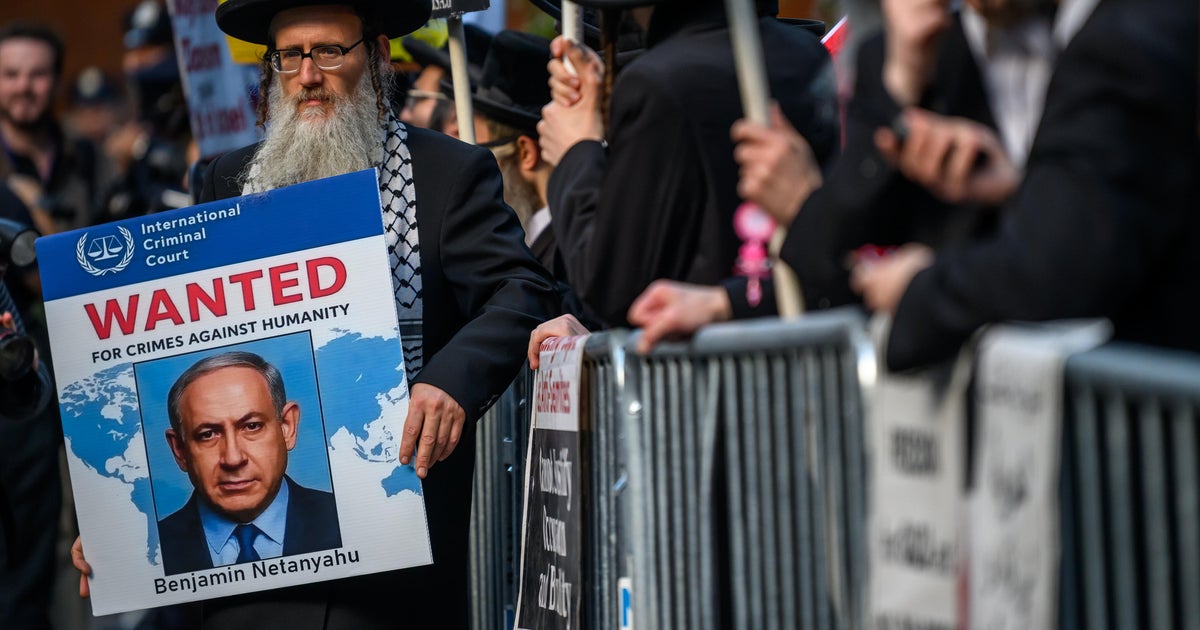
Some protesters have gathered in New York to demonstrate against the Israeli prime minister Benjamin Netanyahu ahead of his speech at the UN general assembly:
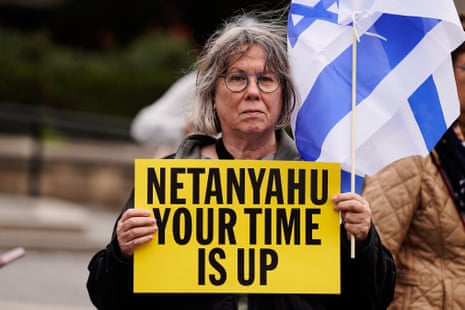
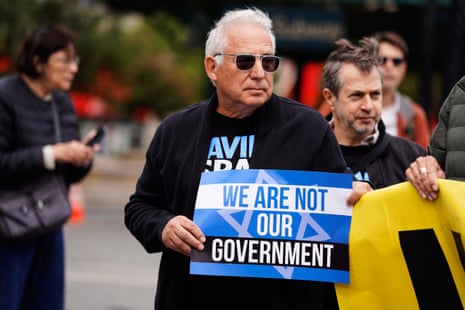
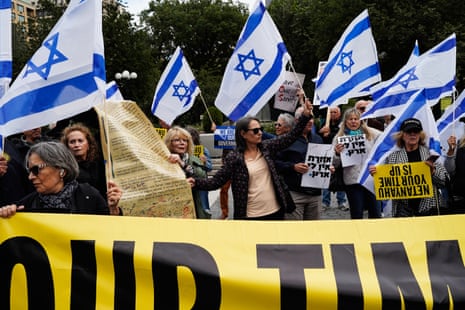
For a closer look at the realities facing Palestinians in Gaza, the Guardian is following five ordinary citizens through a week of their lives nearly three years after the war began.
The series, Gaza: a week in the life, documents their daily experiences, from displacement and power cuts to work, education and family life, offering a personal perspective on some of the issues Abbas addressed in his speech.
Today’s feature focuses on Mahmoud Seydam, a university lecturer who is overcoming internet cuts and power outages to continue providing an education to his students:
Abbas closed his speech by addressing the Palestinian people.
He said:
I address the sons and daughters of our Palestinian people in their homeland and in the diaspora. You have painted the greatest picture of pride and dignity by holding steadfastly onto your land, your unity, and your legitimate rights.
We will not leave our homeland, we will not accept displacement, and we will not allow anyone to decide our future on our behalf.”
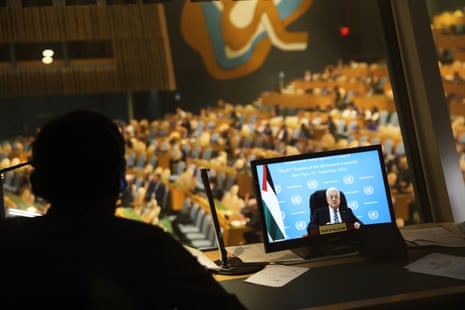
Abbas accused Israel of seeking to “expand its colonial project towards establishing the so-called Greater Israel and completely erasing Palestinian presence”.
He expressed particular gratitude to the UK for the measures it had taken “in order to protect the two-state solution” and ban settlement products.
He added:
We call upon president Trump to fulfil the commitments he made to the leaders of the Arab and Islamic states last September to prevent the annexation of Palestinian land and to reject displacement.
It is impossible to separate Israel’s land seizure practices from the dismantling of Palestinian institutions and the depletion of its financial resources. All of these are tools that lead to one same result – weakening our people’s ability to remain steadfast and stay on their land.”
Abbas said that while he welcomedDonald Trump’s 20-point peace plan for Gaza, he warned that its implementation was falling short and called for the next phase to be accelerated, with a clear timetable for a lasting political settlement.
He told the UN:
Regretfully, we have not seen any of this materialise on the ground. The Israeli killing and aggression continue to claim the lives of men, women and children in Gaza. Nearly a year has passed since the adoption of [the peace plan] and the establishment of the Board of Peace. And only one year remains of the designated transitional period before the end of 2027.
Therefore, we called for accelerating the implementation of the second phase rather than wasting any more time. The transitional period must not be allowed to become a permanent or open-ended situation without any clear time bound political horizon.
Rather, it must lead to the reunification of the Gaza Strip and the West Bank, including East Jerusalem, under the authority of the State of Palestine and its legitimate institutions, in accordance with the principle of one state, one government.
Abbas set out a stark account of the situation facing Palestinians, focusing on both Gaza and the occupied West Bank. He criticised Israel’s military campaign and settlement policies, and called attention to the destruction and humanitarian suffering caused by the conflict.
He said:
I speak to you today as the Palestinian people faces one of the most dangerous times of its history.
This is following long decades of historic injustice… Our people are being subjected at the hands of the Israeli occupation forces to killing, destruction, starvation and attempts at displacement, as well as a genocidal war that has created an unprecedented humanitarian catastrophe.
It has destroyed neighbourhoods, cities, camps, institutions, schools, universities, hospitals, mosques and churches. And it has targeted all the basic necessities of life and the future of entire generations.
In the West Bank, including East Jerusalem, settler expansion is accelerating. The West Bank is being fragmented, and Jerusalem is being isolated and utilised. Settler terrorism is escalating under the protection of the occupying forces, while the crimes of land theft, home demolition checkpoints and raids continue under a system of laws, measures and practices, all built on racial discrimination, ethnic cleansing and state terrorism.”
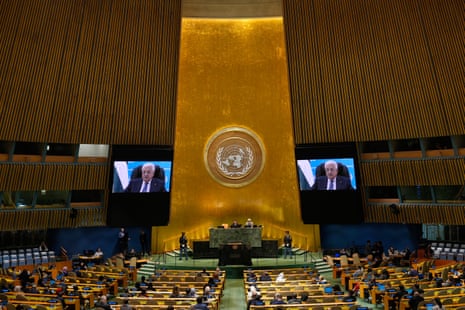
Mahmoud Abbas, the longtime president of the Palestinian Authority, is now addressing the gathering. He is delivering his speech via a pre-recorded video for the second year in a row, after the Trump administration refused to grant him a visa.
He said:
For the second consecutive year, the Palestinian delegation was denied the entry visas required to reach New York and participate in the meetings of the United Nations General Assembly in person. We reject these unlawful punitive measures, and we reject the accusations and justifications on which they were based.”
The state department said in a statement that the Palestinian Authority and the Palestine Liberation Organisation had “failed to live up to their commitments”, accusing the groups of “taking actions to internationalise the Israeli-Palestinian conflict including through the international criminal court and international court of justice” and of “glorifying terrorism” among other allegations.
Abbas denied the accusations, saying:
We affirm that we have fulfilled our obligations, carried out a comprehensive national reform programme, and upheld our commitment to international law, to shunning violence and terrorism, and to the two state solution and to peace on the basis of resolutions of international legitimacy.”
The US and Chinese leaders are expected to soon meet at the White House for talks (and, later, dinner), where they’re expected to discuss a range of issues.
The last time Xi was in the US for a state visit he was hosted by Barack Obama, more than a decade ago. You can follow the latest on those talks on our dedicated live blog:
Emmerson Mnangagwa, in his signature scarf in the colours of Zimbabwe’s flag, told the general assembly hall that the world was facing a “pivotal moment”, with conflicts spreading, climate shocks intensifying and technological advances outpacing the rules governing them.
The Zimbabwean president said:
As the current crop of leaders, it should concern us that today, somewhere, a child is born into war, a family is displaced by conflict, a farmer loses another harvest to drought, and the young person wonders whether technological progress will expand opportunity or deepen inequality.
Though separated by geography, these experiences reveal a common truth – humanity’s challenges are increasingly interconnected, and no nation can overcome them alone.”
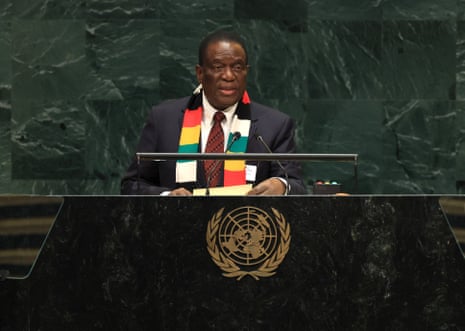
Here is the livestream of the third day of the UN general assembly, with the president of Zimbabwe, Emmerson Mnangagwa, scheduled to speak first. Watch here as we bring you the latest lines and updates:
The Guardian wp:paragraph
هلدینگ کاسپین استانبول | خرید ملک در ترکیه | صرافی معتبر ایرانی در ترکیه | خرید و فروش طلا در ترکیه | مهاجرت به ترکیه | واردات و صادرات در ترکیه | نیازمندیهای ترکیه | اخبار ترکیه | اخبار جهانی | توریست ایران | خدمات توریستی در ایران | تورهای گردشگری ایران | هلدینگ اول | خدمات کاریابی و فریلنسری و شغل | مرجع اطلاعات ایران (همه چیز در ایران) | کیف پول و خدمات مالی و پرداخت یار | اخبار ایران | تابلو زنده قیمت ارز در ترکیه و استانبول | صرافی آنلاین ترکیه | قیمت طلا و نقره در ترکیه | سرمایه گذاری در ترکیه | جواهرات در ترکیه | نرخ لحظه ای ارزها در استانبول | قیمت دلار امروز در ترکیه | قیمت دلار استانبول امروز | قیمت لحظه ای دلار | اخبار روز ترکیه استانبول | اپلیکیشن ISTEX | اپلیکیشن قیمت لحظه ای دلار و یورو و لیر و ارزها در ترکیه
/wp:paragraph wp:paragraph /wp:paragraph
About the Author