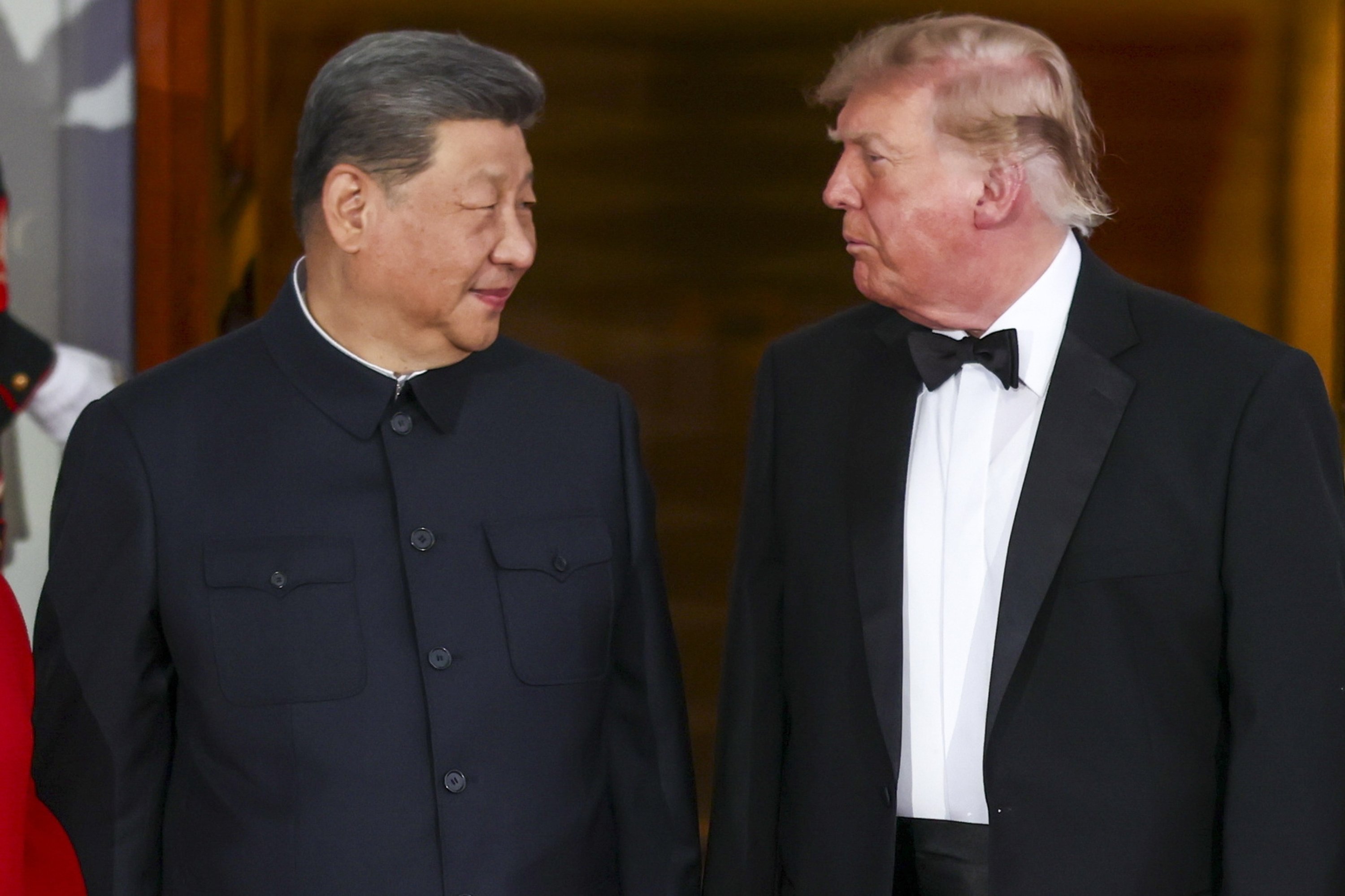
U.S. President Donald Trump treated Chinese leader Xi Jinping to pomp and pageantry Thursday, as the leaders of the world’s two superpowers met in Washington, D.C.
Talks on trade, artificial intelligence and the growing strategic rivalry between the countries were all in the spotlight during an elaborate state visit.
Here are the key takeaways from the keenly watched meeting:
Pomp over substance
Trump hailed his “great friendship” with Xi and pulled out all the stops to woo the Chinese leader, greeting him on the runway on his arrival, offering him a rare tour of the presidential helicopter, and gifting him a bald eagle statue.
The pomp, however, masked the lack of diplomatic breakthroughs.
“The pageantry was the point,” according to Ryan Hass at the Brookings Institution.
“When the troop reviews and opening ceremony are taken out of the schedule, the two leaders had less than two hours of direct meetings with each other,” he added.
Those meetings yielded “many new consensuses”, according to Xi – but the only concrete deals announced were a promise to invite 100,000 young Americans to China for exchanges, and lending two pandas to a zoo in Atlanta.
Instead, the meetings were meant to show that the two leaders could “effectively manage U.S.-China relations within tolerable bounds of competition”, Hass said.
Xi once again urged the two sides to avoid the “Thucydides Trap” – the theory that a rising power will come into conflict with an established one – but there was little sign of progress on thorny issues like Taiwan or artificial intelligence.
Trade deal extended, for now
One significant deal was the extension of the countries’ fragile trade truce, but only a short one.
U.S. Treasury Secretary Scott Bessent said the two sides agreed to extend by two months a trade agreement that ended last year’s trade war and was due to expire in November. The extension would give Washington and Beijing “more time to see what we can do on the economic front,” he said.
But rather than locking in a durable agreement, the extension appears to push the central questions – tariffs, Chinese purchases, rare-earth supplies and technology restrictions – into the next round of negotiations.
Bessent said Wednesday that Beijing was meeting its requirement in the earlier agreement to buy 25 million tons of soybeans but was lagging on its pledge to buy $17 billion in other agricultural goods. U.S. officials have said rare-earth deliveries were also falling short, another sign that significant gaps remain.
For companies, the result is a familiar form of instability: tariff rates remain lower for now, but decisions must still be made against a shifting policy backdrop.
“I think the Chinese would have hoped for a longer extension, but they are also realistic”, said Dylan Loh of Singapore’s Nanyang Technological University.
The truce would provide “some calm on the trade front”, he said.
Trump is “trying to stabilize relations for now until the U.S. can basically decrease its vulnerabilities to Beijing,” according to Jared Mondschein, Director of Research at the United States Studies Centre, University of Sydney.
Dress to impress
For Trump, Xi’s White House visit was an opportunity to show off a Washington being remade in his image.
After Xi treated Trump in Beijing to a tour around a Ming dynasty temple and a walled-off garden retreat rarely opened to foreigners, the U.S. president returned the favor with a different kind of spectacle: Troops wearing wigs and tri-corner hats marched in formation and played music in a Rose Garden redesigned to look like a Trump golf club.
Fighter jets and bombers roared overhead during ceremonies staged Wednesday and Thursday, one so loud it caused Trump to flinch.
When the White House press corps was called to cover the two leaders, it wasn’t to hear them talk about the weighty affairs of state. Instead, it was to watch them tour the Marine One helicopter and the recently redesigned South Lawn of the White House, replete with a large helipad emblazoned with the presidential seal.
Speaking to reporters, Trump brushed away questions about their policy discussions.
“He loves good granite,” Trump said of Xi. “Great meeting.”
Xi wants US ‘prudence’ over Taiwan
As expected, Xi pressed Trump on the Taiwan issue, saying, according to China’s official news agency, that Beijing hoped the United States would “handle the Taiwan question with prudence.”
The agency’s English-language service also wrote that Xi hoped the U.S. would oppose Taiwan independence.
That would be a tougher version of Washington’s long-standing formulation that it does not “support” independence. There are no signs that the Trump administration plans to change its wording.
There was no immediate White House readout of the exchange, but U.S. officials have long avoided explicitly stating opposition to Taiwanese independence. Any shift in language would raise questions about Washington’s resolve to defend the island and provoke opposition in Congress.
The island, which China claims and has vowed to bring under its control, relies on the U.S. for its defense.
A $14 billion U.S. arms package for Taiwan has been put on hold and is “under review,” U.S. Secretary of State Marco Rubio said Wednesday.
In May, Trump suggested the sales could be used as a bargaining chip with China.
Trump “has been willing to talk about the levels of arm sales in a way that previous administrations haven’t,” said Rana Mitter, professor of U.S.-Asia relations at the Harvard Kennedy School.
“But I don’t see any sign… there’s going to be a fundamental change in terms of U.S. assurances (to Taiwan),” he said.
Strategic risk
Xi, not for the first time while meeting Trump, invoked the “Thucydides Trap,” an academic theory that competition between a rising power and an established one tends toward war.
While the Chinese leader said the risk “can be overcome,” his reference underscored how concerns about a potential U.S.-China military conflict continue to shadow relations between the world’s two largest powers.
Xi argued that both nations stand to gain from cooperation and lose from confrontation, and he called for regular military dialogue and stronger crisis-prevention mechanisms.
Trump, for his part, drew on the two nations’ shared history to emphasize the potential for cooperation. They could accomplish much by pursuing common interests, he said, invoking their wartime alliance against Japan.
Differences on AI
The two leaders expressed diverging views about artificial intelligence.
Trump, who has declared that AI should be called super intelligence, or SI, has dismissed calls from tech leaders for regulations to “pace the frontier” of the technology.
He said in a social media post that he wants “to leave it exactly where it is” and rely on the U.S. Department of Justice rather than impose any new guardrails. He insisted that China held the same position.
But Xi said Thursday that, as leading nations on AI, China and the U.S. must manage its growth.
“We have both the capability and responsibility to develop and manage AI for good, and ensure that the development of AI is always under human control and serves the well-being of the people,” Xi said.
“There is some broad general agreement on the risks presented by AI, but they diverge on how to manage this”, according to Loh of Nanyang Technological University.
“Deep suspicions and intensifying competition” on AI mean breakthroughs on governing the technology are unlikely, he said.
Some of the biggest names in AI attended Trump’s state dinner at the White House Thursday for Xi, including Alphabet’s Sundar Pichai, OpenAI’s Sam Altman and Nvidia’s Jensen Huang.
Iran
Trump has repeatedly called on China to help extricate the U.S. from its conflict with Iran and reopen the Strait of Hormuz for shipping, calls Beijing has rebuffed.
China has also been accused of helping Iran target U.S. military assets in the Middle East.
On Thursday, Xi told the U.S. president to end the war and come to a negotiated settlement with Tehran as soon as possible, according to a Chinese readout of the talks.
“The idea that China is going to be a big power broker, appear publicly and negotiate solutions – I think that’s really unlikely,” said Harvard’s Mitter.
“I don’t think that China is going to be the magic card that gets the U.S. out of trouble in the region.”
DAILYSABAH
هلدینگ کاسپین استانبول | خرید ملک در ترکیه | صرافی معتبر ایرانی در ترکیه | خرید و فروش طلا در ترکیه | مهاجرت به ترکیه | واردات و صادرات در ترکیه | نیازمندیهای ترکیه | اخبار ترکیه | اخبار جهانی | توریست ایران | خدمات توریستی در ایران | تورهای گردشگری ایران | هلدینگ اول | خدمات کاریابی و فریلنسری و شغل | مرجع اطلاعات ایران (همه چیز در ایران) | کیف پول و خدمات مالی و پرداخت یار | اخبار ایران | تابلو زنده قیمت ارز در ترکیه و استانبول | صرافی آنلاین ترکیه | قیمت طلا و نقره در ترکیه | سرمایه گذاری در ترکیه | جواهرات در ترکیه | نرخ لحظه ای ارزها در استانبول | قیمت دلار امروز در ترکیه | قیمت دلار استانبول امروز | قیمت لحظه ای دلار | اخبار روز ترکیه استانبول | اپلیکیشن ISTEX | اپلیکیشن قیمت لحظه ای دلار و یورو و لیر و ارزها در ترکیه
About the Author