The Supreme Court has blocked Missouri for a third time from using a Republican-drawn congressional map in the November midterm elections, per the AP.
The justices granted a request by the map’s opponents to suspend lower court decisions that had required the reconfigured US House of Representatives district boundaries to be used in the 3 November midterm elections.
The back-and-forth is occurring as absentee voting is already underway in Missouri.
President Donald Trump is reportedly visiting Alabama for a political rally next week, Politico reports.
It’s a questionable move given the high stakes of this year’s midterm elections. With polls showing Democratic candidates holding a lead, rallying in a reliably red state like Alabama is a curious move.
Two people who spoke with Politico, which reported the news on Thursday, said the event is scheduled for 2 October in Mobile, Alabama, but the plans have not yet been finalized and are subject to change.
In a letter to Donald Trump, a group of more than a dozen senators on both sides of the aisle questioned Russian President Vladimir Putin’s invitation to the December G20 summit scheduled in Miami, expressing “serious concern” as the Russia-Ukraine war continues.
Senators including Mitch McConnell, John Cornyn, Sheldon Whitehouse, Roger Wicker, among others, signed the letter.
“We write to express our serious concern regarding reports that Russian President Vladimir Putin has been invited to attend the Group of Twenty (G20) Leaders’ Summit on December 14 and 15 in Miami, Florida,” reads the letter.
“President Putin bears sole responsibility for launching Russia’s full-scale war of aggression against Ukraine,” the letter continues. “Allowing him to participate in a G20 Summit in the United States raises serious concerns about legitimizing and normalizing a government that continues to attack Ukrainian civilian targets every day.”
The invitation was announced by Marco Rubio, the US secretary of state, during a press conference in New York on Wednesday.
Moments after Dale Caldwell resigned from his position as lieutenant governor of New Jersey, his lawyer Thomas Calcagni said in a statement that they would “continue to forcefully challenge the report” that accuses Caldwell of sexually harassing a staffer and violating state ethics rules.
Dr. Caldwell’s resignation, submitted to put an end to the targeted campaign to discredit his character, does not in any way diminish our outrage concerning the investigative process and its specious findings,” Calcagni said. “Counsel is fully exploring all legal remedies to ensure a true, balanced, and unbiased record.”
My colleague Ariana Baio is reporting the latest details on Caldwell’s resignation:
If the Beijing meeting between Donald Trump and Xi Jinping in May was the “stalemate summit”, the second round of talks between the presidents of the US and China this week seemed to give up entirely on the idea of breakthroughs.
Instead, it was described as a celebration of “diplotainment” rather than diplomacy, where pomp prevailed over progress and where one of the main outcomes was the news that two giant pandas would soon be sent from China to Atlanta zoo.
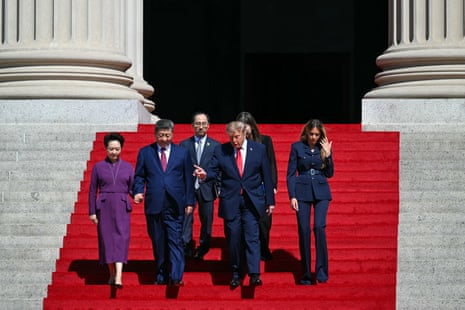
Trump rolled out the red carpet for Xi’s arrival on Wednesday and broke with decades of precedent to meet the Chinese leader at Joint Base Andrews. Thus began a three-day state visit that involved a tour of Trump’s new helipad and the Marine One helicopter, and a 90-minute meeting that Trump described as “great” and that revealed, according to Trump, that Xi “has great interest in granite”.
“The biggest takeaway is that Trump has been displaying an extraordinary degree of deference to Xi Jinping,” said Julian Gewirtz, who served as a senior China official in the Biden administration.
But what of actual substance? Expectations going into the summit were low. But the outcomes somehow still fell short.
One of the biggest issues in the US-China relationship is trade. Last year, as Trump unveiled successive rounds of tariffs on Chinese goods, the White House accused China of unfair practices that it said contributed to the loss of 3.7m US jobs and inflated the trade deficit. The tariffs were supposed to suppress the volume of Chinese imports to the US and put pressure on China.
To some degree, they worked. The US trade deficit with China in 2025 fell to $200bn, down from nearly $300bn in 2024. But experts have noted that some of this shortfall is made up for by Chinese goods being shipped to the US via third countries, a trend underlined by the fact that China’s trade surplus surpassed a record $1tn last year.
With the US and China accounting for 43% of global GDP, their trade war has far-reaching implications for the world economy. So it was a relief not just to Beijing and to US consumers when the two countries agreed a temporary truce in Busan last year.
That truce is due to expire in November. China, where the economy is heavily reliant on exports, was reported to be pushing for the truce to be extended until the end of Trump’s term, in January 2029.
On Thursday, it was revealed that Xi’s first state visit to the US in more than a decade had resulted in a mere two-month extension. That reflects “the lack of preparation for this summit beyond the pomp and circumstance”, said Neil Thomas, a senior fellow at the Asia Society.
William Yang, a senior analyst at the International Crisis Group, said: “This summit largely achieved symbolism and ritualism over substance. That is very clear.” The short extension “reflects the level of fundamental differences that still exist between the two countries over a variety of issues”.
China’s most powerful response to Trump’s tariffs was the decision to block the export of rare earths, critical minerals vital to US manufacturing and military supply chains. That seemed to skewer Trump’s leverage over China.
Gewirtz said: “Beijing’s retaliation … seems to have had a profound effect on [Trump] and his administration’s willingness to take risks vis-a-vis China.”
Apart from the trade war agreement, the summit failed to achieve any meaningful progress on thorny issues in the US-China relationship such as artificial intelligence, Taiwan, the wars in Iran and Ukraine, and human rights.
On Taiwan, which Beijing considers to be the most important issue in the relationship, Xi put pressure on Trump to weaken the US’s support for the self-governing island that China claims as its own. According to the Chinese readout of the Xi-Trump meeting, Xi told Trump he hoped “the US side will adhere to the correct position of opposing Taiwan independence”.
For the US to state that it “opposes” Taiwanese independence would be a rhetorical shift from the current position of “does not support” such a claim, and would be a move welcomed by Beijing. Trump has not yet commented on whether he agreed to such a statement. But it does seem he is no closer to approving a $14bn arms sale package for Taiwan, a sale that Beijing would like to see disappear completely.
On Thursday, US Senate Democrats lambasted Trump for opting for “pageantry over purpose” and for failing to deliver agreements on “the economic and security issues that will shape America’s future”. Trump ignored recent warnings about the dangers posed by AI, writing on social media on Thursday: “I want to leave it exactly where it is,” adding: “That is China’s position also.”
For China, the lack of big news from the visit is a win in itself. “The summit went excellently from the Chinese perspective,” Thomas said. Xi “got a huge amount of respect from the American president, the full state visit treatment [and] really great images beaming back to China of the Chinese and the American presidents interacting as peers on the global stage, without having to make any meaningful concessions or compromises.”
New Jersey Governor Mikie Sherrill announced this afternoon that Dale Caldwell, her lieutenant governor, had resigned in light of an ethics probe that concluded he had sexually harassed a staffer and violated ethics rules.
Caldwell, a pastor and former university president with a long career in education, was found to have broken the rules of his office when he lobbied for a promotion for a government employee who he was in a romantic relationship with, and brought guests to ticketed events without paying, according to the report commissioned by Sherrill’s office . He also allegedly made romantic advances on the friend of a young female staffer in that staffer’s presence, and, when declined, told the staffer: “you young women are looking for young sperm.”
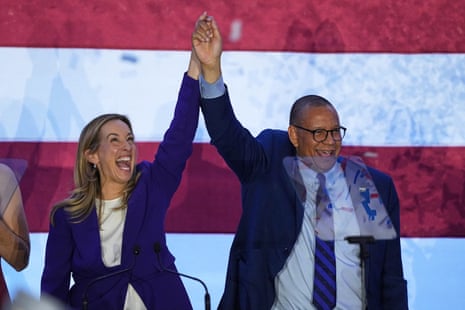
The findings of that report prompted Sherrill, a Democrat, to request Caldwell’s resignation on Thursday when she publicized the report’s findings.
In an interview with The New York Times before Sherrill’s press conference, Caldwell insisted he was not resigning because of the report, whose contents he disputed.
“It’s false,” Caldwell said of the report to the outlet. “I’m resigning because I don’t want to be a distraction to the administration.”
In a post to social media shortly after Xi Jinping’s departure from the White House, Trump confirmed that he planned to meet twice more with the Chinese president this year.
Trump said he first planned to meet President Xi in China during November’s Asia-Pacific Economic Cooperation summit, scheduled to take place in Shenzhen. They’ll meet again in December during the G20 in Miami.
“The meeting was one of Friendship, Strength, and Success, for both China and the USA,” Trump said.
He added: “Much has been, and will be, accomplished. I look forward to our next meeting!”
The statement is a friendly coda to Xi’s first official state visit (the most formal designation such a diplomatic trip can receive) since the tail end of the Obama administration, in which Trump gave the Chinese leader an uncharacteristically warm welcome, including a red carpet greeting on the tarmac and a lavish dinner filled with dignitaries, Trump allies and business executives.
The pleasantries may have papered over long-simmering tensions between the two countries, but what conclusions, if any, were reached during the pair’s White House talks remains unclear.
Trump has said the two sides discussed the Iran war, as the administration seeks China’s buy-in to a plan to economically isolate the country. Artificial intelligence was also a subject of conversation (Xi, Trump said in an earlier post, seemed on board with his push to rebrand the technology as “SI,” or “super intelligence.”)
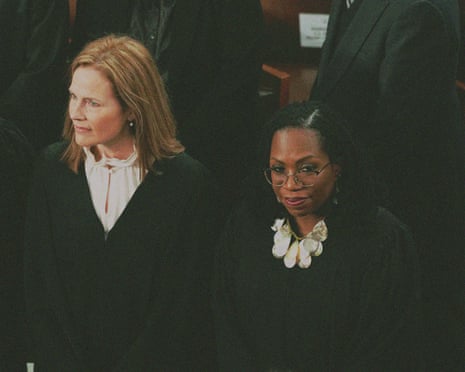
US supreme court justice Ketanji Brown Jackson acknowledged serious concerns about her colleagues’ handling of emergency requests, the method Donald Trump often uses to seek approval from the court.
Jackson, one of the three liberal members of the supreme court, criticized the justices’ willingness to issue rulings via the “shadow docket”, saying it undermines the public’s faith in the judicial system.
“There is a serious concern that the supreme court’s modern stay practices are having a disruptive and potentially corrosive effect,” Jackson told faculty and students at the University of the District of Columbia’s David A Clarke school of law on Thursday.
Her comments came just hours after the Trump administration filed its latest emergency request – this time asking justices to allow officials to continue deporting immigrants to countries other than their own.
The emergency docket, sometimes also referred to as the “shadow docket”, is where plaintiffs can request immediate relief from the supreme court in consequential cases.
Justices can quickly grant or dismiss requests without conducting the same legal review that is typically required in merit cases or providing a lengthy explanation to the public.
The Trump administration has used the method to rapidly push forward the US president’s agenda. Since returning to office in January 2025, the administration has filed more than 30 emergency requests. Many have been granted.
Via emergency requests, the conservative wing of the supreme court has allowed Trump to temporarily end protections for migrants seeking asylum, eliminate transgender rights, roll back environmental protections, fire the officials in charge of independent federal agencies and more.
The justices have faced criticism for their handling of emergency requests from members of Congress and the public.
However, in July, justice Elena Kagan, another member of the liberal wing of the court, told Congress that she thought they were improving its handling of requests by providing some justification.
Jackson pointed to that on Thursday, telling the audience that while the court “began to explain more”, it was “still not the full kind of explanation” that cases receive on the merits docket. “If we’re not careful, the emergency docket can and will become an end-run around the standard review process,” she added.
As Jackson critiqued the court’s current methods, which have become more prominent under the second Trump administration, three of her colleagues dined with Trump and Chinese president Xi Jinping at the White House.
Chief justice John Roberts and justices Brett Kavanaugh and Amy Coney Barrett joined other officials for the state dinner to welcome Xi.
Diplomatic editor
Iran’s seven-day timetable to reopen the strait of Hormuz and start talks on its nuclear programme has been pitched as a deal that could rapidly extricate Donald Trump from a political crisis but requires the US president to make difficult concessions.
In the five days left before the proposed reopening of the strait, which is expected to relieve pressure on global energy markets, Trump would need to lift Iranian asset freezes, permit Iran to export its oil and, probably most difficult of all, order Benjamin Netanyahu to end Israel’s attacks on Hezbollah in Lebanon, thus achieving the “ceasefire on all fronts”.
Iranian diplomats in New York said they thought a three-hour meeting earlier this week with the US envoy Steve Witkoff in which they laid out the seven-day plan was productive, but were doubtful the US would deliver.
Iran nevertheless feels it has done the diplomatic spadework, taking the proposal to China for endorsement and ensuring that Oman, located on the south side of the strait, was also on board.
The foreign minister, Abbas Araghchi, explained that the idea was to take the elements of the Iran-US memorandum of understanding that Trump signed in June and repackage and accelerate the process since, as they understood it, Trump had come to hate the MoU.
“The conditions we have asked the US to meet is nothing new, nothing more than what was already in the Islamabad agreement, which was signed by the US president,” Araghchi said. But what is new is the speed.
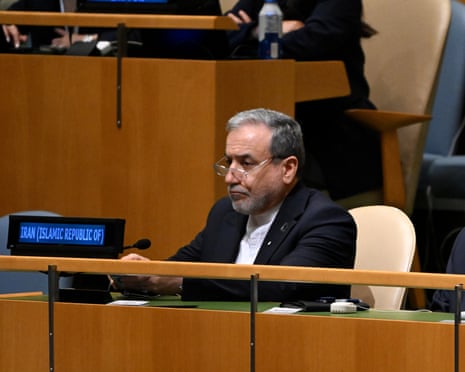
In the first four to five days under this timetable, the US would have to lift the naval blockade on Iran’s oil ports, restore the waiver that lifted sanctions on Iran’s oil exports, end the war on all fronts and permit the release of some of Iran’s frozen assets.
On the sixth day, the strait of Hormuz would be reopened by Iran, with ships using a new route designated by Oman and Iran. And on the next day, negotiations would start on the future of Iran’s civil nuclear programme, including a protocol to allow UN nuclear inspectors back in to look at Iran’s damaged sites and the stockpile of highly enriched uranium. This accelerates the point at which nuclear talks would begin, from 60 days in the June agreement to seven.
It is a difficult deal for Trump to swallow since the strait would reopen largely on Iran’s terms, with the new route predominantly going through Iranian waters. Saudi Arabia is also concerned that the route deal is bilateral between Iran and Oman, and not with the Gulf states as joint signatories.
Trump says he has a choice to make between the annihilation of Iran and engagement – an engagement that, he says with typical hyperbole, could make Iran one of the great countries of the world. In reality, the judgment he has to make is more prosaic. Is he prepared to go back to war with Iran after the midterms and, if not, does he believe the US can squeeze the Iranian economy so hard that the leadership will succumb.
Earlier today, the primary White House television pool resumed filming administration events the day after a court ruling temporarily overturned a Trump administration ban on CNN.
In an unprecedented move, the pool – which also includes NBC, ABC, CBS and Fox News – ceased recording and transmitting White House footage on Monday, in solidarity with CNN, MS Now and Politico, which had been banned by Trump from the building over what he said was “their constant ‘reporting’ FAKE NEWS.”
The decision meant that, for much of this week, there was no high-quality pool footage of White House events and the president’s movements, though some smaller outlets attempted to provide coverage.
With the pool still inactive yesterday afternoon, that meant that a significant presidential event, a summit with Xi Jinping, China’s president, did not receive video coverage on the leading television networks. ABC had been listed as the TV pooler for the day, but held off until the network received assurances that CNN would be let back into the pool.
Tensions between the media and the administration were further exacerbated yesterday evening when journalists for CNN and MS Now were denied access to the White House state dinner in honor of Xi. The journalists were blocked despite a ruling earlier in the day from a federal judge who granted a request by CNN, MS Now and Politico to force the White House to restore their access for the next two weeks while the case plays out.
Although television networks remain apprehensive, a producer for CBS News confirmed that the network would be serving as the TV pooler for the day as scheduled, according to an internal note obtained by the Guardian.
“The plan is to return covering the President in a normal capacity with a full crew,” the note read, with the pool covering Trump and Xi arriving at the South Portico for tea and a tour of the National Archives.
Pamela Brown, a CNN anchor, told viewers this morning:
CNN’s access to the White House has been restored, and the TV pool appears to be functioning as normal.
The resumption ends – for now – an extraordinary standoff between the US’s biggest media companies and the Trump administration that led to an effective TV blackout of coverage of the president during the United Nations general assembly.
The US supreme court has lifted restrictions on a controversial federal voter database before November’s elections, granting Donald Trump a temporary win in his aggressive campaign against non-citizen voting.
The emergency order allows states, for now, to use the Department of Homeland Security program, called Systematic Alien Verification for Entitlements, or SAVE, in their efforts to verify the eligibility of voters on their rolls.
The court’s three liberal justices publicly dissented from the decision.
The order puts on hold a federal judge’s June ruling that had deemed the Trump administration’s recently revamped version of SAVE illegal. US district court judge Sparkle L. Sooknanan had blocked the use of the tool, saying it violated Americans’ privacy rights and could result in voters being wrongly removed from the rolls.
A federal appeals court let her order stand.
But the supreme court majority found that a 1996 law explicitly allows DHS to get information about citizenship and immigration from other federal agencies. The federal government also has “an obligation to respond” to states seeking to verify citizenship.
“The order below prevents the Federal Government from using the program it believes is best suited to the task,” the majority wrote in the unsigned order.
Justice Ketanji Brown Jackson dissented, joined by Justices Elena Kagan and Sonia Sotomayor. The database has long been seen to fall under federal privacy laws, she wrote, and there are real risks that legitimate voter registrations could be mistakenly revoked.
Jackson wrote:
The harm caused by burdening or disenfranchising even a few lawful voters outweighs the nonexistent harm that the Government experiences when it is prevented from taking an action that it likely lacks the authority to take.
The plaintiffs and counsel team in the case called the ruling “profoundly disappointing” and said it puts “millions of Americans at risk of being unlawfully targeted by the administration’s unreliable voter purge database” before the midterms.
“However, this case is not over,” their statement read, as quoted by the Associated Press. “The D.C. district court ruled that the expanded SAVE program violated multiple laws. We will be doing everything in our power to protect Americans’ voting and privacy rights by ensuring that the district court decision stands.”
During President Trump and Xi Jinping’s shared tour of the National Archives, Trump said that he and the Chinese president had discussed the war in Iran.
“We did,” Trump said, when asked about the subject by a reporter during a tour of the National Archives. In response to a follow-up question about what progress had been made, he added: “I think we’re gonna do great.”
Earlier this morning, David Perdue, US ambassador to China, said that Trump had shared with Xi during their White House meeting Thursday that it would be “unacceptable” for China to support Iran during the US military campaign against it.
During the brief tour of the National Archives, Trump and Xi viewed the Declaration of Independence, Constitution and Bill of Rights.
The warm rapport between the two men persisted through the final day of the visit, with Trump saying that he and Xi were together “charting the course for the great ship of China and US relations”.
Earlier, during their meeting for tea at the White House, Trump seemed to welcome an invitation to visit Xi in China, possibly at the Asia-Pacific Economic Cooperation meeting in Shenzhen in November.
“We will.” Trump said in response to the invite. “And we’ll be speaking a lot.”
Trump’s remark during tea with Xi Jinping that farmers would be “very happy” about his talks with China comes as the GOP, staring down the midterm elections, worry about losing ground with their rural voters.
Top Republicans have in recent days pressed the president to take action to bring down the price of diesel, surging due to the Iran war’s disruptions to the international fuel supply, which has hit farmers especially hard. Those calls have led the administration to weight an embargo of exports of diesel fuel from the US.
The Guardian wp:paragraph
هلدینگ کاسپین استانبول | خرید ملک در ترکیه | صرافی معتبر ایرانی در ترکیه | خرید و فروش طلا در ترکیه | مهاجرت به ترکیه | واردات و صادرات در ترکیه | نیازمندیهای ترکیه | اخبار ترکیه | اخبار جهانی | توریست ایران | خدمات توریستی در ایران | تورهای گردشگری ایران | هلدینگ اول | خدمات کاریابی و فریلنسری و شغل | مرجع اطلاعات ایران (همه چیز در ایران) | کیف پول و خدمات مالی و پرداخت یار | اخبار ایران | تابلو زنده قیمت ارز در ترکیه و استانبول | صرافی آنلاین ترکیه | قیمت طلا و نقره در ترکیه | سرمایه گذاری در ترکیه | جواهرات در ترکیه | نرخ لحظه ای ارزها در استانبول | قیمت دلار امروز در ترکیه | قیمت دلار استانبول امروز | قیمت لحظه ای دلار | اخبار روز ترکیه استانبول | اپلیکیشن ISTEX | اپلیکیشن قیمت لحظه ای دلار و یورو و لیر و ارزها در ترکیه
/wp:paragraph wp:paragraph /wp:paragraph
About the Author