Home – CBSNews.com
Add CBS News on Google
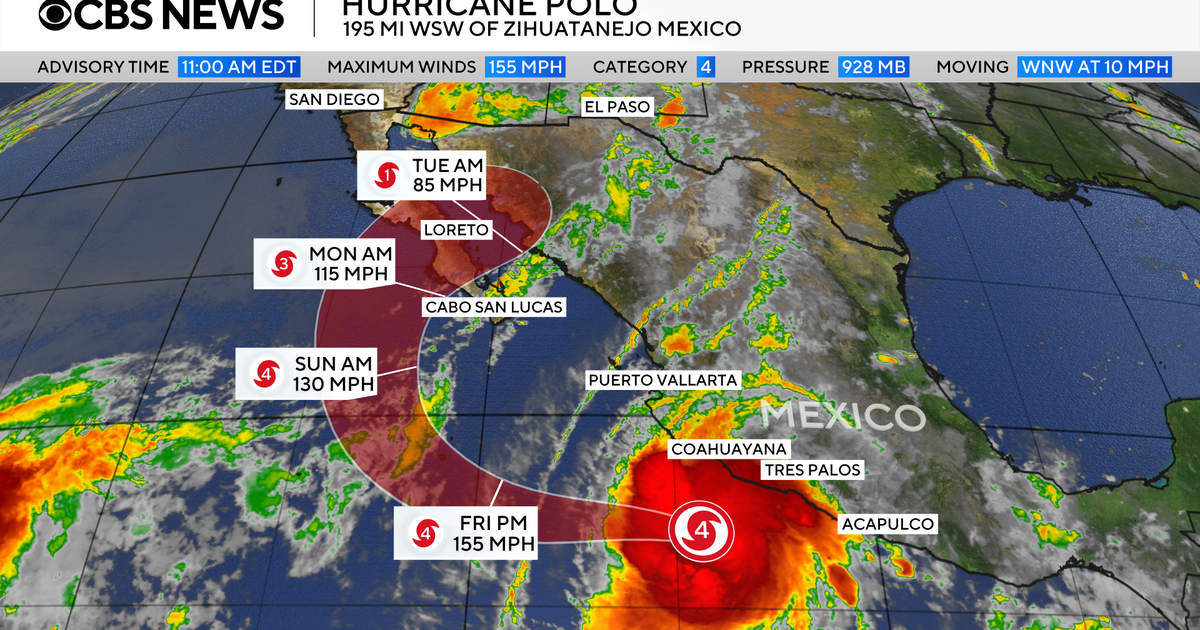
Communities in Mexico’s Baja California Sur are preparing for the arrival of Hurricane Polo, which remains a major hurricane even after its downgrade to a Category 3 storm earlier this weekend.
The storm’s intensity has fluctuated as it swirled hundreds of miles off Mexico’s southwestern coast early Sunday, but it was still expected to make landfall as a strong storm in Baja California on Monday, the Miami-based National Hurricane Center said. A hurricane warning is in effect for a stretch of northwestern Mexico from Punta Abreojos to Santa Fe in Baja California, the east coast of Baja California Sur, from Loreto to Santa Rosalia, and in mainland Mexico from Guaymas to Huatabampito.
The storm had maximum sustained winds of 125 mph at the hurricane center’s latest update. Hurricane-force winds were extending outward up to 45 mph from the center of the storm, while tropical storm-force winds extended outward up to 105 mph.
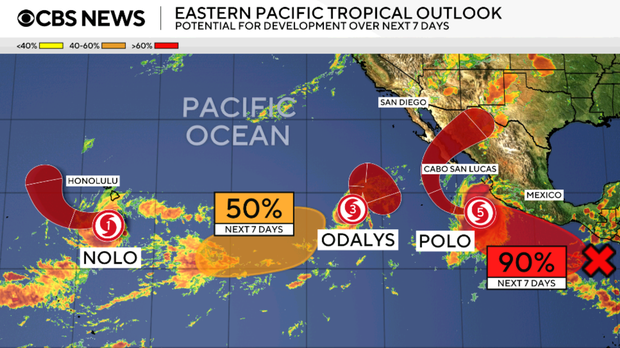
Elsewhere in the Pacific, Hurricane Nolo moved past Hawaii’s Big Island this weekend, bringing heavy rain and winds.
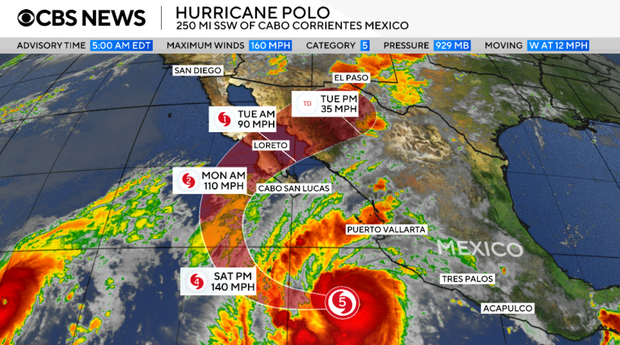
Maps show Hurricane Polo’s projected path
Polo’s core on Sunday was about 260 miles west of Cabo San Lucas at the tip of the Baja California peninsula. It was heading north at 12 mph.
The storm is expected to move northward over the next few hours. By Monday, Polo is forecast to turn northeast and make landfall in Baja California Sur and then move across northwestern mainland Mexico by Tuesday.
The State Department, citing forecast models, said the storm is expected to weaken to a Category 1 storm before making landfall. It will then continue northeast into southern Sonora, the State Department said. The hurricane center noted, however, that despite weakening, Polo is still expected to be a “strong hurricane” when it reaches Baja California Sur.
CBS News/Nikki Nolan
Polo could produce 4 to 8 inches of rain, and up to 10 inches in isolated areas, across parts of Baja California Sur, the hurricane center said, cautioning the rain “may produce life-threatening flooding and mudslides, especially in areas of steep terrain.”
Along with the hurricane warning, tropical storm warnings were also in place for the west coast of Baja California Sur, north of Punta Abreojos to Punta Eugenia; the east coast of Baja California Sur, north of Santa Rosalia to Bahia San Juan Bautista; the east coast of Baja California Sur, south of Loreto to San Evaristo; and mainland Mexico north of Guaymas to Bahia Kino and south of Huatabampito to Topolobampo.
Hurricane watches were also in place for those areas.
CBS News/Nikki Nolan
Polo-generated swells will affect the southwestern Mexican coast over the next couple of days, spreading north along the coast of the Baja California peninsula through the weekend, the hurricane center said, warning that swells are “likely to cause life-threatening surf, rip currents, and coastal flooding.”
Mexican leaders ordered evacuations, opened shelters and deployed military troops to areas that could be affected by the storm.
Classes were suspended at schools across the city of Acapulco, along the coast of Guerrero, its municipal government announced. Shelters across the state remained open, and officials said they were coordinating with local and national authorities to prepare for additional impacts of the hurricane.
Polo’s extreme rapid intensification
Polo underwent what’s called extreme rapid intensification, in which a storm’s wind speeds increase by 58 mph or more over the course of 24 hours, between Sept. 21 and Sept. 22.
Its intensification was dramatic even by those standards, with winds that skyrocketed from 45 mph on the morning of Sept. 21 to 150 mph at around the same time the following day. The hurricane center described the storm’s transformation as “truly remarkable.”
Its maximum sustained winds climbed as high as 180 mph at one point, far exceeding the 157 mph threshold for Category 5, the strongest on the hurricane scale.
Polo’s central pressure — an indicator of its strength and potential destructiveness — made it the second-strongest hurricane on record in the Eastern Pacific, behind 2015’s Hurricane Patricia. The storm’s wind speeds tied 2009’s Hurricane Rick as the third-strongest on record for the region.
Unusually strong El Niño conditions this year have been amping up tropical cyclone activity in the Pacific, with warmer waters, moist air and less wind shear enabling storm formation.
wp:paragraph
هلدینگ کاسپین استانبول | خرید ملک در ترکیه | صرافی معتبر ایرانی در ترکیه | خرید و فروش طلا در ترکیه | مهاجرت به ترکیه | واردات و صادرات در ترکیه | نیازمندیهای ترکیه | اخبار ترکیه | اخبار جهانی | توریست ایران | خدمات توریستی در ایران | تورهای گردشگری ایران | هلدینگ اول | خدمات کاریابی و فریلنسری و شغل | مرجع اطلاعات ایران (همه چیز در ایران) | کیف پول و خدمات مالی و پرداخت یار | اخبار ایران | تابلو زنده قیمت ارز در ترکیه و استانبول | صرافی آنلاین ترکیه | قیمت طلا و نقره در ترکیه | سرمایه گذاری در ترکیه | جواهرات در ترکیه | نرخ لحظه ای ارزها در استانبول | قیمت دلار امروز در ترکیه | قیمت دلار استانبول امروز | قیمت لحظه ای دلار | اخبار روز ترکیه استانبول | اپلیکیشن ISTEX | اپلیکیشن قیمت لحظه ای دلار و یورو و لیر و ارزها در ترکیه
/wp:paragraph wp:paragraph /wp:paragraph
About the Author



