Norma Bowe pressed a stethoscope against the 10-year-old’s chest, listening to her lungs.
It was Memorial Day outside Delaney Hall, an immigration detention center in Newark, New Jersey. The child, worried about her father locked inside, was hyperventilating.
Norma, a professor and registered nurse who had previously worked in emergency rooms, told her to breathe deeply as she checked for wheezing.
Through the building’s opaque windows, Norma could make out the silhouettes of detainees pressing their bodies against the glass. Several hundred had recently gone on hunger strike over rotten food, metallic-tasting drinking water, and a lack of access to medications, toilet paper and menstruation products.
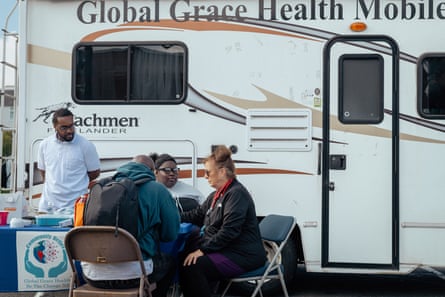
For the past year, Norma had parked her brown-and-beige camper van outside Delaney’s gates most weekends. Converted into a mobile clinic, it was stocked with sutures, glucometers and trauma and CPR kits, and offered health checks to families and protesters. That day, the clinic was busier than usual.
“Can you come over here?” someone asked.
Norma followed, thinking a person may need first aid. Instead, she encountered a wall of two dozen ICE agents in paramilitary vests, carrying batons, tasers and firearms, most of their faces masked.
Protesters faced them, some holding phones in the air to record the scene.
The sounds of drums echoed. Then, someone screamed.
Norma looked down and saw a federal agent dragging a young woman across the ground, her bright pink shirt ripping off, until she was down to a black bra.
“Help me!” the young woman shouted.
Decades earlier, as a psychiatric nurse, Norma had watched colleagues reach for restraints and sedatives when patients became violent. Her instinct was different: “No, let me talk to him.” She would sit beside them and try to calm them down.
Now that same instinct kicked in: de-escalate the situation and help the woman being dragged across the ground. Norma felt herself going into “mom mode”, moving closer.
That’s when someone from behind yanked her up. An ICE agent in a cap, black facemask, and gloved hands reached for her arms from behind her. She felt her body fling through the air.
Norma’s body barreled hard on to the sidewalk face down, as someone screamed: “Dr Bowe!”
Bystanders tried to help. One yelled: “She’s a medical professional!”
At 69, Norma knew what it felt like to be thrown like a sack of trash. She had been abused as a child, an experience that helped propel her toward a life caring for others. But now the violence came from an ICE officer, flinging her “like a javelin”, as she would later describe.
Five months earlier, Norma had been horrified by the killing of another nurse, Alex Pretti, when ICE shot him to death after he stepped in to help a woman shoved to the ground by federal agents on a Minnesota street.
As Norma felt her own face slam against the concrete, she thought about Pretti. And she thought about death.
What does it take for an ordinary person – a nurse, journalist, construction laborer or cemetery worker – to seek justice after being harmed by a federal agent?
The question is becoming increasingly urgent as ICE arrests have surged since the summer. A recent ACLU report in eight states found that over 400 of more than 1,200 incidents involved misconduct by agents, including use of force with batons or grabbing people by their necks.
But taking legal action against a federal officer – especially when ICE agents operate from unmarked vehicles, often masked and without visible names or badges – is harder and more convoluted than suing local police.
A claim against city law enforcement will typically identify the officers involved and requests police records and body-camera footage (depending on state public record laws). The municipality can take about 45 days to reply before the plaintiff can then file a lawsuit, which may lead to a jury trial.
Claims involving ICE are much more constrained. Most people must first file under the Federal Tort Claims Act and wait up to six months for a response before they can file a lawsuit.
These “are essentially negligence claims”, said Joanna Schwartz, a professor at UCLA school of law. “They’re brought against the United States, and not against individual officers.” The case is then decided by a judge, not a jury. There is no entitlement to punitive damages.
As lawyers receive more training in bringing such claims, Schwartz expects their number to grow.
It is an uphill battle. Staying the course requires a measure of courage, money and persistence. Yet an increasing number of lawyers are also taking cases pro bono as people try to exercise their rights within a narrow legal window.
In July, the ACLU simultaneously filed 54 claims in 17 states and Washington DC against the federal government on behalf of people who have suffered violence, abuse and neglect at the hands of federal law enforcement.
One of those claims was filed on behalf of Norma Bowe, whom I first met nearly two decades ago.
I first saw the video of Norma careening like a busted mannequin to the ground on Facebook. She posted it after her release from the emergency room.
Viewing the footage felt like watching someone hurt my own auntie. I met Norma in 2008, after stumbling across her “death class” at Kean University, which at the time had a three-year waiting list. I spent the next several years shadowing her classes as she took students into cemeteries, prisons, autopsy rooms and crematories, teaching them to face death in order to better understand life. In 2014, I published a book about her work.
We stayed in touch. I sent congratulations when she became a grandmother; she did the same when I became a mother. I knew she has long felt called to serve people who need care or someone to advocate on their behalf.
Ever since the 2020 pandemic, Norma had been operating the mobile clinic with grant funding and donations, offering free health checkups to undocumented and uninsured people at shelters or community hubs: Covid vaccines, checks for blood pressure diabetes, blood glucose levels or cancer, mental health screenings, stroke assessments. She spent her days at Kean University, teaching the death class, as she has every semester.
She knew it was risky to stand up to ICE, considering its rogue and aggressive tactics, and especially given the backlash she had already received.
“I am just back home after the ER,” Norma wrote that day on Facebook. “These agents have no control and they do what they want with no impunity. The conditions in Delaney Hall are horrible. The water is poisoned. The food has worms. There is inadequate medical help.”
Norma’s post received 24,000 comments, and her notifications exploded with comments from trolls.
“Stay the hell away from ICE doing their job,” one wrote. “You got all you deserved. Stupid libturd.” Another: “You should have had your fucking head bashed in with a fucking night stick.”
When I posted a comment expressing support and concern, others piled on, zeroing in on my Asian last name: “How do you think Japan would or is handling their illegal problem. Wake the fuck up.” And another wrote to me: “GO BACK TO CHINA.”
Norma signed up for DeleteMe, a service that journalists also recommend, which scrubs personal data from the internet.
The choice to take legal action against the federal government is intimidating and onerous. And as a white woman who holds tenure at her university, Norma told me she knows she has better security and protections than most.
But the vitriol against her felt minor when she thought of what was happening to others on the streets of her own state.
“If this is what they’re doing to me outside with impunity,” she said, “what the heck are they doing to the people inside?”
Last May, Norma celebrated one of her students who received magna cum laude honors. A few days later, ICE agents picked up the same student’s husband on his way to work.
He ended up at Delaney Hall, and the student went from her graduation ceremony to visit him while still wearing her cap and gown.
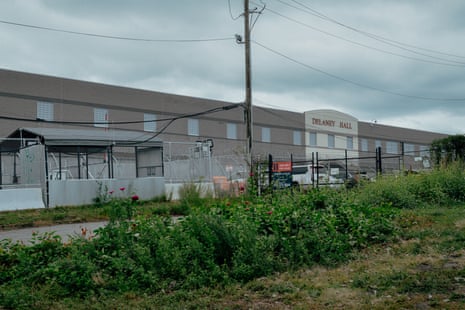
Delaney Hall had just reopened that same month to house more than 1,000 people under Donald Trump’s ramped up immigrant deportation initiative. The two-story site previously served as a halfway house and detention center before closing in 2023. Geo Group, one of the largest private for-profit prison operators in the US, now runs the detention center under a 15-year, $1bn federal contract.
That same month, Newark’s mayor, Ras Baraka, also visited the facility, along with other congressional state representatives, including LaMonica McIver. She stood between the mayor and agents, who yanked Baraka’s hands behind his back in handcuffs as he repeated: “I’m not resisting.”
ICE arrested Baraka for trespassing and held him in custody for five hours, later dropping charges. But the government claimed in a lawsuit that McIver had “slammed” one of the agents. The congresswoman was charged with three felony counts of assaulting federal agents, a case she is still fighting.
New Jersey’s governor, Mikie Sherrill, visited Delaney Hall the next day. “I say this as a former federal prosecutor: these are the hallmarks of a secret police,” Sherrillsaid in a statement. “They are acting in service to a political agenda, rather than the rule of law, and they are operating without accountability.”
As the weeks stretched on, Norma’s student shared reports from visits with her husband inside. Many of the prisoners were sick. The cells, freezing. The water tasted funny and smelled bad.
By now, Norma was visiting Delaney Hall with the mobile clinic a couple of Saturdays a month, handing out water, food, blankets and baby formula to waiting families, offering checkups, or chairs for people to sit. She listened to everyone’s stories.
One family told her they couldn’t get a man’s bladder cancer medication inside, and without it he could die soon. Norma tried to make a plea to ICE officials to let her into Delaney to administer his medication – to no avail. Another detainee had recently undergone spinal surgery, and his wife told Norma he needed antibiotics and physical therapy. Some explained to Norma that their loved ones locked inside were complaining of rashes, vomiting, or flu.
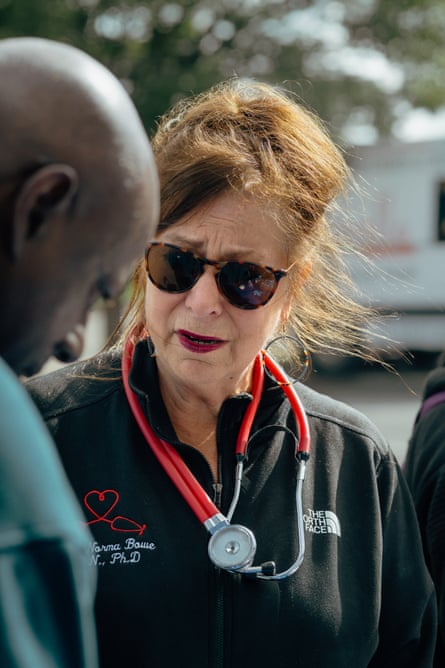
“I found myself writing a lot of medical letters,” Norma said. Families tried to carry these letters inside hoping to get treatment or medical care for detainees. But they came back defeated.
On 12 December, Norma learned that a 41-year-old, Jean Wilson Brutus, died after a day in custody at Delaney Hall on 12 December. ICE said he experienced an unexplained “medical emergency” and died from “natural causes”.
By winter, at least seven people detained inside of Delaney Hall had gone on a hunger strike. One person had been “subject to force feeding, hydration, or forced urinary catheterization, or involuntary blood draws”, according to a document published by the ICE Health Service Corps.
Delaney Hall was not an outlier. That May, ICE agents detained Elton Purvis at Boston Logan international airport. A Rastafarian priest, Purvis was taking medication for malaria and diabetes at the time. Yet in custody, Purvis said he was repeatedly denied his prescriptions, according to his federal claim.
In detention, Purvis suffered from chills, fever, and heavy sweating. Seven days after his detainment, he was hospitalized. It took several more days for him to be treated for his malaria.
Over the next six months, Purvis would move from detention center to detention center, spending the longest stretch at the South Texas ICE processing center in Pearsall, Texas, which is also operated by the Geo Group.
He would later detail how his health mistreatment had caused him to go into a hypoglycemic crash. Purvis also reported suffering bouts of diarrhea, dehydration and malnutrition, repeatedly falling unconscious.
The ACLU would file a claim on Purvis’s behalf under the Federal Tort Claims Act the same week its lawyers filed Norma’s and over four dozen others. (When I reached out to the Department of Homeland Security about the claims, a spokesperson replied: “If the AMERICAN Civil Liberties Union is this committed to the cause of criminal illegal aliens, it should change its name.”)
In detention, Purvis met a lot of people going through the same predicament, “and sometimes even worse”. Filing this claim, he told me, is for them too. “It feels like standing up for something, and I think this is the best chance I have to do so.”
Back at Delaney Hall that Memorial Day, after Norma left for treatment at the hospital, Senator Andy Kim emerged outside Delaney Hall, wearing a suit and tie, standing between a line of armed ICE agents and their armored vehicles, and a line of protesters.
With about 600 men and women surviving inside, politicians had continued to press for investigations, inspections and to speak to people inside. A woman being held inside told Kim she was forced to handle her miscarriage on her own. Another pregnant woman said she had not received any gynaecological care.
“The cruelty that you see behind me, this is the point,” the senator told a reporter on the scene. “Right now, I’m trying to have them not point guns at us.”
With Kim still wedged between the two sides, holding his hands up in a gesture of “stop”, agents shot pepper balls toward him and the crowd. The senator had to receive aid to relieve his burning eyes and throat.
It has not always been so impossible to sue federal officers for constitutional rights violations.
In 1971, the supreme court actually made it easier for people to do so in its ruling in Bivens v Six Unknown Named Agents. But in the decades since, the court has severely dismantled any remaining rights to sue them under Bivens – leaving the Federal Tort Claims Act as the primary option left to seek any legal recourse.
Last week, the family of Renee Good, the mother killed by immigration agents in January in Minneapolis, filed two federal lawsuits against the agent who shot her and several top officials in the Trump administration, under Bivens as well as the Federal Tort Claims Act. Good’s family will face the same barriers as other claimants, Schwartz told me, despite intense public attention.
The six-month clock to receive federal responses to Norma’s and the other claims is ticking. If the government then denies or ignores the claims, plaintiffs can file lawsuits. But the path forward will inevitably be lengthy and emotionally taxing for people pushing on.
Sean Beckner-Carmitchel, a journalist based in Los Angeles, filed a tort claim with the ACLU against federal immigration officers after he said they hurled a gas canister in his direction, walloping his forehead. Crystalline powder exploded across his face.
If the canister had hit his face an inch away, he said: “I could have lost an eye, or I could have died.”
He knows it is a drawn out, difficult process. But the choice to keep going, he told me, is not only about him. “I didn’t want someone else to have something even worse happen to them,” he told me. “This is the only way that I know how to prevent that.”
Two pieces of legislation – the Bivens Act and the Constitutional Accountability Act – could allow people to sue federal law enforcement officers when they violate their rights. Other states are contemplating, or in the case of Illinois and Vermont, have recently passed legislation, giving people the right to sue ICE.
The legal outcomes of such state rulings, Schwartz said, has yet to be seen. But until more legislation on the state and national level is passed making it easier for victims and their families to seek accountability, many will continue to be forced to navigate the tremendous hurdles of the Federal Tort Claims Act.
“It’s the one that exists, so we’re going to use it,” said Yasmin Cader, ACLU deputy executive director. “And we are going to win.”
On a Friday in July, Edwin López-Cornejo told his mother something was wrong.
Edwin, 39, had been detained at Delaney Hall since June. He had diabetes and high blood pressure, and as a deadly heatwave hit the region, he told Maria Cornejo that he was not receiving his medications regularly. His face and hand felt numb.
It was the last time they spoke.
The next day, Maria received a call from University hospital asking her to identify a body.
When Maria arrived, she realized her worst fears had come true: the dead person on the table was her son.
Nationwide, 48 people had died in ICE custody since Norma first began coming to Delaney Hall, according to ICE data. A June report from Physicians for Human Rights, examining 52 deaths during the first 500 days of the second Trump administration, found delays in CPR and cases in which detainees who died from sepsis had received neither blood cultures nor antibiotics.
An AP investigation that month found that hundreds of detainees in at least 33 states had alleged in federal lawsuits that immigration detention facilities denied adequate care for conditions including epilepsy, Parkinson’s, cancer and HIV.
Norma had been warning for months that more people would die at Delaney Hall. She had talked at length with members of Cosecha, an organization advocating for undocumented immigrants, which had published letters signed by dozens of detainees describing conditions inside.
One listed “inhumane” bathroom conditions, ventilation problems, urinary tract infections, beatings and the use of pepper spray inside. “If you’re sick, you have to submit a request that takes two weeks to be answered – or you never get a response at all,” another said, adding: “They only prescribe Tylenol for all ailments.”
Members of Cosecha contacted Norma and asked her to visit Maria at her Plainfield home, where she was distraught after seeing her son’s body. Maria had medical problems of her own, and they were worried the shock might worsen her condition.
Norma drove to Maria’s garden apartment. Decorated with plants and framed family photos hung on walls: Edwin in a suit and tie; his daughter, now 12, in a pink princess gown wearing a tiara and white gloves.
Maria sat slumped in a chair. Norma pricked her finger for a blood glucose screening, gently wrapping a Band-Aid around the tip. She checked in throughout the week leading up to Edwin’s funeral, bringing her protein powder, since Maria had been unable to eat.
On Saturday, 8 August, Maria wept, holding her husband’s hand as their son’s casket was lowered into the ground.
Four days later, Norma and others learned about the death of a third person who had been detained at Delaney Hall. José Chajón-Raxón had been in ICE custody since 18 July, where Department of Homeland Security officials said he suffered a seizure, before he died at the hospital.
Norma was furious, convinced that each death could have been prevented.
If the families of any of the people who died after being detained at Delaney Hall decide to seek legal compensation for damages, they too, like Norma, will likely have to resort to filing Federal Tort claims.
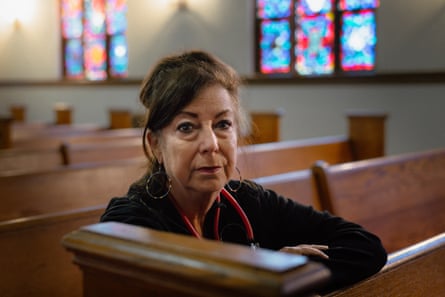
“I have taught students for years about the reality of death,” Norma told me. People we love die of old age and illness, or sometimes violence, homicide, accidents, suicide. It is a part of life, as she tells her classes. Long ago, her death class also reminded me how to remain attentive to life’s smallest moments, even amid the most painful challenges.
But what is happening to people at the hands of federal immigration officers in the US today is not just incomprehensible – it is preventable.
Detention centers, Norma told me, should not be death camps. For now, all she can do is keep showing up. To the places where people may need medical assistance. And to court, if that day comes.
She might never know the identities of the ICE agents who hurt her. But if she ever has a chance to face the men who grabbed her from behind, she would want to look at them, unmasked: “What if I was your mother or sister?” she would ask. “Where is your humanity?”
The Guardian wp:paragraph
هلدینگ کاسپین استانبول | خرید ملک در ترکیه | صرافی معتبر ایرانی در ترکیه | خرید و فروش طلا در ترکیه | مهاجرت به ترکیه | واردات و صادرات در ترکیه | نیازمندیهای ترکیه | اخبار ترکیه | اخبار جهانی | توریست ایران | خدمات توریستی در ایران | تورهای گردشگری ایران | هلدینگ اول | خدمات کاریابی و فریلنسری و شغل | مرجع اطلاعات ایران (همه چیز در ایران) | کیف پول و خدمات مالی و پرداخت یار | اخبار ایران | تابلو زنده قیمت ارز در ترکیه و استانبول | صرافی آنلاین ترکیه | قیمت طلا و نقره در ترکیه | سرمایه گذاری در ترکیه | جواهرات در ترکیه | نرخ لحظه ای ارزها در استانبول | قیمت دلار امروز در ترکیه | قیمت دلار استانبول امروز | قیمت لحظه ای دلار | اخبار روز ترکیه استانبول | اپلیکیشن ISTEX | اپلیکیشن قیمت لحظه ای دلار و یورو و لیر و ارزها در ترکیه
/wp:paragraph wp:paragraph /wp:paragraph
About the Author