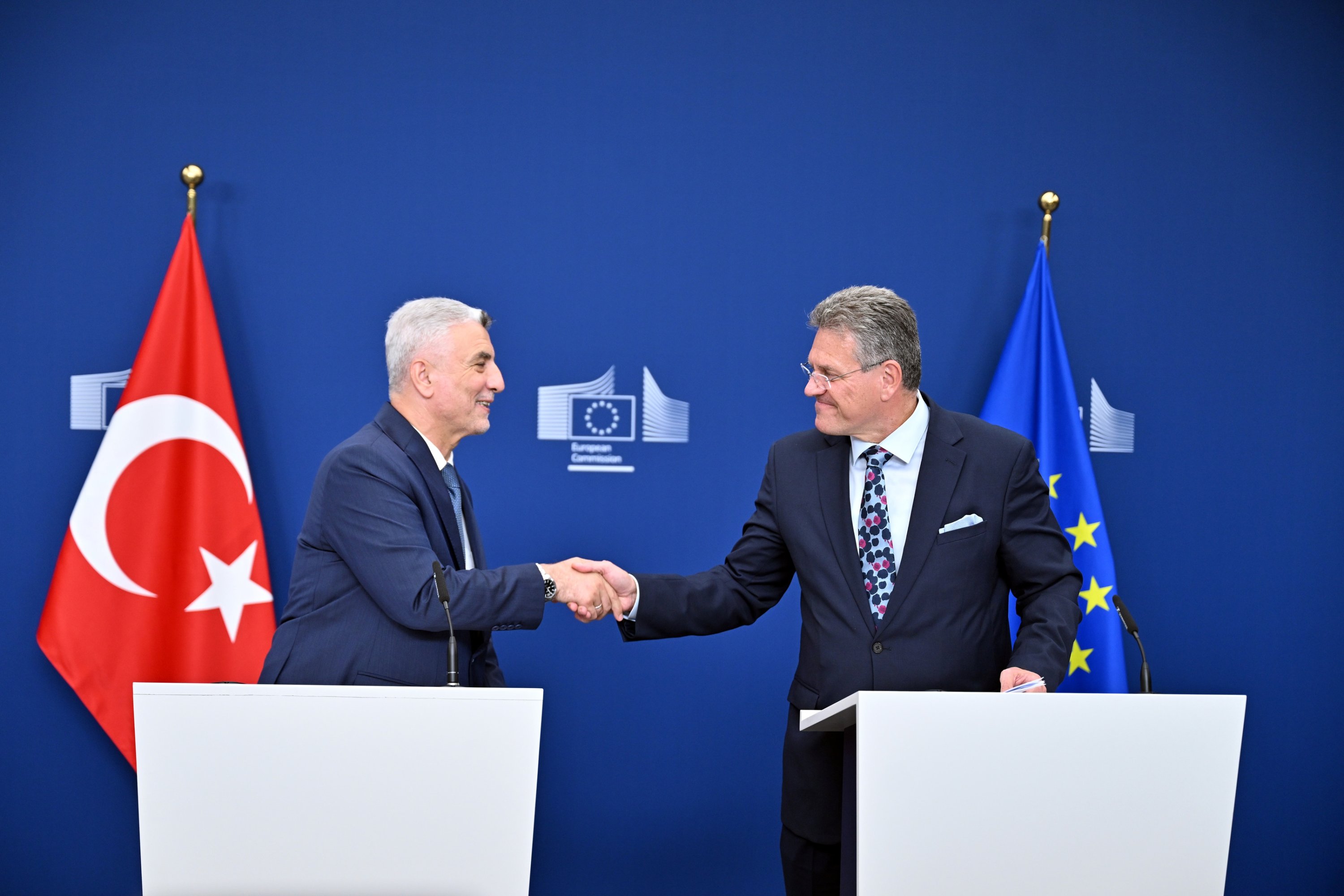
Trade Minister Ömer Bolat said Wednesday that progress had been made in some areas of efforts to update Türkiye’s customs union with the European Union.
Bolat, speaking to reporters in Brussels, also said Ankara is lobbying hard against restrictions in a planned EU industrial law that could affect Turkish carmakers.
A day earlier, European Trade Commissioner Maros Sefcovic announced progress on two customs-related issues after the High-Level EU-Türkiye Trade Dialogue, and defended the bloc’s “Made in EU” proposals amid differences among member states.
This week’s trip marks Bolat’s third official visit to the de facto capital of the European Union in the past three months and fifth in the past year.
The trade chief held a series of high-level talks, including the trade dialogue with Sefcovic, and attended the Türkiye-EU Business Summit, which was dominated by calls for a modernized customs union, a place in the bloc’s industrial supply chains and a clearer accession perspective.
Customs union update
Bolat said the EU Council has not yet authorized the European Commission to open formal negotiations on updating the customs union, because of the position of some member states.
“Since the relevant issues have come up, the relevant authorities at the European Commission are conducting negotiations with us. We are making progress on a case-by-case basis,” he said.
Bolat said the four main topics of the update are e-commerce, public procurement, investment and agricultural products, and that progress has been made in each.
On public procurement, Bolat pointed to a law that Türkiye’s Parliament passed in July. He said the analysis phase for a bilateral agreement with the EU is complete and technical talks have started.
In digital trade, he said the EU coordinated with Türkiye while drafting its own rules. Türkiye was exempted from EU legislation that took effect on July 1 and imposes a charge of 3 euros ($3.36) per package, he said.
Steps announced after trade dialogue
Speaking at a news conference with Bolat on Tuesday, Sefcovic announced progress in addressing barriers linked to Türkiye’s import control system, TAREKS. He said Ankara had introduced several transparency measures to make the system easier for EU exporters to use.
The two sides also agreed on a mutual recognition agreement covering their Authorized Economic Operator (AEO) programs, which has been published in the EU’s Official Journal. Under the deal, each side will recognize the other’s trusted traders, allowing their goods to benefit from faster border procedures.
“This is a real step forward for smooth trade flows and customs cooperation within the current Customs Union framework,” Sefcovic said.
Industrial policies and ‘Made in EU’
Bolat said Türkiye has worked intensively for the past year on the EU’s regulations proposed under the draft Industrial Accelerator Act (IAA).
He stressed the draft contains restrictive provisions affecting future investment and electric vehicles, particularly in the automotive industry.
Türkiye is conducting intensive diplomacy to have those provisions removed, he said. Turkish officials have set out their expectations clearly to their counterparts and remain in contact, he added.
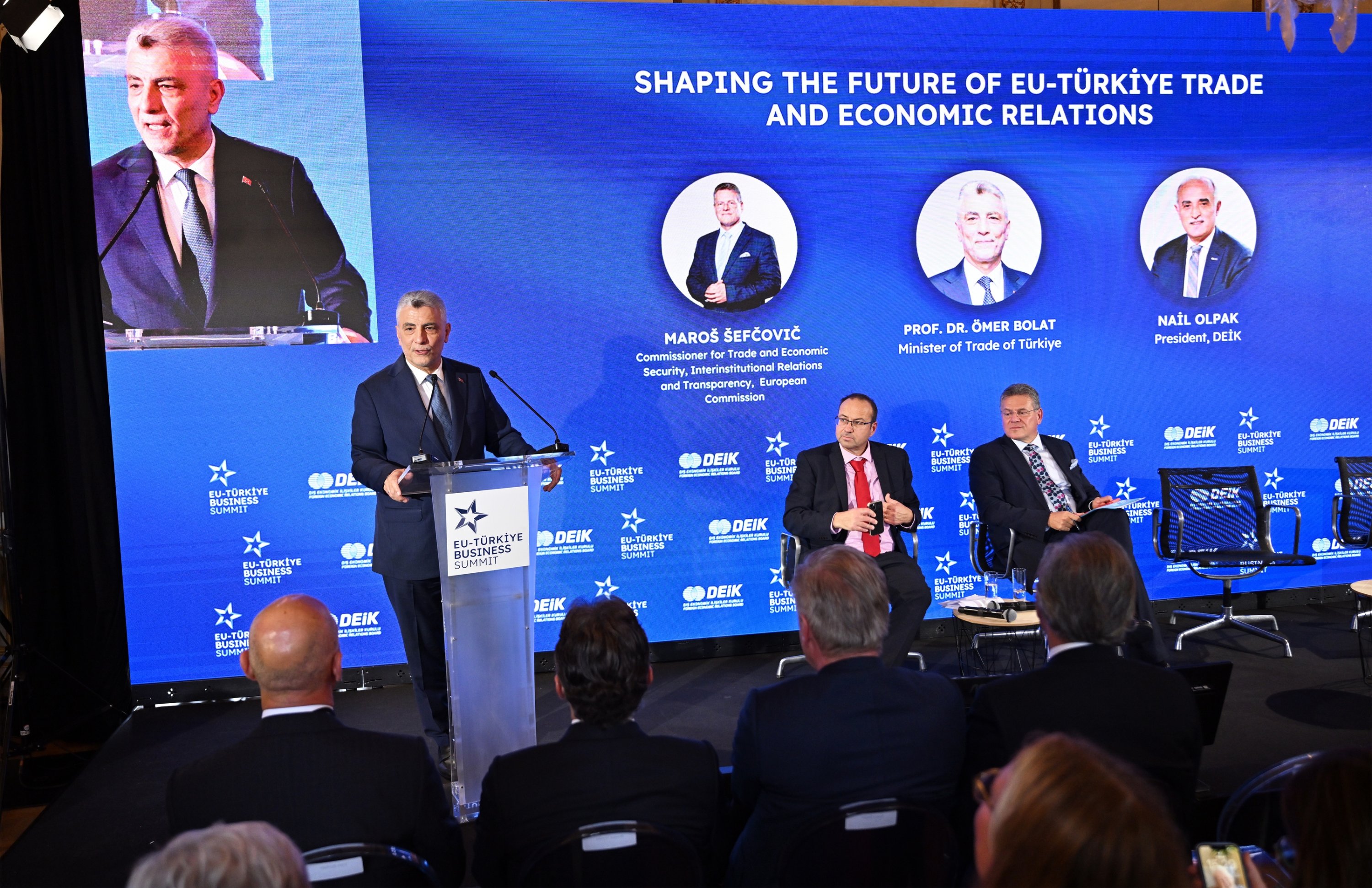
At the Türkiye-EU Business Summit, Bolat warned that excluding Türkiye from the “Made in EU” initiative would undermine decades of economic integration and established supply chains.
“We respect the (EU’s) ideal Industrial Accelerator Act, which is normal, and we suffer from the same grave concerns about huge imports from third countries. But the solution should not be to exclude trusted partners or the customs union,” he said.
Bolat stressed that Türkiye’s inclusion would serve the interests of both sides, particularly their auto industries and wider manufacturing sectors.
Sefcovic, for his part, said the Commission’s proposals aim to strengthen the bloc’s competitiveness and help it adapt to changing global trade conditions. He said they followed “very thorough reflection” on how to respond to concerns about state subsidies, trade-distorting practices and a European market flooded with goods, amid strong suspicions that some practices did not comply with World Trade Organization rules.
The EU, he said, is seeking new ways to address these challenges while maintaining its commitment to free and fair trade.
Asked about member states’ concerns over the proposed rules, Sefcovic noted that many of the proposals are in the legislative process and will go through the usual procedures in Parliament and the Council. “I believe that the goal is the same: to make sure that Europe is more competitive, stronger, and better fit for the current very volatile trade world,” he said.
The proposal has exposed differences among member states over which countries should qualify. France favors an EU-only approach, while Germany wants eligibility extended to trusted partners such as the United Kingdom, Canada and Japan, with Türkiye also potentially included.
The European Commission has put forward the proposal, and the European Parliament and EU Council are still to make decisions on it, Bolat told reporters on Wednesday.
He cautioned that an unfavorable outcome is possible once politics and parliaments are involved. But many EU officials, he said, believe Türkiye must be included under “Made in EU” rules.
He said the EU is not a single, uniform bloc and contains very different communities and nations, and that the number of friends and partners Türkiye has within it is growing.
“God willing, the result will be a good one,” he said.
‘Win-win relationship’
Bolat said economic ties are just as important for the EU as they are for Türkiye, and that many European partners recognize this.
“They want to continue close and strong economic relations with Türkiye,” he said.
Trade between Türkiye and the EU has grown since the customs union came into force three decades ago to $233 billion, he said. “So this is a win-win relationship.”
Türkiye’s exports to the EU rose 3.9% year-over-year to $81.5 billion in the first nine months of this year, according to official data.
Germany was Türkiye’s top European market, with exports rising 4.2% to $15.4 billion, followed by Italy with $9.6 billion, Spain with $8.3 billion and France with $7.9 billion.
Other leading export destinations included Romania and the Netherlands, with nearly $5.5 billion each, and Poland with $4.8 billion.
Türkiye’s total exports to its top four European markets (Germany, Italy, Spain and France) reached $41.2 billion in January-September.
The auto sector was the main driver of growth, with exports to the EU rising 4.8% to $22.9 billion, followed by the chemicals and chemical products sector with $10.2 billion and the ready-to-wear apparel sector with $7.3 billion.
DAILYSABAH
هلدینگ کاسپین استانبول | خرید ملک در ترکیه | صرافی معتبر ایرانی در ترکیه | خرید و فروش طلا در ترکیه | مهاجرت به ترکیه | واردات و صادرات در ترکیه | نیازمندیهای ترکیه | اخبار ترکیه | اخبار جهانی | توریست ایران | خدمات توریستی در ایران | تورهای گردشگری ایران | هلدینگ اول | خدمات کاریابی و فریلنسری و شغل | مرجع اطلاعات ایران (همه چیز در ایران) | کیف پول و خدمات مالی و پرداخت یار | اخبار ایران | تابلو زنده قیمت ارز در ترکیه و استانبول | صرافی آنلاین ترکیه | قیمت طلا و نقره در ترکیه | سرمایه گذاری در ترکیه | جواهرات در ترکیه | نرخ لحظه ای ارزها در استانبول | قیمت دلار امروز در ترکیه | قیمت دلار استانبول امروز | قیمت لحظه ای دلار | اخبار روز ترکیه استانبول | اپلیکیشن ISTEX | اپلیکیشن قیمت لحظه ای دلار و یورو و لیر و ارزها در ترکیه
About the Author