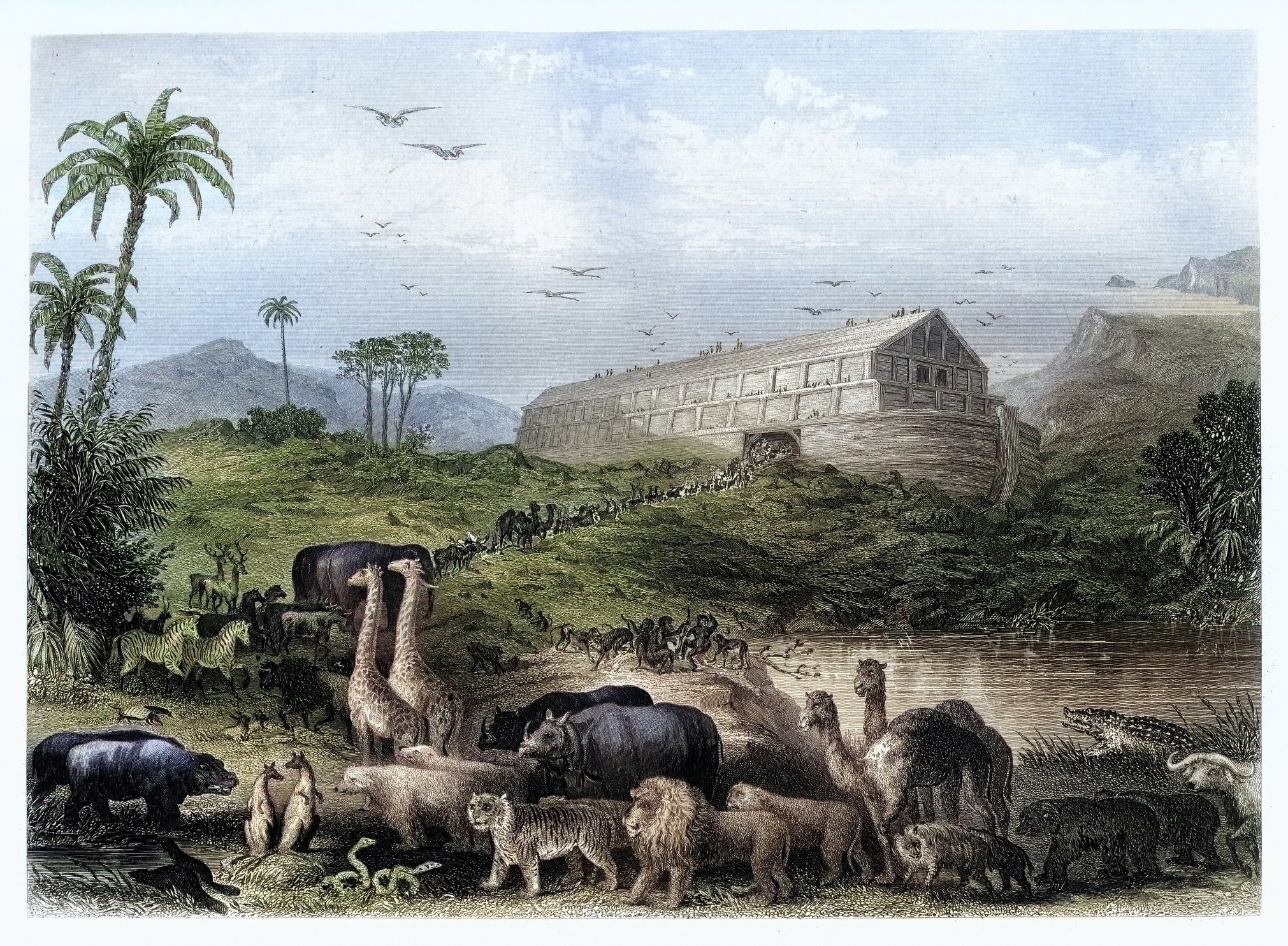
In the Torah and the Quran, Noah is a prophet at the center of one of humanity’s great turning points. Recounted in the Book of Genesis in the Torah and in several Surahs of the Quran, particularly Surahs Hud, Noah, Al-Mu’minun and Al-Shu‘ara, Noah is portrayed as a figure who calls people to worship God and uphold moral righteousness, is rejected by his own people, and ultimately witnesses a great catastrophe. The most dramatic episode in his story is the Flood.
According to the Torah, wickedness had spread across the earth, and God decided to punish the world with a great flood, commanding Noah to build an ark. Noah boarded the vessel with his family, and animals were brought aboard as well. The rain continued for 40 days and 40 nights; the waters rose, and every living creature on dry land perished. When the waters receded, the ark came to rest on the “mountains of Ararat,” and Noah and those with him emerged to begin anew. In the Torah, the Flood is more than a catastrophe: it also marks a reordering of the relationship between humanity and God. The rainbow that appears afterward serves as a sign of God’s promise never again to destroy all living creatures in this way.
The Quranic account retains the same broad narrative framework but places the emphasis somewhat differently. Noah calls his people to worship God, but they reject his message. At God’s command, Noah builds the ark and boards it with those who believe. When the Flood subsides, the waters recede, and the ark comes to rest on “Mount Judi.” Unlike the Torah, the Quran does not specify the ark’s dimensions, provide a day-by-day account of the Flood’s duration, or describe in detail how the animals were arranged aboard the vessel. Instead, it places greater emphasis on Noah’s people rejecting his message, his efforts to guide them, his son’s unsuccessful attempt to escape the Flood, and the fulfilment of God’s decree.
Ancient myths, holy texts
The Flood of Noah, however, is not an event recounted exclusively in the Torah and the Quran. Much older accounts of great floods survive from the ancient Mesopotamian world. The principal written examples of the Mesopotamian flood tradition are the Sumerian Flood Story (Eridu Genesis), whose surviving manuscript dates to approximately the 17th century B.C.; the “Akkadian Atrahasis Epic,” thought to have taken shape around the 18th-17th centuries B.C., with its earliest major surviving copies dating to the 17th century B.C.; and Tablet XI of the “Epic of Gilgamesh,” whose Standard Babylonian version dates to approximately the 13th-11th centuries B.C. The flood hero in the Sumerian tradition is Ziusudra; in the “Akkadian Atrahasis Epic,” the hero is Atrahasis, while in Tablet XI of the “Epic of Gilgamesh,” he appears as Utnapishtim.
The similarities in the basic narrative structure are striking: an impending catastrophe, a person warned in advance, a great vessel constructed for survival, the rescue of family members and living creatures, the eventual recession of the waters, and the beginning of a new life after the Flood. Academic research has demonstrated substantial parallels between Genesis 6-9 and the Mesopotamian flood traditions.
It would nevertheless be an oversimplification to conclude immediately that “the Torah copied the Mesopotamian texts.” Cultural transmission, literary interaction, and shared traditions must certainly be taken seriously. Indeed, modern scholarship has extensively examined the relationship between the Genesis narrative and works such as the “Atrahasis Epic” and the “Epic of Gilgamesh.” Yet another possibility deserves equal consideration: a major regional flood that occurred in the ancient Near East may have endured in the collective memory of different societies, each of which subsequently retold the catastrophe through its own cosmology, theology and literary traditions. From this perspective, rather than assuming that one text simply copied another, we might consider the possibility that different versions of a shared memory of a devastating flood have survived.
From the Quranic perspective, it is not necessary to conclude that the Flood was a universal catastrophe that covered the entire world. The Quran’s emphasis on Noah being sent to a particular people allows for the interpretation that the Flood was a regional disaster directed at Noah’s community. If communities that had never received Noah’s message were also punished by the Flood, this would raise serious questions about the Quran’s conception of divine justice, which ties moral responsibility to the delivery of divine guidance and the exercise of individual choice. Contemporary Islamic scholars have likewise supported a regional interpretation. Nevertheless, since the Quran does not explicitly define the geographical boundaries of the Flood, this remains an interpretation rather than an established geographical fact.
Where is Noah’s Ark?
One of the most intriguing questions surrounding the Flood is where the ark came to rest. The Torah states that it came to rest on the “mountains of Ararat.” Ararat is generally associated with the ancient name Urartu and understood as referring to the mountainous region to the north of Mesopotamia. Over time, particularly in Western traditions, this reference became identified with modern Mount Ağrı in eastern Türkiye, making the mountain and its surrounding area a principal focus of searches for Noah’s Ark. Yet, the text says the “mountains.” Identifying the modern summit, which rises to 5,137 metres (16,853.67 feet), as the precise location indicated by Genesis is therefore not a necessary conclusion of the text, but a later geographical identification.
The Quran, by contrast, states that the ark came to rest on “Judi.” An important distinction must be made here: the existence of a mountain known today as Cudi in the vicinity of Şırnak, in southeastern Türkiye, does not necessarily mean that the Quranic term “Judi” must be the proper name of that particular modern mountain. The etymology of “Judi” remains disputed, and the claim that the word directly means “fertile lands” is not an established linguistic fact. In early and classical Islamic geographical traditions, however, Judi was associated with a particular mountain in Upper Mesopotamia. Here, too, we must distinguish between what the text actually says and the geographical identifications made in later traditions. It is reasonable to interpret the narrative as describing Noah and his companions descending, after the Flood, to elevated land suitable for settlement. But insisting that this must refer specifically to the mountain now called Cudi goes beyond what the text itself establishes.
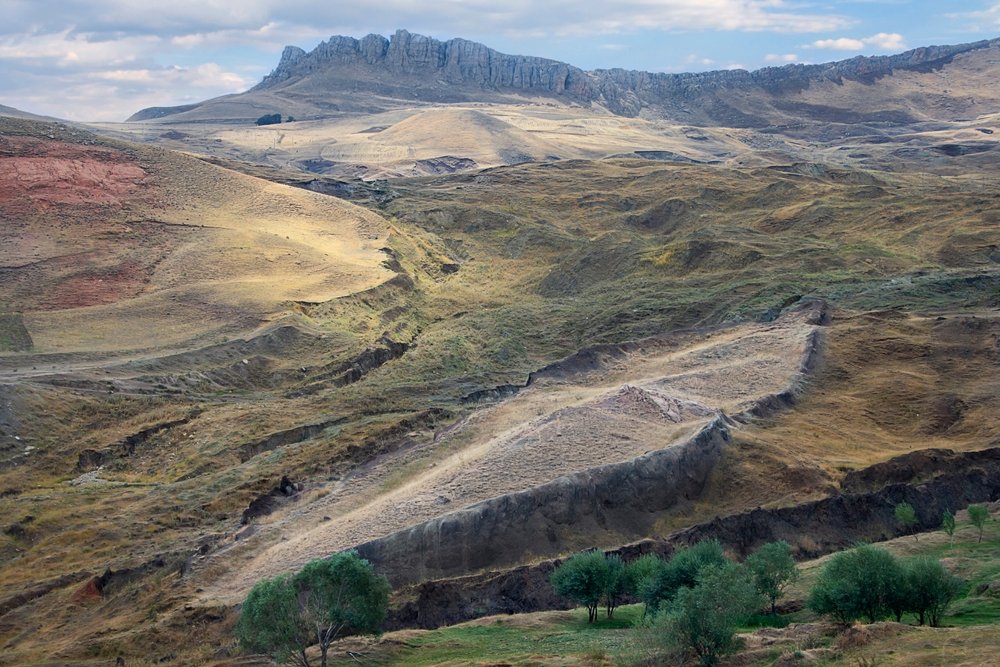
For these reasons, the claim that Noah’s Ark lies on Mount Ararat or Mount Cudi is not a necessary conclusion of either the Torah or the Quran. Neither text provides geographical coordinates in the modern sense, and the possibility that the ark came to rest elsewhere remains open. It is in this context that the Durupınar Formation, which has recently returned to the headlines, becomes significant. New investigations conducted under the name Noah’s Ark Scans at the boat-shaped formation near Doğubayazıt, in Ağrı Province, developed in 2026 into extensive geological and geophysical studies carried out with official authorization. An international team reportedly conducted radar surveys, LiDAR mapping, electrical resistivity measurements, soil sampling, and core drilling. Reports indicate that hundreds of samples were collected from 16 core-drilling locations, with laboratory results expected to be announced in the spring of 2027.
This is also where the renewed public excitement comes from. The research team has suggested that the formation contains regular structures beneath the surface, layers rich in organic material, and other findings that may warrant further examination of conventional geological explanations. Some researchers have even argued that these features could indicate a human-made structure. None of this, however, means that “Noah’s Ark has been found.” The project team itself has indicated that conclusions will depend on laboratory analyses and independent assessments. At present, no wooden material, structural component, or other archaeological remains have been verified as belonging to the ark. There is therefore no confirmed positive result so far; the current excitement rests primarily on new investigations and claims based on possibilities that remain unverified.
Nevertheless, if remains belonging to Noah’s Ark were genuinely discovered one day, whether in the vicinity of Mount Ararat or elsewhere, such a finding would not pose a problem for either the Torah or the Quran. Neither text identifies the ark’s location in terms that can be mapped unambiguously onto a modern geographical reference. On the contrary, such a discovery would constitute an exceptionally significant historical and archaeological contribution to the study of both the Bible and the Quran, opening a new window onto the historical memory underlying the Flood narratives.
Ultimately, when it comes to Noah’s Ark, we should neither dismiss religious belief nor mistake a possibility for proof. The soundest approach is to await the findings of ongoing research and assess the evidence through critical and scientific methods.
The views and opinions expressed in this article are solely those of the author. They do not necessarily reflect the editorial stance, values or position of Daily Sabah. The newspaper provides space for diverse perspectives as part of its commitment to open and informed public discussion.
DAILYSABAH
هلدینگ کاسپین استانبول | خرید ملک در ترکیه | صرافی معتبر ایرانی در ترکیه | خرید و فروش طلا در ترکیه | مهاجرت به ترکیه | واردات و صادرات در ترکیه | نیازمندیهای ترکیه | اخبار ترکیه | اخبار جهانی | توریست ایران | خدمات توریستی در ایران | تورهای گردشگری ایران | هلدینگ اول | خدمات کاریابی و فریلنسری و شغل | مرجع اطلاعات ایران (همه چیز در ایران) | کیف پول و خدمات مالی و پرداخت یار | اخبار ایران | تابلو زنده قیمت ارز در ترکیه و استانبول | صرافی آنلاین ترکیه | قیمت طلا و نقره در ترکیه | سرمایه گذاری در ترکیه | جواهرات در ترکیه | نرخ لحظه ای ارزها در استانبول | قیمت دلار امروز در ترکیه | قیمت دلار استانبول امروز | قیمت لحظه ای دلار | اخبار روز ترکیه استانبول | اپلیکیشن ISTEX | اپلیکیشن قیمت لحظه ای دلار و یورو و لیر و ارزها در ترکیه
About the Author