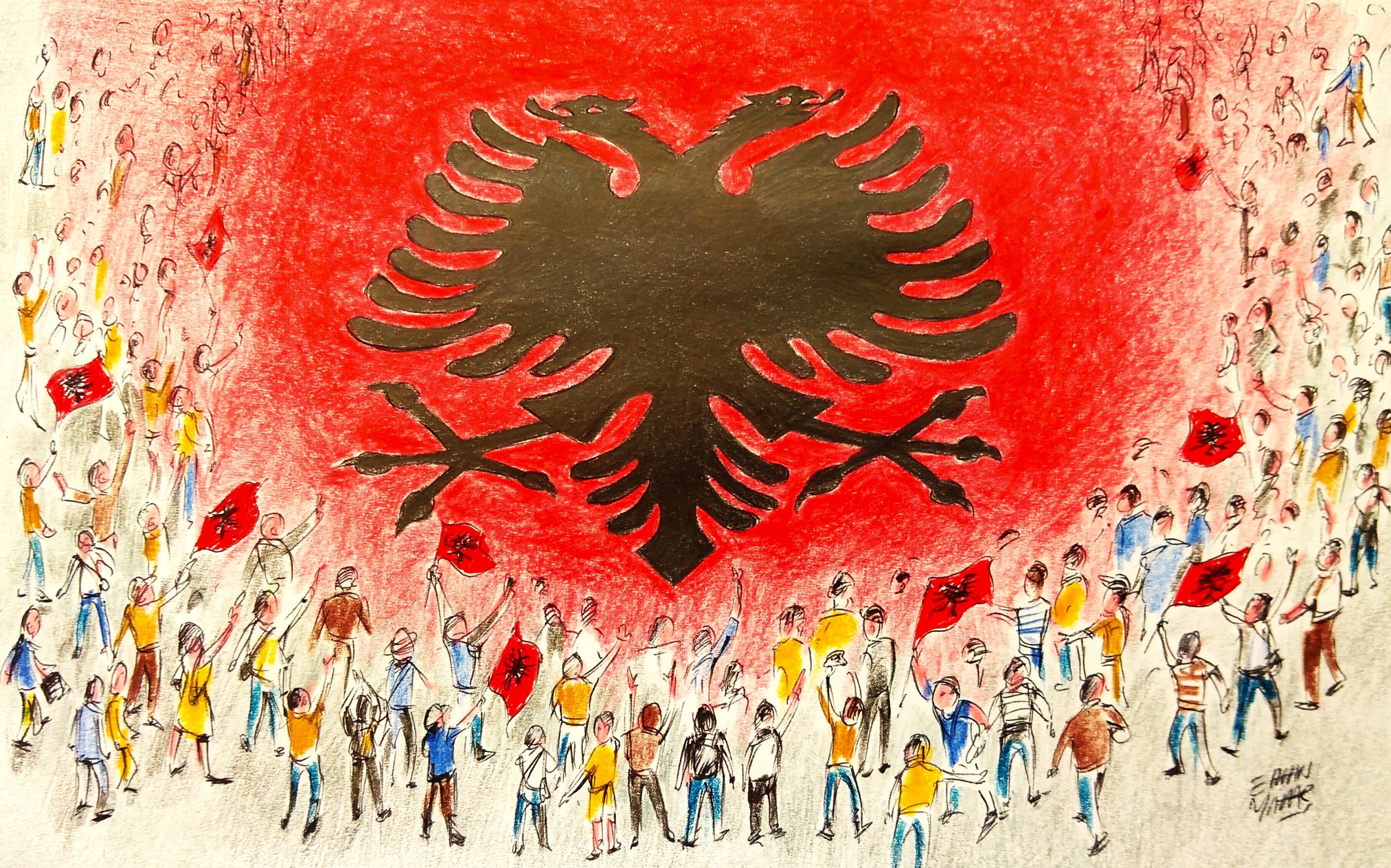
In the heart of Tirana, a demonstrator gave a striking answer when asked why he was marching: “We are at war with Israel.” What began as student-led demonstrations quickly descended into severe violence, with protesters hurling molotov cocktails at government ministries and setting political headquarters ablaze, leaving over 270 people injured, including more than 150 police officers. Viewed alongside the pro-Palestinian, keffiyeh-wearing protesters filling the streets of other European capitals, a provocative question emerges: Are the violent protests in Tirana merely about local grievances, or are they a reflection of a growing global anger against Israel?
The immediate spark behind this chaos is a series of controversial multibillion-dollar luxury real estate deals on Sazan Island and Zvernec. These projects, backed by U.S. President Donald Trump’s son-in-law Jared Kushner and linked to Israeli-backed investment funds, have drawn intense public outrage. Protesters accuse Prime Minister Edi Rama of auctioning public coastal lands off to foreign oligarchs under the guise of tourism development. In response to the mounting unrest, Rama claimed the protests were orchestrated by “foreign hands,” specifically pointing to Iranian interference and stating that an explosive-laden drone targeting the Prime Minister’s Office had been neutralized.
Yet, this sudden surge of violence and the anti-government slogans echoing through the streets stand in sharp, confusing contrast to the country’s recent political reality. Just last year, Rama’s Socialist Party secured a landslide victory, capturing over 52% of the popular vote and winning 83 of the 140 parliamentary seats. This stark divide raises a critical question: Why does a leader with such an overwhelming mandate face these demonstrations? The chaos in Tirana underscores a growing rift between ballot boxes and street realities. While social grievances fuel immense public frustration, this anger did not translate into a coherent electoral alternative during the last vote.
However, a closer look at the street dynamics reveals that the protesters’ deepest fury is not merely directed at Rama the politician, but at the controversial decisions he has made under perceived Israeli influence and foreign pressure. For many of the demonstrators, Rama is seen as placing national sovereignty at risk by accommodating external business interests and advancing deals such as the Kushner project, which they believe reflect priorities shaped in Tel Aviv and Washington more than public debate in Tirana. Rama relies heavily on his ultimate geopolitical project: securing Albania’s accession to the European Union, a milestone widely seen as essential to the country’s Western integration, despite mounting domestic anger.
Stands of Brussels and Ankara
It remains nearly impossible to predict how much longer these street demonstrations will persist or whether Rama’s EU integration project will be enough for the government to navigate the ongoing unrest. Brussels continues to issue routine statements calling for restraint, lawfulness and dialogue. However, European leaders find themselves in a delicate bind: The EU cannot easily condone escalating street violence in an accession candidate state, but it is equally hesitant to abandon a stable regional partner.
Alongside Brussels’ cautious stance, Türkiye’s role introduces another vital layer of diplomatic stability to the regional picture. Rooted in a close working dialogue between President Recep Tayyip Erdoğan and Rama, alongside deep economic and defense ties, Ankara favors a calm, constructive approach. While firmly advocating for stability and public order in a friendly Balkan nation, Türkiye also remains quietly observant of the public sensitivity surrounding foreign-backed coastal projects and Middle Eastern political influences.
Between Tel Aviv and Tehran
In fact, to fully grasp the magnitude of the unrest in Tirana, one must look beyond domestic grievances and examine Albania’s deep integration into Middle Eastern geopolitical rivalries. The tension between Tirana and Tehran is hardly new; formal diplomatic relations have been frozen since September 2022 following a massive, state-sponsored Iranian cyberattack that paralyzed Albania’s digital infrastructure. Since then, Rama has unequivocally pivoted Albania toward Tel Aviv, framing Israel not just as a strategic partner but as a foundational reference point for security. Throughout the Gaza genocide, while public outrage surged across European capitals and the global South, Rama maintained a pro-Israel stance, even delivering speeches in the Knesset offering staunch political backing. This deepening alliance reached its ideological peak with Rama’s controversial proposal to establish a sovereign, Vatican-style Bektashi state in Tirana, a move widely interpreted by critics as a Tel Aviv-inspired geopolitical maneuver.
Rama has blamed Tehran for orchestrating the demonstrations from afar; what remains beyond doubt is that these violent outbursts also reflect a public backlash against Rama’s pro-Israel foreign policy and his government’s silence on the ongoing atrocities in Gaza. If Rama manages to weather this political storm and survive the current wave of protests, it would be wise for his administration to recalibrate its approach. Moving forward, adopting a far more balanced and nuanced foreign policy will be essential to restoring long-term domestic stability.
The views and opinions expressed in this article are solely those of the author. They do not necessarily reflect the editorial stance, values or position of Daily Sabah. The newspaper provides space for diverse perspectives as part of its commitment to open and informed public discussion.
DAILYSABAH
هلدینگ کاسپین استانبول | خرید ملک در ترکیه | صرافی معتبر ایرانی در ترکیه | خرید و فروش طلا در ترکیه | مهاجرت به ترکیه | واردات و صادرات در ترکیه | نیازمندیهای ترکیه | اخبار ترکیه | اخبار جهانی | توریست ایران | خدمات توریستی در ایران | تورهای گردشگری ایران | هلدینگ اول | خدمات کاریابی و فریلنسری و شغل | مرجع اطلاعات ایران (همه چیز در ایران) | کیف پول و خدمات مالی و پرداخت یار | اخبار ایران | تابلو زنده قیمت ارز در ترکیه و استانبول | صرافی آنلاین ترکیه | قیمت طلا و نقره در ترکیه | سرمایه گذاری در ترکیه | جواهرات در ترکیه | نرخ لحظه ای ارزها در استانبول | قیمت دلار امروز در ترکیه | قیمت دلار استانبول امروز | قیمت لحظه ای دلار | اخبار روز ترکیه استانبول | اپلیکیشن ISTEX | اپلیکیشن قیمت لحظه ای دلار و یورو و لیر و ارزها در ترکیه
About the Author