-
Serbia’s strongman Aleksandar Vučić faces the strongest challenge to his 12-year rule in the country, as grassroots protest movement led by Serbia’s students hopes to oust him from office in snap parliamentary elections (17:31).
-
The vote comes after nearly two years of widespread protests against alleged government and institutional corruption, triggered by a railway disaster in 2024 (17:42).
-
Critics say Vučić, a former information minister of Slobodan Milošević, deploys nationalist playbook in domestic politics, while keeping close ties with Russia and China (17:14) and not making progress on Serbia’s path towards the European Union (17:48).
-
The election takes place amid tense atmosphere with partial turnout data pointing to unprecedented voter mobilisation (18:32, 18:58) amid allegations of electoral irregularities with a record-high number of observers following the vote (18:00, 19:11).
-
Polls close at 8pm (7pm UK), with first projections expected later tonight, around 9.30pm (8.30pm UK; 18:34, 18:42).
Ana Milosavljevic
in Belgrade
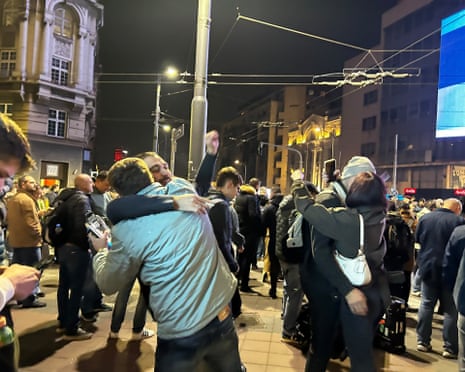
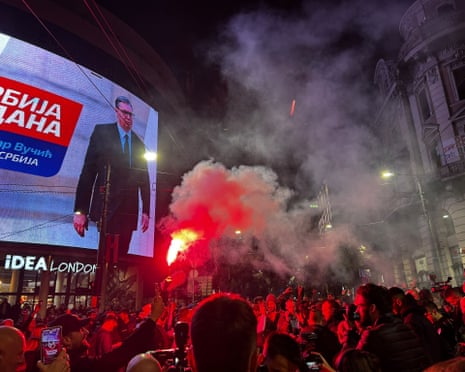
Vučić’s concession prompts wild scenes of celebration here in Belgrade.
Some are still in disbelief. “This was kind of easy, no?,” they laugh.
We are just getting the first Ipsos/CeSID projection, which shows the Student List well ahead on 52%, with Vučić’s list on mere 39.3%.
They are projected to have 138 seats in the new parliament, well clear of the 126 required for majority, to Vučić’s 104.
That’s via the N1 broadcaster.
Did you have that on your bingo?
Vučić appears to concede the election.
He says he is expecting the Student List to have a majority in the new parliament, well clear of the 126 required to govern, and his SNS will have only 105 mandates.
Wow. What a moment.
Serbia’s former president and list leader Aleksandar Vučić is expected to speak in the next few minutes, according to the Serbian state broadcaster, RTS.
Let’s see what he has to say.
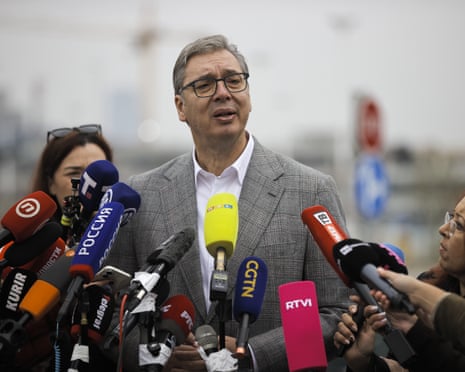
For what it’s worth, he told reporters earlier today:
“I’m expecting a huge turnout, of course, democratic will to be expressed by Serbian people, and as I was always saying, if we lose, we’ll concede it, if we win, we’ll keep it as it is, and that’s it.”
He later added:
“We’ll see whether I’ll be in the opposition or in power. We will see tonight.”
Head of the CRTA monitoring mission Raša Nedeljkov spoke about the restrictions in accessing the electoral commission on his press conference just moments ago (20:18).
“We noticed that, for the first time ever in history, access to the Republican Electoral Commission is blocked to the electors. As a citizen, you cannot go to the Electoral Commission and file complaints. You cannot come close to the building, which is… very worrying.”
During his briefing, he also got repeatedly asked about the view of the international observers, but declined to comment, saying that it’s up to them to declare it at their press conference tomorrow.
But he eventually says:
“I do regret that we are in a situations that the members of the European Parliament need police security to be able to move around Belgrade in Serbia. This is an illustration, a litmus test of the freedoms existing [here].”
Ana Milosavljevic
in Belgrade
Some excited people are gathering near the closed off electoral commission, shouting the students’ slogan “pumpaj” and “he’s finished!” to honking cars passing by.
Let’s see if that’s not premature.
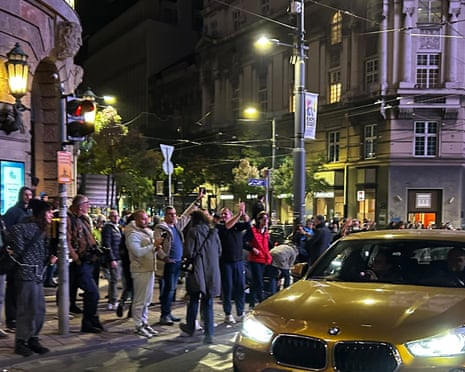
Alicia Kearns, former chair of the House of Commons foreign affairs select committee, is the latest politician to sound the alarm over the potentially escalating climate in Serbia.
Writing on X, she said:
“Scenes from Serbia are deeply concerning and fears are escalating. The Government has a duty to keep all citizens safe, and ensure there is no climate of intimidation or use of military threat against citizens.
The UK Govt & EU must ensure the Serbian Government is in no doubt that peace must be upheld.”
It looks like voting hours are being extended at some polling stations after a somewhat chaotic afternoon.
In the southern city of Leskovac, one polling station will remain open until 11pm after voting was briefly suspended following an altercation involving a smaller party representative – and then another two other staff members got into a fight, prompting a police intervention, N1 reported.
Good luck with that vote count. Looks like they will need it.
The latest projection from election monitoring group CRTA puts turnout at 67.8% as of 7pm, running consistently 13 to 14 percentage points ahead of the 2023 vote.
That’s very similar to CeSID/Ipsos projection, perhaps encouragingly so (19:55).
Observers expect that figure to climb by another three or four percentage points before polls close, potentially challenging Serbia’s all-time record of 71.4% set in 1990.
Earlier today, I mentioned how important the diaspora vote could be in this year’s election – despite some unsocial voting times for voters in the US, Canada and Australia (18:58, 19:09).
Here are some videos showing the extent of mobilisation in London, Vienna and Chicago, which all saw lengthy queues to get into the polling stations:
It’s worth noting that earlier today, the students urged their supporters to stay away from any areas seeing reinforced police presence to avoid any provocations.
In a statement on X, they said:
“We call on all citizens of Belgrade not to gather near the locations where increased police presence and plainclothes individuals have been observed. Safely, peacefully, and with dignity until the end.”
Ana Milosavljevic
in Belgrade
Police have cordoned off part of Kralja Milana Street in downtown Belgrade, where the Republic Electoral Commission is located.
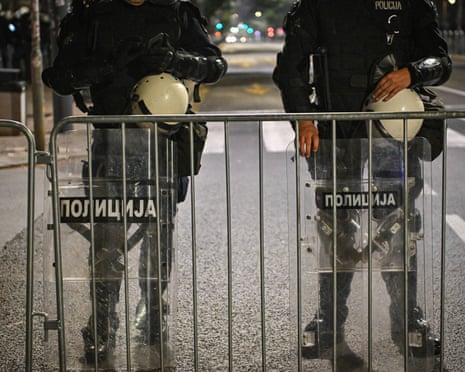
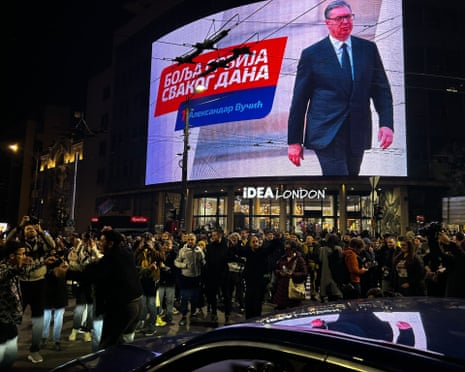
Meanwhile, groups of people congregate in front of the cordon, catching up and speculating about the results, as Vučić’s campaign advertisements cycle on a screen above them.
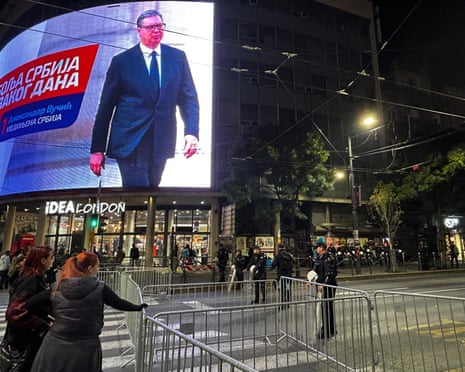
Dozens of gendarmerie officers, some looking bored and scrolling through their phones, are scattered throughout Pionirski Park, opposite the National Assembly and home to “Ćacilend,” the notorious government-backed counter-encampment.
In front of the Presidency, several cordons have also been set up, behind which squads of police officers gather around a handful of police vans.
Meanwhile, drivers stopped at the intersection in front of the National Assembly lean on their horns as passersby pump their fists into the air in anticipation of the results to come.
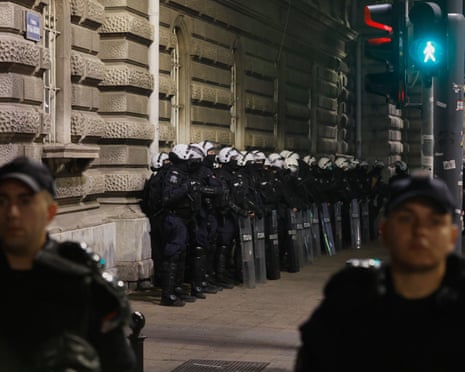
Meanwhile, let’s go across to Ana Milosavljevic in Belgrade for the latest on what’s happening in the capital.
Welcome to the geek corner.
Serbia’s electoral system is both straightforward and complicated, which makes it a nightmare to explain in a short blog post.
Generally, we are talking about a 250-seat parliament, and it’s a race to 126 in terms of securing a majority. There is only one constituency, and you vote for a closed party list, not a specific candidate.
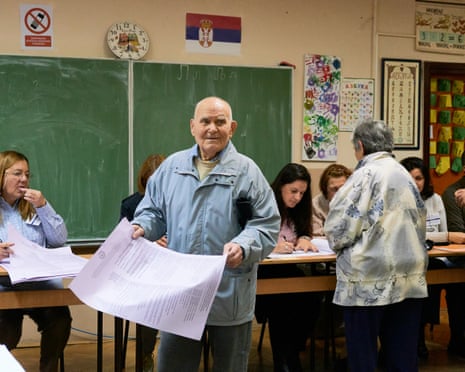
So far, so good.
The electoral threshold is generally 3%, but there are exceptions from this rule for national minority parties and they may or may not be relevant when determining the outcome of the vote.
Over to Florian Bieber of the University of Graz:
“What is important is not just the support for the two big lists, but it’s also about whether the smaller parties make it into parliament.
We’re talking about three parties which are really on the threshold. I expect them not to [get in], but again, we don’t know for sure. There’s the Socialists, which are the long-term coalition partners, and they seem to be in crisis, and Vucic’s could lose his only reliable coalition partner.
And then there are the two other opposition lists, the so-called Authentic Right, which is a kind of nationalist far right, but opposition list, and the European Serbia, which is a more pro-European opposition.
Neither of them is expected to get in. If they do enter parliament, they would be a coalition partner for the Student List, but if they are just below the threshold, it’s basically a lot of votes wasted for the opposition. …
In the end, unless the students get close to 50% of the vote, they’re unlikely to be able to form a government alone. So then these things start mattering a lot.”
And that’s before we look at the minority parties and what they may want (or not) to do with their votes.
So, that’s done.
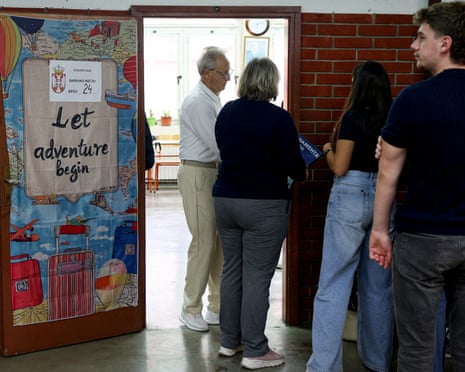
Now, the wait begins.
As explained earlier, we are expecting first projections – based on what both groups claim are representative samples of polling stations – to drop a bit later, around 9.30pm local time, so 8.30pm UK (18:42)
The polls are theoretically closing in under five minutes now – but anyone standing in the queue at 8pm Serbian time will still be able to cast their votes even a bit later.
So, if you are somewhere in the world, waiting in that queue, and reading our blog – don’t lose your spot.
The latest data from CeSID and Ipsos projects national turnout at 67.6% as of 7pm – once again pointing towards an exceptionally high final figure.
The Guardian wp:paragraph
هلدینگ کاسپین استانبول | خرید ملک در ترکیه | صرافی معتبر ایرانی در ترکیه | خرید و فروش طلا در ترکیه | مهاجرت به ترکیه | واردات و صادرات در ترکیه | نیازمندیهای ترکیه | اخبار ترکیه | اخبار جهانی | توریست ایران | خدمات توریستی در ایران | تورهای گردشگری ایران | هلدینگ اول | خدمات کاریابی و فریلنسری و شغل | مرجع اطلاعات ایران (همه چیز در ایران) | کیف پول و خدمات مالی و پرداخت یار | اخبار ایران | تابلو زنده قیمت ارز در ترکیه و استانبول | صرافی آنلاین ترکیه | قیمت طلا و نقره در ترکیه | سرمایه گذاری در ترکیه | جواهرات در ترکیه | نرخ لحظه ای ارزها در استانبول | قیمت دلار امروز در ترکیه | قیمت دلار استانبول امروز | قیمت لحظه ای دلار | اخبار روز ترکیه استانبول | اپلیکیشن ISTEX | اپلیکیشن قیمت لحظه ای دلار و یورو و لیر و ارزها در ترکیه
/wp:paragraph wp:paragraph /wp:paragraph
About the Author