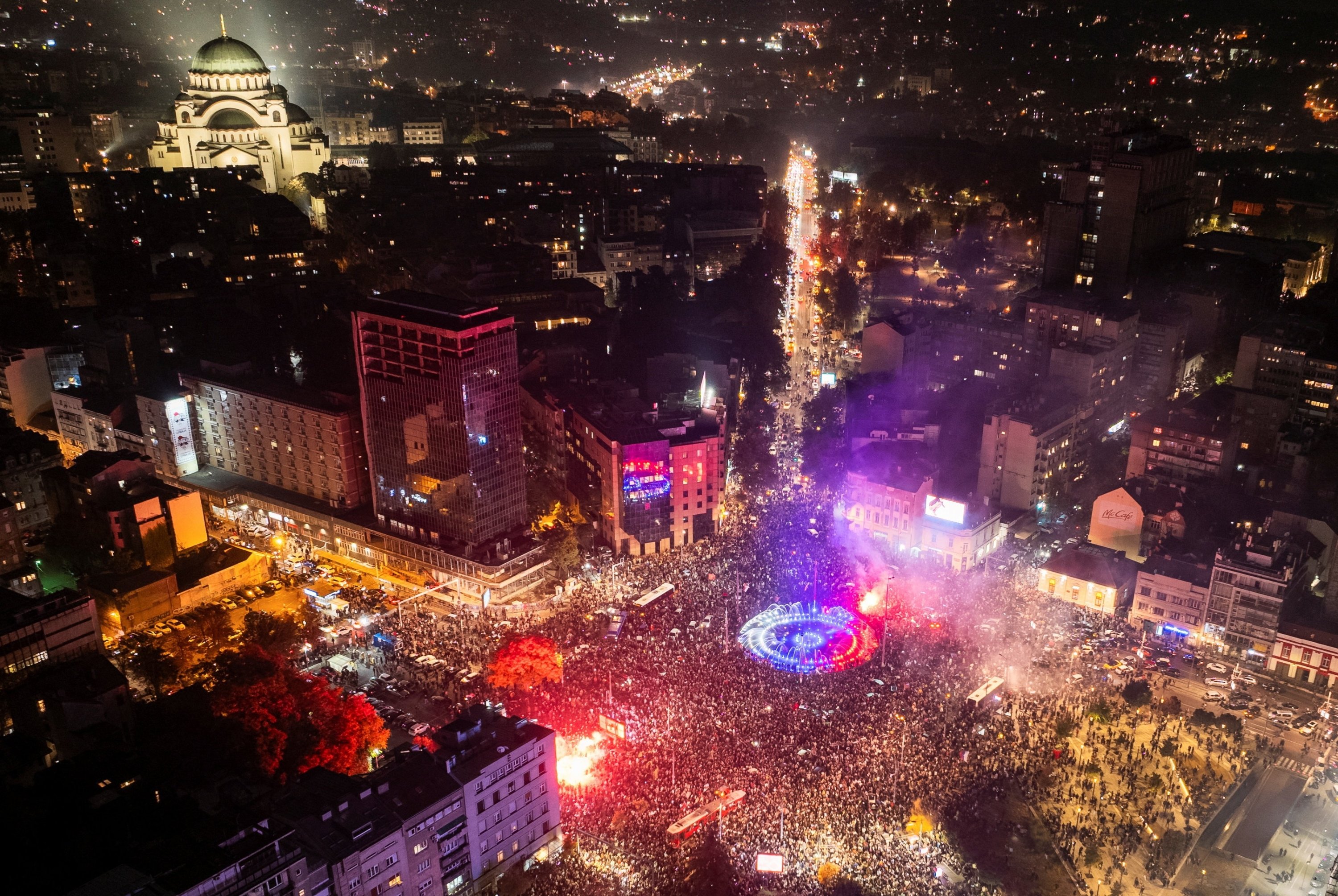
Serbia experienced a major political shift after yesterday’s general elections. After 14 years under Aleksandar Vucic and his Serbian Progressive Party (SNS), the country’s political landscape has entered a completely new chapter. The snap elections, triggered after months of mounting societal tensions and widespread anti-government student protests, resulted in a clear victory for the opposition-backed “Student List,” effectively bringing a long-standing political era to a close. Throughout his tenure, Vucic faced growing criticism over persistent corruption, rising living costs, and his administration’s economic and trade ties with China.
As polls closed on election night, anxieties briefly peaked across Belgrade, where an increased police presence and unidentified groups raised fears of confrontation. However, the situation quickly defused. Vucic appeared before the public to officially concede defeat, while leaders of the Student List issued strong calls for calm, restraint and vigilance. Thanks to these measured steps, the night passed without any notable violence, giving way instead to enthusiastic celebrations among supporters of the Student List.
Who is ‘Student List’?
According to the election results, the Student List secured approximately 2.2 million votes, translating into 135 to 140 seats in the 250-member Assembly and comfortably achieving the majority required to form a single-party government. And although its leadership remained fluid during the campaign, professor Ilija Srdanovic has emerged to the forefront and is widely expected to become the new prime minister.
A closer look at the victorious “Student List” reveals that it is far from a traditional political coalition. Rather than being formed by conventional political parties, the movement stands as a broad civic platform composed of technocrats, academics, civic activists and professionals whose unity currently rests primarily on a shared opposition to the previous administration.
Domestically, the movement claims it will execute a comprehensive institutional overhaul. Its local agenda purports to target systemic corruption, restore judicial independence, and introduce strict transparency in state tenders and public procurement, a direct response to long-standing public grievances. By replacing partisan appointees with independent experts across state institutions, the Student List asserts that it will establish a decentralized and merit-based governance model. However, while this diverse, anti-establishment movement successfully mobilized a nation eager for reform, whether a platform brought together mainly by anti-government sentiment can maintain long-term internal harmony, bridge ideological differences, and deliver on its bold domestic claims remains a major question mark for Serbia’s political future.
Why did Vucic lose?
The political shift in Serbia was not a sudden turn, but rather the cumulative result of growing structural pressures on the administration. A pivotal moment occurred following the tragic canopy collapse at the Novi Sad railway station in late 2024, which triggered the student protests. The disaster, which claimed 16 lives, quickly became a catalyst for widespread anger over institutional negligence and alleged state corruption. Domestically, public outrage centered on the government’s lack of accountability.
Internationally, however, the tragedy amplified existing friction surrounding Serbia’s economic alignment with China, whose firms were closely associated with the station’s renovation work. Beijing’s expanding footprint in the Balkans, a region traditionally viewed by the European Union as a critical security buffer, had long drawn concern in Western capitals. The EU’s supportive messages during the protests, followed by its swift congratulatory statements after the election results, clearly underscore Brussels’ discomfort with this external influence and its quiet backing for Serbia’s political transition.
Foreign policy realignment
With power shifting to the Student List, Serbia’s foreign policy is expected to undergo a calibrated realignment. While the technocratic administration is unlikely to pursue a sudden break with major economic partners like China or traditional allies like Russia, it will face stronger pressure to increase transparency over foreign investments. Consequently, the new leadership’s primary objective will be restoring institutional credibility, strengthening the rule of law, and repairing key diplomatic bridges with Brussels to revive the long-stalled EU accession process.
In this recalibrated international outlook, relations with Türkiye are expected to remain a steady pillar of regional continuity. Bilateral cooperation between Ankara and Belgrade over recent years has evolved beyond ideology, grounded instead in robust trade, infrastructure investments and shared economic interests. As Türkiye is widely recognized across the Western Balkans as a stabilizing economic partner and a pragmatic mediator, the new technocratic leadership in Belgrade is likely to maintain strong diplomatic and commercial relations with Ankara. Ultimately, the Student List’s foreign policy test will lie in balancing a renewed European trajectory while preserving strategic economic partnerships that serve Serbia’s domestic stability.
The views and opinions expressed in this article are solely those of the author. They do not necessarily reflect the editorial stance, values or position of Daily Sabah. The newspaper provides space for diverse perspectives as part of its commitment to open and informed public discussion.
DAILYSABAH
هلدینگ کاسپین استانبول | خرید ملک در ترکیه | صرافی معتبر ایرانی در ترکیه | خرید و فروش طلا در ترکیه | مهاجرت به ترکیه | واردات و صادرات در ترکیه | نیازمندیهای ترکیه | اخبار ترکیه | اخبار جهانی | توریست ایران | خدمات توریستی در ایران | تورهای گردشگری ایران | هلدینگ اول | خدمات کاریابی و فریلنسری و شغل | مرجع اطلاعات ایران (همه چیز در ایران) | کیف پول و خدمات مالی و پرداخت یار | اخبار ایران | تابلو زنده قیمت ارز در ترکیه و استانبول | صرافی آنلاین ترکیه | قیمت طلا و نقره در ترکیه | سرمایه گذاری در ترکیه | جواهرات در ترکیه | نرخ لحظه ای ارزها در استانبول | قیمت دلار امروز در ترکیه | قیمت دلار استانبول امروز | قیمت لحظه ای دلار | اخبار روز ترکیه استانبول | اپلیکیشن ISTEX | اپلیکیشن قیمت لحظه ای دلار و یورو و لیر و ارزها در ترکیه
About the Author