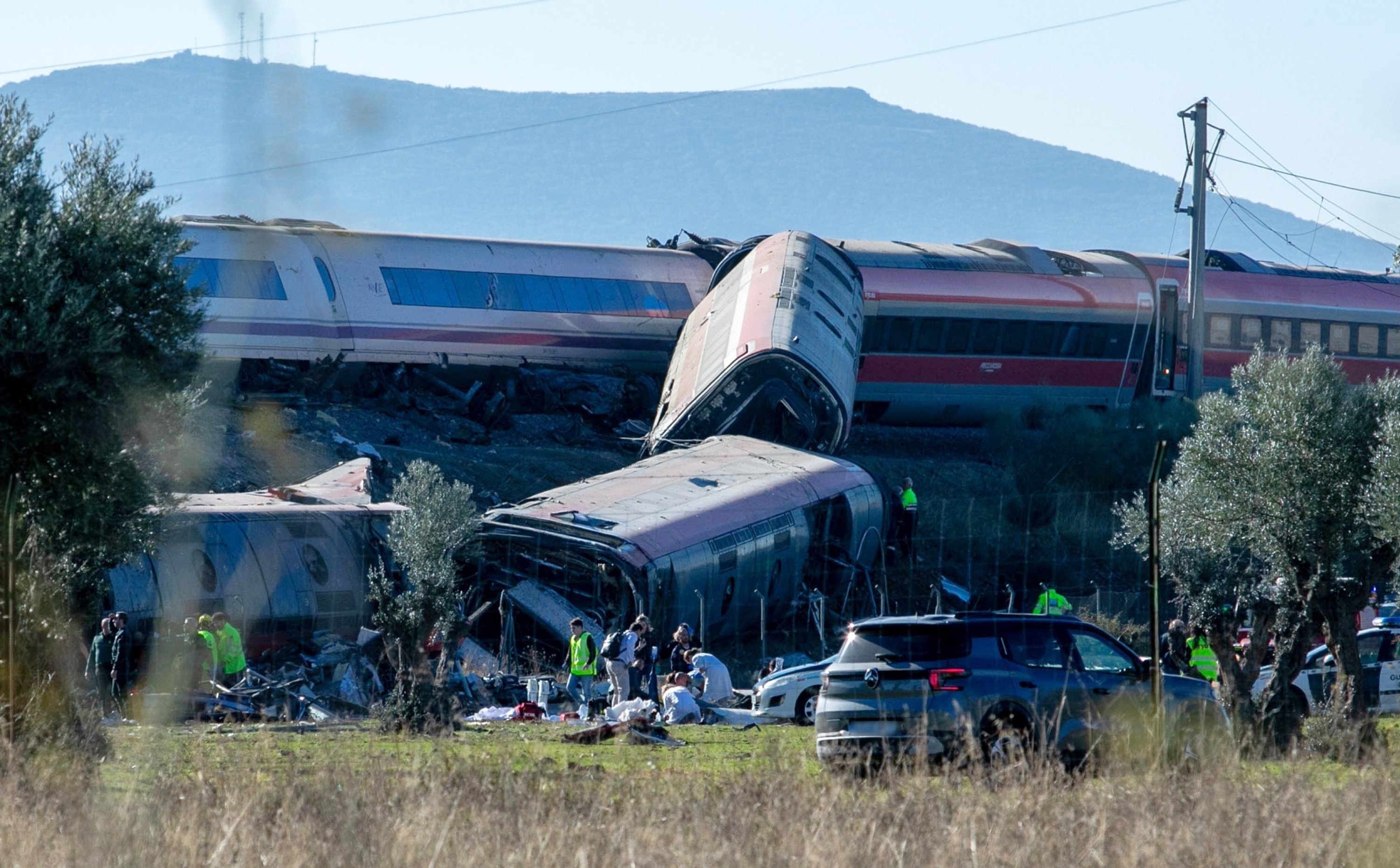
At least 10 people were killed Wednesday when two high-speed trains collided in central Spain, derailing carriages and prompting the suspension of rail services connecting Madrid with southern Spain, authorities said.
Officials warned that the death toll could rise as emergency crews worked to rescue passengers and assess the damage.
The collision occurred shortly after 9 a.m. near the towns of Mora and Orgaz, in Toledo province, on the high-speed line linking Madrid and Seville, according to Spain’s rail infrastructure operator ADIF.
The crash involved trains operated by state-owned Renfe and private rail company Iryo. A Renfe train struck the rear of an Iryo train that had stopped, knocking two Iryo carriages off the tracks, regional authorities said. The cause of the collision was not immediately known.
Esther Padilla, a spokeswoman for the Castilla-La Mancha regional government, confirmed 10 deaths and warned that the number would likely increase as rescue operations continued.
The two trains were carrying hundreds of passengers. The Renfe train had 397 people aboard, while the Iryo service was carrying 147, according to regional authorities.
ADIF announced on X that rail traffic on the Madrid-Andalusia high-speed line had been suspended following the collision. The disruption affected services between Madrid, Ciudad Real and Andalusia.
Emergency services mobilized rescue teams to the scene to assist injured passengers. Manuel Galán, the mayor of nearby Urda, told Spanish state broadcaster TVE that emergency officials had asked his town hall to prepare a sports pavilion to accommodate passengers affected by the crash.
Emiliano Garcia-Page, president of the Castilla-La Mancha region, said on X that he was traveling to the crash site.
The collision came months after another deadly rail disaster in southern Spain. In January, 46 people were killed when a train derailed near Adamuz in Cordoba province and collided with an oncoming train.
That crash was Spain’s deadliest rail accident since 2013, when a train derailed near Santiago de Compostela, killing 80 people. The January disaster raised concerns about railway safety and public confidence in the country’s extensive high-speed rail network.
Investigators will seek to establish what caused Wednesday’s collision. Meanwhile, emergency crews continued responding to the crash, and rail services remained suspended along the affected route.