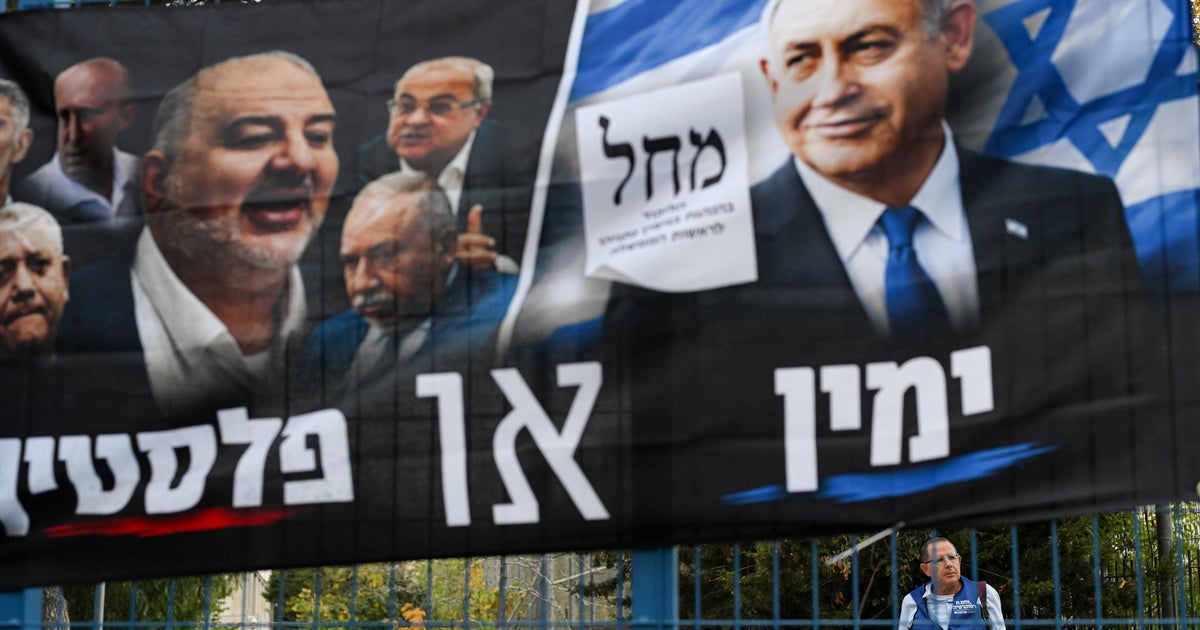
It’s just after 9am in Tel Aviv where Israelis are grappling with the results of yesterday’s elections, with no clear victor and uncertainty guaranteed at this point.
-
With 50% of the vote counted, Israeli media report that Netanyahu’s bloc is ahead, with projections he could take 55 seats under the current vote share. The projections put Gadi Eisenkot’s opposition bloc on 49 seats and the Palestinian parties on 16 seats. Sixty-one seats are needed to form a majority to govern in the Knesset, and the final seat projection will probably be updated as more votes are counted.
-
Exit polls published by Israel’s major TV networks show Benjamin Netanyahu’s governing bloc tied with the opposition grouping led by Gadi Eisenkot on 51 seats each. Earlier exit polls had Eisenkot winning most seats in the Knesset by a slight margin. Israeli exit polls are often revised after publication and are notoriously imprecise, with the final count often swinging by several seats.
-
Voter turnout surged to the highest level in more than two decades, underscoring the stakes of an election that has been labelled the most important in the country’s history. More than 77% of eligible voters cast a ballot, according to Israel’s central elections committee, about 7 percentage points higher than in 2022.
-
The Palestinian parties are projected to dramatically increase their representation in the Knesset, with exit polls showing they could win as many as 18 seats, up from 10. Experts have said that if Eisenkot falls short of a majority, as the exit polls suggest, he would be obliged to sit down to talk to the Palestinian groupings, the Joint List and Ra’am, to try to form a government – which could take weeks.
-
Netanyahu took the stage at a post-election rally in Jerusalem just after 3am, telling his supporters official results will show that “Likud is the largest party in Israel”. He told his supporters that the country must “establish a strong, right-wing national government” – adding that a government that relies on the support of Palestinian parties must not be formed.
-
Eisenkot told cheering supporters in Tel Aviv that the “Israeli public has voted against Netanyahu’s service as Israel’s prime minister … a worthy leader would have accepted the people’s non-confidence and announced today his retirement from politics.” In his speech, he also warned Netanyahu not to “use Israel’s security” for political ends, playing on fears that the prime minister could use this period of uncertainty to launch a new attack on Iran.
-
The exit polls were released after a last-ditch effort by Netanyahu and several other parties to keep polling stations open beyond their 10pm deadline was rejected by the Central Elections Committee. The prime minister suggested publicly that efforts were being made by the “left and Arabs” to steal the election, a claim rejected by the committee, which said it had seen no evidence of systematic tampering.
As the vote count flows in, Yair Golan, leader of the Democrats, issued a strong statement rejecting attempts to frame results as a tie, and warning against the racist exclusion of Palestinian representatives from a future government.
Golan leads the only centre-left party in the Jewish-Israeli opposition bloc. Many of the parties in that anti-Netanyahu ‘Change’ grouping have explicitly ruled out governing with Palestinian Israeli parties.
The unofficial leader of the bloc, Gadi Eisenkot, has laid out conditions for joining his coalition that effectively bar the Arab parties.
This morning Golan says:
There is one resounding lesson from the reality we face: we have no future here unless we stop being afraid. And unless we put an end to racism. We must no longer accept Netanyahu’s racist division between Jewish votes and Arab votes.
The vote of an Israeli citizen casting a ballot in Tira is worth exactly the same as the vote of an Israeli citizen casting a ballot in Givat Shmuel. Not less. Not approximately the same. Exactly the same.
Anyone who tries to erase the votes of Arab citizens is surrendering to Netanyahu and giving up on Israel.
The largest Palestinian-Israeli alliance, the Joint List, is expected to get significantly more seats in the Knesset than the Democrats. With two thirds of votes counted, the Joint List is on track for 12 seats, and the Democrats for 8.
Golan said the clearest message from voters was that Netanyahu’s coalition has lost its majority, and its mandate to rule.
I know how to count to 120 [the number of seats in parliament]. 65 is more than 55. That is how Israeli democracy works. Period.
We have a majority. We have a responsibility. And we have an opportunity to form a change government in partnership with Arab citizens of Israel—a government that serves all Israeli citizens.
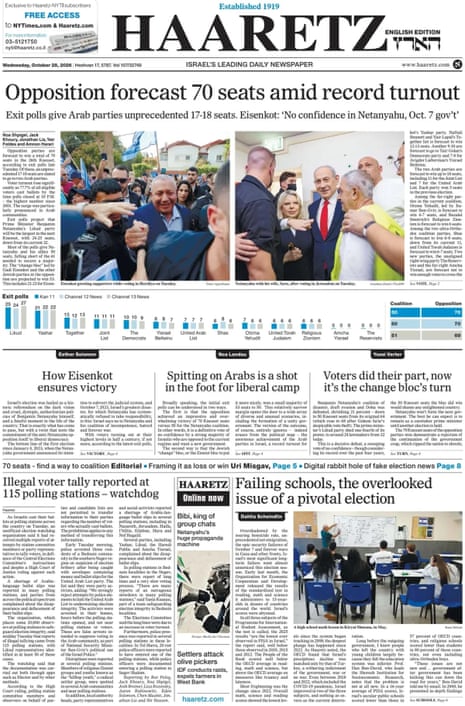
It’s worth noting the front page headlines in Israeli media today, printed before dawn so slightly out of date on some of the projections.
But the top headlines for each masthead are notable – with most highlighting the rise in the Palestinian-Israeli parties. The fact that there is no clear government formation had been expected; as we’ve reported, no single political party has ever won an outright majority in Israel’s political history so governments have also been coalitions of multiple parties. The papers did indicate a slight lead among the opposition bloc.
Yedioth Ahronoth:
-
Eisenkot on His Way to the President
-
Small Parties Fall Beneath the Electoral Threshold
-
Surge in Arab Sector Vote
Ma’ariv:
-
Vote of No-Confidence
-
Exit Polls on All Channels: Pro-Change Bloc: 52; Netanyahu Bloc: 50; Arab Parties: 18
-
A Masterpiece of Delicate Embroidery
Ha’aretz:
-
Exit Polls: 70 Seats for Opposition, 18 of Them from Arab Parties
-
Self-Defensive Democracy
-
Voter Turnout was 77.7%, Highest Since 1999
Israel Hayom
-
No Clear Government
-
Record Number for Arab parties: 18 Seats
-
Haredi Parties Drop to 12-15 Seats
We’re expecting a sharper picture of results just after 10am local time, where a majority of votes will be tallied and crucially, key counting from areas supporting Palestinian parties will have come in.
As of 9.16am local time, 65% of the vote had been counted showing the Netanyahu bloc on 56 seats, the Eisenkot-anchored ‘Change’ bloc on 48, and Palestinian Israeli parties with 16.
Hours after Israel’s polling stations closed, and with more than half of votes counted, several things are clear.
Benjamin Netanyahu’s current coalition has lost its mandate, Palestinian citizens of Israel have secured a key bloc of seats on the back of historic turnout, and the main Jewish-Israeli opposition bloc has no clear path to power without their support.
By 8am Israeli time, partial results put the opposition bloc led by former Israeli military chief Gadi Eisenkot on 49 seats, behind Netanyahu’s coalition at 55 seats. Palestinian-led parties are forecast to secure the remaining 16 seats, but several key towns were yet to report their counts.
A more complete picture is expected by late morning. Exit polls had put Eisenkot in a stronger position, and Israeli political analyst Nadav Eyal said around 6am local time that the pollsters were standing behind their samples.
They haven’t corrected further, and apparently validated their exit polls against the true results at the polling stations. In their view, these will be the final results.”
He noted that samples in Israel have historically been very accurate in forecasting the size of potential coalition blocs, but also that Likud’s strength is often underestimated.
Exit polls also do not capture absentee ballots, although these are fairly restricted under Israel’s voting system. Eligible groups include diplomats, serving soldiers and people medically unable to reach polling stations.
It’s just after 9am in Tel Aviv where Israelis are grappling with the results of yesterday’s elections, with no clear victor and uncertainty guaranteed at this point.
-
With 50% of the vote counted, Israeli media report that Netanyahu’s bloc is ahead, with projections he could take 55 seats under the current vote share. The projections put Gadi Eisenkot’s opposition bloc on 49 seats and the Palestinian parties on 16 seats. Sixty-one seats are needed to form a majority to govern in the Knesset, and the final seat projection will probably be updated as more votes are counted.
-
Exit polls published by Israel’s major TV networks show Benjamin Netanyahu’s governing bloc tied with the opposition grouping led by Gadi Eisenkot on 51 seats each. Earlier exit polls had Eisenkot winning most seats in the Knesset by a slight margin. Israeli exit polls are often revised after publication and are notoriously imprecise, with the final count often swinging by several seats.
-
Voter turnout surged to the highest level in more than two decades, underscoring the stakes of an election that has been labelled the most important in the country’s history. More than 77% of eligible voters cast a ballot, according to Israel’s central elections committee, about 7 percentage points higher than in 2022.
-
The Palestinian parties are projected to dramatically increase their representation in the Knesset, with exit polls showing they could win as many as 18 seats, up from 10. Experts have said that if Eisenkot falls short of a majority, as the exit polls suggest, he would be obliged to sit down to talk to the Palestinian groupings, the Joint List and Ra’am, to try to form a government – which could take weeks.
-
Netanyahu took the stage at a post-election rally in Jerusalem just after 3am, telling his supporters official results will show that “Likud is the largest party in Israel”. He told his supporters that the country must “establish a strong, right-wing national government” – adding that a government that relies on the support of Palestinian parties must not be formed.
-
Eisenkot told cheering supporters in Tel Aviv that the “Israeli public has voted against Netanyahu’s service as Israel’s prime minister … a worthy leader would have accepted the people’s non-confidence and announced today his retirement from politics.” In his speech, he also warned Netanyahu not to “use Israel’s security” for political ends, playing on fears that the prime minister could use this period of uncertainty to launch a new attack on Iran.
-
The exit polls were released after a last-ditch effort by Netanyahu and several other parties to keep polling stations open beyond their 10pm deadline was rejected by the Central Elections Committee. The prime minister suggested publicly that efforts were being made by the “left and Arabs” to steal the election, a claim rejected by the committee, which said it had seen no evidence of systematic tampering.
Turnout among Israeli army personnel was 79.9%, an increase of 6.2% from the 2022 elections, according to the IDF.
In its statement, the IDF said that 809 polling stations were deployed throughout the country’s bases and in combat zones.
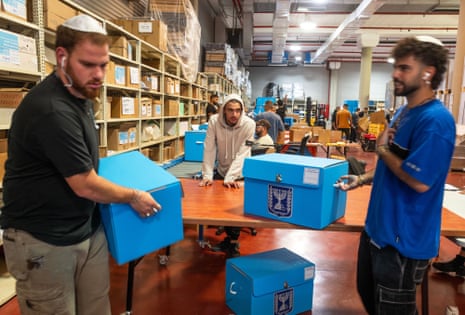
Under Israeli electoral law each voter is assigned to a specific polling station and can only vote at that station. However in exceptional circumstances, some voters are allowed to cast their ballot at special polling stations they are not registered at; among those afforded this exception are IDF personnel.
Ballot boxes from these special polling stations are transported directly to the Knesset where they undergo a series of checks before they are counted.
One apparent loser from Tuesday’s election was far-right national security minister Itamar Ben-Gvir, who was expected to better his party’s result of six seats from the 2022 elections.
But instead there was stunned silence at the watch party for Otzma Yehudit (Jewish Power) in central Israel as results from the exit polls flashed across the screen, with most channels suggesting the party would remain on just six seats.

Speaking earlier in the evening, Ben-Gvir attempted to revive his supporters spirits by reminding them of all he had achieved in the past four years to further their agenda, including passing a law approving the death penalty for Palestinians convicted of murdering Israelis and worsening conditions for Palestinian prisoners.

He also denounced other members of Netanyahu’s coalition who had suggested a unity government with his main rival, Gadi Eisenkot, which the audience booed loudly.
This is precisely the scenario we warned against – it is a terrible mistake.”
The big gains made by Palestinian parties in Israel’s general election pose an urgent and fundamental challenge to the country’s mainstream opposition: either cooperate with Arab Israelis or hand Benjamin Netanyahu a roadmap to political survival.
In the wake of Tuesday’s exit polls, the leader of the opposition bloc, Gadi Eisenkot, declared them a victory for “Israel’s Zionist national majority” but the real outcome looks as if it will be far more complex than that.
The greatest change between the new Knesset and the old will be the dramatically increased representation of Palestinian parties, currently projected to win 17 to 18 seats, up from 10. That redraws the battle lines on Israel’s political landscape. Arab Israelis will not so easily be sidelined and ignored.
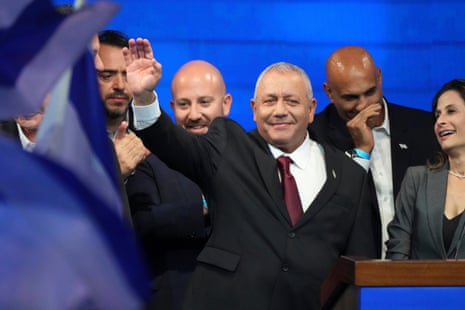
Eisenkot could argue he has a chance of negotiating his way to a Knesset majority. To do so, however, he and his partners in the “change” bloc would be obliged to sit down to talk with the Palestinian groupings, the Joint List and Ra’am (an acronym for the United Arab List).
They would probably find Ra’am and its leader, Mansour Abbas, easier to talk to. Abbas has already participated in a right-leaning government of Naftali Bennett, now a junior partner in the Eisenkot bloc. Abbas has shown willingness to make political compromises and stated emphatically on Tuesday that his priority is to “bring down Benjamin Netanyahu, Smotrich, and Ben Gvir in this election”.
However, most estimates based on the exit polls show Ra’am as the smaller of the two Palestinian groupings, with seven projected seats in the new Knesset and it is not clear that would be enough, even if a pact was made with the consent of the other members of Eisenkot’s bloc, to produce a majority government.
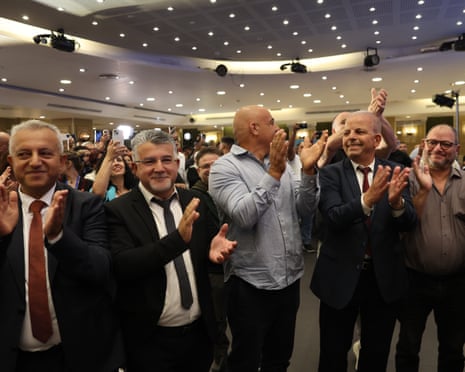
Negotiations with the Joint List, with 10 or more projected seats, would be tougher. Eisenkot has laid down four conditions: recognise Israel as a Jewish and democratic state, accept the values expressed in Israel’s declaration of independence, accept conscription for Palestinians Israeli citizens, who are currently exempt, and denounce Hamas as a terrorist organisation.
Speaking on Tuesday as the votes were being counted, Amjad Shbita, the general secretary of Hadash, the socialist party that is the biggest faction in the Joint List, said Eisenkot would be in no position to impose terms for coalition talks.
With 50% of the vote counted, Israeli media report that Netanyahu’s bloc is ahead, with projections he could take 56 seats under the current vote share.
The projections put Gadi Eisenkot’s opposition bloc on 49 seats and the Palestinian parties on 15 seats.
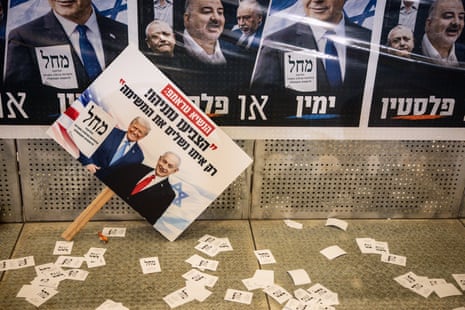
Sixty-one seats are needed to form a majority to govern in the Knesset, and the final seat projection will probably be updated as more votes are counted.
Exits polls earlier in the evening had both Netanyahu’s and Eisenkot’s bloc tied on about 51 seats.
The lead that exit polls gave to the opposition bloc early in the night has disappeared, with Netanyahu’s grouping now neck and neck with Gadi Eisenkot.
Israeli television networks gave the two blocs approximately 51 seats each in the 120 member Knesset – well below the 61 needed to govern. Palestinian parties meanwhile saw a surge in support, with exit polls showing them winning 17 or 18 seats between them.
What’s next?
Parties will attempt to reach a majority
No single party has ever reached the requisite 61 seats needed to form a government in the Knesset, so parties must work together to form governing coalitions.
President Isaac Herzog will name a candidate who has the best chance to form a government – not necessarily the party with the most seats – but with the exit polls showing both parties falling short of a majority that process could take weeks.
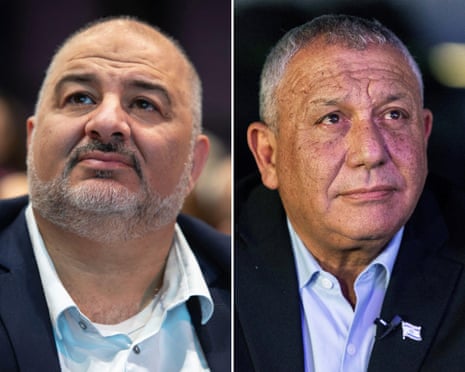
Coalition building in Israel has always been difficult because mainstream parties usually refuse to collaborate with parties run by Palestinian citizens of Israel. However some have suggested Eisenkot could begin discussions with the Palestinian groupings who have seen a surge in support.
Palestinian grouping Ra’am is seen as a potential kingmaker if Netanyahu fails to secure enough votes to try to form a government. Their leader, Mansour Abbas, participated in a right-leaning government in the past.
However Eisenkot’s camp kept them at arm’s length during the campaign, perceiving their support as a liability. In the past he has said Arab-led parties do not meet Zionist criteria to govern.
For Netanyahu’s bloc, however, there is no obvious place to pick up more seats, save for defections. Addressing his supporters in the early hours of Wednesday morning, he said that a government that relies on the support of Palestinian parties must not be formed.
Coalition negotiations can be arduous and can produce unstable governments. It took Netanyahu 58 days to form his government after the previous election in November 2022.
A minority government could be attempted
If no bloc manages to secure 61 seats, a candidate could attempt to govern without a majority but rather through support on an ad hoc basis from other lawmakers.
In this scenario, lawmakers from the Palestinian parties whose representation in the Knesset is likely to have increase, could play a critical role.
The Joint List – which represents a number of Israeli Arab parties – has said it would be unlikely to join a coalition government outright, but has offered to provide a “safety net” for anyone that ousts Netanyahu from power.
A national unity government?
While appearing fanciful at first glance, Israeli commentators have mused in recent weeks on the possibility of a national unity government in which Netanyahu would jettison his far-right allies as well as ultra-Orthodox parties and team up with Eisenkot, who shares Netanyahu’s views on many security issues.
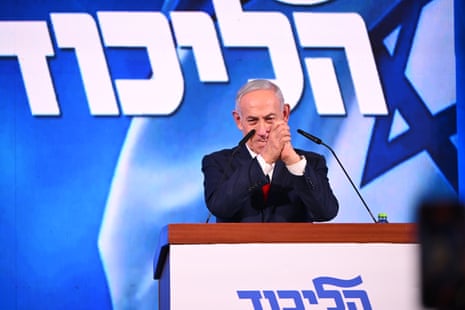
Amit Segal, the chief political analyst for Channel 12 and journalist seen as close to Netanyahu, suggested that the prime minister’s extortion that the “Zionist majority must come to its senses and unite”, could be interpreted as an olive branch to Eisenkot.
This scenario has a recent precedent. In 2020, Netanyahu and Benny Gantz, like Eisenkot a retired general appealing to the centre, reached a power-sharing agreement, but their partnership fell apart after a year, triggering another election.
A unity government in the present situation would face strong opposition from both sides, particularly the opposition bloc, which has built its campaign around ousting Netanyahu, casting him as unfit to lead.
New elections
If no candidate manages to form a government, Israel will have to return to the polls.
The country held five elections between 2019 and 2022 due to the inability of politicians to forge a lasting coalition.
However if we a new set of polls is on the horizon, they are not likely to happen for weeks at the minimum, with the candidate designated by the president having 28 days to form a coalition, with a possible two week extension.
Israel could be in for weeks of political haggling after exit polls and partial official results showed neither Benjamin Netanyahu’s coalition nor the opposition bloc led by former general Gadi Eisenkot had won enough seats to form a government.
The polls published by Israel’s major TV networks show Netanyahu’s governing bloc tied with the opposition grouping led by Eisenkot on 51 seats each, short of the 61 seats needed to form a majority coalition government.
Speaking at 3 am local time, Israel’s longest-serving prime minister vowed to assemble a coalition through agreements between his Likud party, far-right factions and Jewish religious parties.
“We must put in place a strong government of the right,” Netanyahu told cheering supporters. “The Jewish and Zionist majority must unite,” he added.

Eisenkot, speaking to his own supporters in Tel Aviv, said earlier in the evening that “people decided in favour of change” and Netanyahu should have “announced today his retirement from politics”.
The election was marked by a record participation by Israeli citizens of Palestinian origin, a discriminated minority that makes up about 20% of the country’s population. Many in the group have sought a stronger political voice after decades of boycotting polls in the Jewish state. Millions of other Palestinians living under Israeli rule in the occupied West Bank and Gaza cannot vote, leading to accusations of apartheid.
Exit polls predicted Palestinian parties could win about 18 seats, up from 10. However, their role in any coalition would be difficult. Netanyahu has said it was “out of the question” to have a government backed by Palestinian parties, while Eisenkot has said Arab-led parties do not meet Zionist criteria to govern.
Donald Trump has said he is “hearing that [Netanyahu] did very well,” speaking to reporters at Joint Base Andrews, Maryland. “I actually heard he did pretty well.”
Trump cautioned that it was a “little bit early” and said he has not yet spoken with Netanyahu about the results. Trump endorsed Netanyahu late in the campaign, while Netanyahu stressed his close ties with the White House in his election night speech.
Later on, Trump posted a quote to social media, crediting the support he gave to Benjamin Netanyahu for effecting the outcome of the elections, which remain far from clear.
Attributing the lines to “Irving C. Schwartz”, the US president has posted:
When President Trump endorsed Bibi Netanyahu, the whole tide turned, and now, rather than a decisive defeat for a Great Prime Minister, it looks like a big come-from-behind stalemate, or even a WIN for Netanyahu. It all took place AFTER the Endorsement by President Trump, who only wants what is good for the Middle East, Israel, and the United States of America!”
A record number of Israelis are expected to have voted at “special polling stations” in 2026, casting more confusion into the mix as the results as these ballots are not expected to be announced before Thursday.
Under Israeli electoral law, each voter is assigned to a specific polling station and can only vote at that station. However in exceptional circumstances, some voters are allowed to cast their ballot at special polling stations they are not registered at. Among those afforded this exception are soldiers stationed at IDF bases, diplomats working abroad, prisoners and prison guards and people in hospital.
Ballot boxes from these special polling stations are transported directly to the Knesset where they undergo a series of checks before they are counted.
According to some reports, Israel’s Central Elections Committee expects between 600,000 and 650,000 people to vote in such a way, almost 10% of elegible voters and an unprecedented number in Israeli electoral history.
While the count continues, let’s recap some of the comments made by Benjamin Netanyahu and rival Gadi Eisenkot in their speeches to supporters.
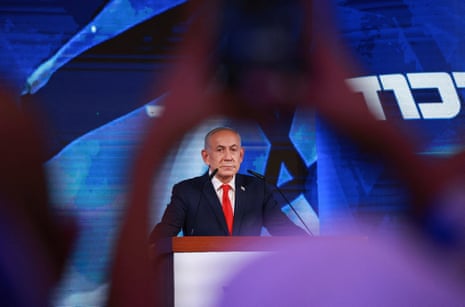
Netanyahu greeted cheering supporters at a Jerusalem convention centre after 3am. The 77-year-old prime minister was unusually brief and did not directly claim victory. He called for a “strong government of the right” and said that the “Jewish and Zionist majority must unite”.
He also listed leaders Israel has killed under his orders and again hinted that he was ready for a third bombing campaign against Iran alongside Donald Trump. “Israel has a unique opportunity with our partner President Trump to forever eliminate the existential threat of Iran,” he said.
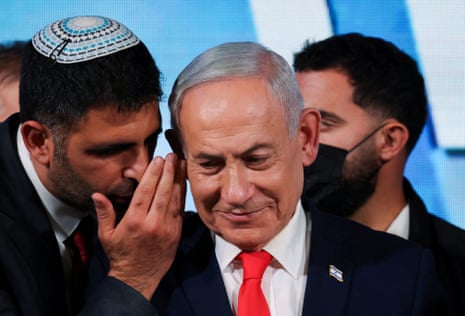
Eisenkot, speaking earlier to his own supporters in Tel Aviv, issued a veiled warning to Netanyahu, who observers say could use a war to push for a unity government.
“Netanyahu, don’t you dare use Israel’s security for your political needs,” he said.
Addressing Israel’s security establishment, Eisenkot said that they served the state and not Netanyahu, calling him “a caretaker prime minister, without a mandate or the people’s trust”.
Supporters of the opposition bloc breathed a sigh of relief after the first exit polls were announced, but as the night has worn on nervousness has grown on both sides.
With exit polls shifting to put the two sides on equal footing, Agence France-Presse is reporting that voters like former Hamas hostage Ohad Ben Ami have expressed alarm that Netanyahu could come out ahead.

“Three years ago, the government abandoned us,” he said.
An Israeli citizen should never have spent a year and a half in Hamas tunnels when deals [with Hamas] were on the table.”
Netanyahu kept supporters waiting until past 3am in a Jerusalem convention centre. Known for his long, passionate speeches, he was unusually brief.
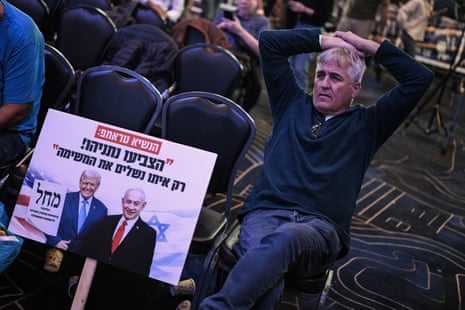
Ari Marx, holding a large sign bearing the prime minister’s image, said he was not “scared” of the results or of another war with Iran, which Netanyahu has threatened.
“Either Bibi is going to win or there’s going to be a new election,” he said, using Netanyahu’s nickname, doubting anyone else could form a government.
It’s just after 6am in Tel Aviv where Israelis are waking up to exit polls that show no clear victor in yesterday’s elections, with uncertainty guaranteed at this point.
The polls published by Israel’s major TV networks show Benjamin Netanyahu’s governing bloc tied with the opposition grouping led by Gadi Eisenkot on 51 seats each, short of the 61 seats needed to form a majority coalition government.
Earlier exit polls had Eisenkot’s bloc winning most seats in the Knesset by a slight margin. Israeli exit polls are often revised after publication and are notoriously imprecise, with the final count often swinging by several seats.
Voter turnout surged to the highest level in more than two decades, underscoring the stakes of an election that has been labelled the most important in the country’s history. More than 77% of eligible voters cast a ballot, according to Israel’s central elections committee, about 7 percentage points higher than in 2022.
Final counting is ongoing, with more than 30% of the votes tabulated so far.
The Palestinian parties are projected to dramatically increase their representation in the Knesset, with predictions they could win as many as 18 seats, up from 10. Experts have said that if Eisenkot falls short of a majority, as the exit polls suggest, he would be obliged to sit down to talk to the Palestinian groupings, the Joint List and Ra’am, to try to form a government – which could take weeks.
It is also possible that Eisenkot could try to govern as a minority government, with informal vote-by-vote agreements that would keep the new coalition afloat.
-
Netanyahu took the stage at a post-election rally in Jerusalem just after 3am, telling his supporters official results will show that “Likud is the largest party in Israel”. He told his supporters that the country must “establish a strong, right-wing national government” – adding that a government that relies on the support of Palestinian parties must not be formed.
-
Eisenkot told cheering supporters in Tel Aviv that the “Israeli public has voted against Netanyahu’s service as Israel’s prime minister … a worthy leader would have accepted the people’s non-confidence and announced today his retirement from politics.” In his speech, he also warned Netanyahu not to “use Israel’s security” for political ends, playing on fears that the prime minister could use this period of uncertainty to launch a new attack on Iran.
-
The exit polls were released after a last-ditch effort by Netanyahu and several other parties to keep polling stations open beyond their 10pm deadline was rejected by the Central Elections Committee. The prime minister suggested publicly that efforts were being made by the “left and Arabs” to steal the election, a claim rejected by the committee, which said it had seen no evidence of systematic tampering.
The Guardian wp:paragraph
هلدینگ کاسپین استانبول | خرید ملک در ترکیه | صرافی معتبر ایرانی در ترکیه | خرید و فروش طلا در ترکیه | مهاجرت به ترکیه | واردات و صادرات در ترکیه | نیازمندیهای ترکیه | اخبار ترکیه | اخبار جهانی | توریست ایران | خدمات توریستی در ایران | تورهای گردشگری ایران | هلدینگ اول | خدمات کاریابی و فریلنسری و شغل | مرجع اطلاعات ایران (همه چیز در ایران) | کیف پول و خدمات مالی و پرداخت یار | اخبار ایران | تابلو زنده قیمت ارز در ترکیه و استانبول | صرافی آنلاین ترکیه | قیمت طلا و نقره در ترکیه | سرمایه گذاری در ترکیه | جواهرات در ترکیه | نرخ لحظه ای ارزها در استانبول | قیمت دلار امروز در ترکیه | قیمت دلار استانبول امروز | قیمت لحظه ای دلار | اخبار روز ترکیه استانبول | اپلیکیشن ISTEX | اپلیکیشن قیمت لحظه ای دلار و یورو و لیر و ارزها در ترکیه
/wp:paragraph wp:paragraph /wp:paragraph
About the Author