Home – CBSNews.com
Yemen’s Iran-backed Houthis said Friday that a Saudi strike on a market in southwestern Yemen had killed or wounded 30 people.
The Houthis’ Saba news agency said the “horrific massacre” had “resulted in the martyrdom and injury of more than 30 citizens.”
The Houthis’ political bureau said in a statement carried by Saba: “It is regrettable that these documented Saudi crimes have become like a forgotten file in the drawers of the United Nations and the so-called international community.”
Yemen’s Iran-backed Houthi rebels said Friday that the Saudi-led coalition fighting on behalf of Yemen’s internationally recognized government had targeted a market in the southwest of the country, killing and wounding “dozens of civilians.”
Houthi military spokesperson Yahya Saree said in a post on X that Saudi aircraft struck the Al-Hadara market in the Taiz governorate on Friday “with three airstrikes, leaving dozens of civilians dead and wounded.”
“These brutal crimes will not go unanswered and unpunished,” he added.
The Saudi-led coalition said Friday, meanwhile, that air defense systems had intercepted two ballistic missiles launched by the Houthis at Najran, a major city in southwest Saudi Arabia.
Iran’s Revolutionary Guard claimed Friday to have destroyed another U.S. drone over Qeshm Island in the Strait of Hormuz.
In a statement carried by the state TV network IRIB, the IRGC said a U.S. MQ-1 drone was “intercepted and destroyed over Qeshm Island by the IRGC’s new advanced air defense system.”
The IRGC claimed this was the 16th American MQ-1 drone it had intercepted during the war, and the second in two days. Iranian forces have also claimed to have shot down other U.S. drones, including more than two dozen of the more advanced, and more expensive MQ-9 Reapers.
A seafarer was killed in an explosion caused by a suspected missile attack on an oil tanker Thursday in the Persian Gulf, a Greek company that manages the vessel said Friday.
The MT Velos Sapphire, a Marshall Islands-flagged tanker, which was not carrying cargo, was hit Thursday as it sailed toward Bahrain, management firm Velos Tankers said in a statement, according to Reuters.
“The company is greatly saddened to report the death of one of its seafarers, who was found fatally injured on board after having initially been reported missing in the aftermath of the explosion,” the statement said.
Velos said, according to Reuters, that no crew members were injured and they managed to extinguish a fire on the ship caused by the blast.
The vessel was brought to Khalifa Bin Salman Port in Bahrain, and the damage to its hull was still being assessed, Reuters said.
The Saudi-led coalition fighting the Iran-backed Houthis said Friday that it had intercepted a drone in the region of Mecca, Islam’s holiest city, following repeated attacks on Saudi Arabia by the Yemeni rebels.
“Interception and destruction of a drone in the Mecca region,” Turki al-Malki, the coalition’s spokesman, wrote on X, without elaborating.
Since the breakdown of a truce in July, Saudi Arabia has traded blows with the Houthis, who have retaliated with strikes on Saudi airports, energy infrastructure and military sites that killed at least 20 people in October.
The Houthis have repeatedly denied targeting the holy cities of Mecca or Medina in Saudi Arabia and said they would not do so.
On Thursday, the Saudi coalition said it intercepted a missile fired by the Houthis at the Medina region, a claim rejected by the Iranian proxy group as a “blatant and grave falsehood.”
CBS/AFP
The Iranian supreme leader’s adviser on international affairs, Aliakbar Velayati, said Friday that Iran was now “one of the main architects” of security in the Middle East.
Referring to how the U.S.-Iran war has changed the region in a series of posts on X, Velayati said that a “tsunami of geopolitical changes in West Asia swept up the Israeli and U.S. elections,” and that “Iran is now one of the main architects of the regional order, a reality that cannot be erased or replaced.”
Iran is a “bridge between the Persian Gulf, Central Asia, the Caucasus, and the Sea of Oman,” he added, saying that “any energy or transit corridor seeking to bypass us will either be costly or unstable.”
“The domino effect of crises, from Gaza to the Red Sea and from Lebanon to Iraq, has shown that regional security is indivisible,” Velayati said. “Either collective security is achieved, or everyone will experience collective insecurity.”
Iran’s Supreme Leader Mojtaba Khamenei has not been seen in public since being wounded in the strikes that killed his father on Feb. 28.
A tanker was hit by an explosion Thursday in the Strait of Hormuz, a British navy agency said Friday.
The master of a tanker leaving the Strait of Hormuz near Oman’s coast reported “an explosion at the waterline” of the vessel, the United Kingdom Maritime Trade Operations center said, adding that the crew were all safe and the ship was “still under its own power and is continuing on its voyage.”
Iran’s state media reported Thursday that five oil tankers and a tugboat had caught on fire in or near the strait after hitting sea mines. It was unclear if the UKMTO report was in relation to one of those incidents claimed by Iran.
Iran’s Islamic Revolutionary Guard Corps claimed Friday, in a statement carried by state media, that two more oil tankers had hit mines and caught on fire in or near the strait.
President Trump has accused Iran of lying about such incidents in an effort to drive up energy prices.
President Trump called Qatari Emir Sheikh Tamim bin Hamad Al Thani to discuss efforts to end the U.S.-Iran war, a U.S. official confirmed to CBS News Friday, amid a diplomatic push to avoid a new round of major hostilities.
Their discussion, which the White House had not provided any information about by Friday morning, came as Iran’s top diplomat made his own calls Thursday to counterparts across the Persian Gulf aimed at maintaining “stability in the region” amid concerns in many Gulf capitals that Mr. Trump will order major new U.S. strikes.
Al Thani received a call from Mr. Trump, according to a statement from the emir’s office, during which the pair discussed “the latest regional developments, particularly diplomatic efforts aimed at de-escalating tensions in the region.”
The emir “emphasized the importance of continuing dialogue and relying on diplomatic means to settle disputes and prevent further escalation,” the statement said.
Motorists could soon see U.S. gas prices drop below $4 a gallon for the first time since July, according to energy experts.
Patrick De Haan, a petroleum analyst at price-tracking firm GasBuddy, told CBS News he expected the national average for gas, which the price-tracking firm put at $4.06 a gallon on Thursday and early Friday morning, to dip below the $4 threshold by next week. He also predicted diesel could fall below $6 a gallon by Thanksgiving.
Gas and diesel prices have both dropped over the last week, thanks largely to market expectations that the U.S. midterm election results would underscore public dissatisfaction with the Iran war and pile pressure on the Trump administration to make a deal to end the conflict, De Haan said.
“Oil prices have been falling in the run-up to the election,” he said. “My read is because there was optimism that after the midterms these problems would be addressed.”
The Saudi-led coalition backing Yemen’s government said Friday that air defense systems had intercepted and destroyed two ballistic missiles launched by the Iran-backed Houthi rebels at Najran, a major city in southwest Saudi Arabia.
“Debris fell as a result of the interception, and damage assessment is underway,” the statement said.
Iran’s Islamic Revolutionary Guard Corps said in a statement carried by state media Friday that two oil tankers hit mines and caught fire in or near the Strait of Hormuz, a day after Tehran claimed five other tankers had met similar fates.
“Two violating oil tankers — one east of the Strait of Hormuz and the other within the Strait itself — that attempted to transit via an unauthorized route struck mines,” the IRGC said in a statement, according to state news outlets.
“These two tankers had deactivated all their navigation and identification systems. Supported by the aggressive and terrorist U.S. military, they attempted to exit the Strait of Hormuz via an unauthorized path; however, upon striking mines, they caught fire and were immobilized,” the statement said.
On Thursday, Iranian media reported that five oil tankers and a tugboat caught fire in the Strait of Hormuz in similar incidents.
There has been no confirmation of any of the incidents from maritime officials, and President Trump has accused Iran of making up such attacks to drive up global energy prices.
A U.K. naval agency said earlier this week, however, that despite repeated assurances from the U.S. that shipping lanes through the strait are open and safe, there were at least 30 attacks on commercial vessels in the region during October alone, a record high.
Since the war began with joint U.S.-Israeli strikes on Iran on Feb. 28, Tehran has sought to control traffic through the strait, a key passage through which, before the war, about a fifth of global crude oil supplies would typically pass. In response, the U.S. imposed a blockade on Iranian ports.
The U.S. military has escorted tankers through the strait, which, along with other routes has helped bring shipments from the Gulf back up to or at least near to pre-war levels, but ships continue coming under attack.
CBS/AFP
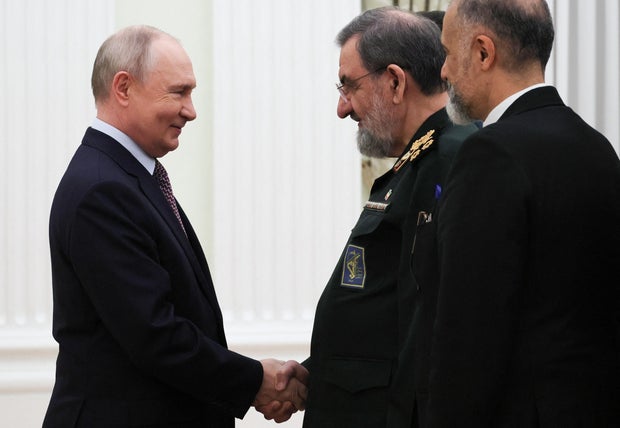
Russian President Vladimir Putin met Iranian security chief Mohsen Rezaei in Moscow Thursday to discuss strengthening ties between the two countries, including with the potential construction of a pipeline for Iran to import Russian gas.
Speaking with journalists after their meeting, Rezaei, secretary of Iran’s Supreme National Security Council, called it “an extremely important exchange,” according to the Iranian embassy in Moscow.
“During the meeting with Mr. Vladimir Putin, discussions were held regarding the construction of gas pipelines from Russia to Iran,” Rezaei was quoted as saying by Iranian state TV.
He noted the aim was to enable Iran “to address its own gas shortages while also facilitating the sale of Russian gas to neighboring countries.”
Alexey Babushkin/Pool/AFP via Getty Images
Despite being a major producer, Iran has long suffered natural gas shortages, which have been exacerbated by the war with the United States and Israel.
During the most intense phase of the fighting, which lasted nearly 40 days, the U.S. and Israel struck key Iranian infrastructure including natural gas refineries, according to Tehran.
CBS/AFP
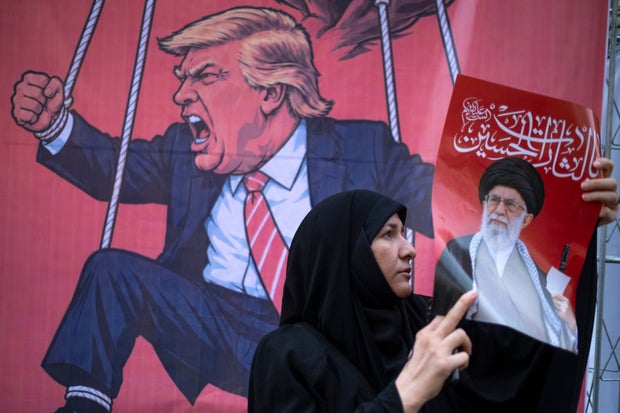
President Trump said Thursday that people will “know soon enough” his decision on whether to order a new round of U.S. strikes to “destroy what is left of” Iran.
“Now we will make a decision [on Iran]. Do we want to go further … and ensure that this will never happen again?” Mr. Trump told reporters in the Oval Office, adding that he believed it would take Iran “25 years to rebuild the country” from the damage already inflicted during the war.
“I would prefer not to destroy what is left of the country, if possible, but I may have to do so. You will know very soon,” he said.
The president kept the possibility of a major new U.S. assault on Iran on the table in the run-up to the midterm elections this week, but hadn’t renewed the threat since his Republican party’s dismal performance in the vote, which he acknowledged was, at least in part, a repudiation of the war.
Morteza Nikoubazl/NurPhoto/Getty
Mr. Trump told the Financial Times newspaper on Tuesday evening, as U.S. ballots were counted, that he had no immediate plans to order new strikes on Iran.
About the Author