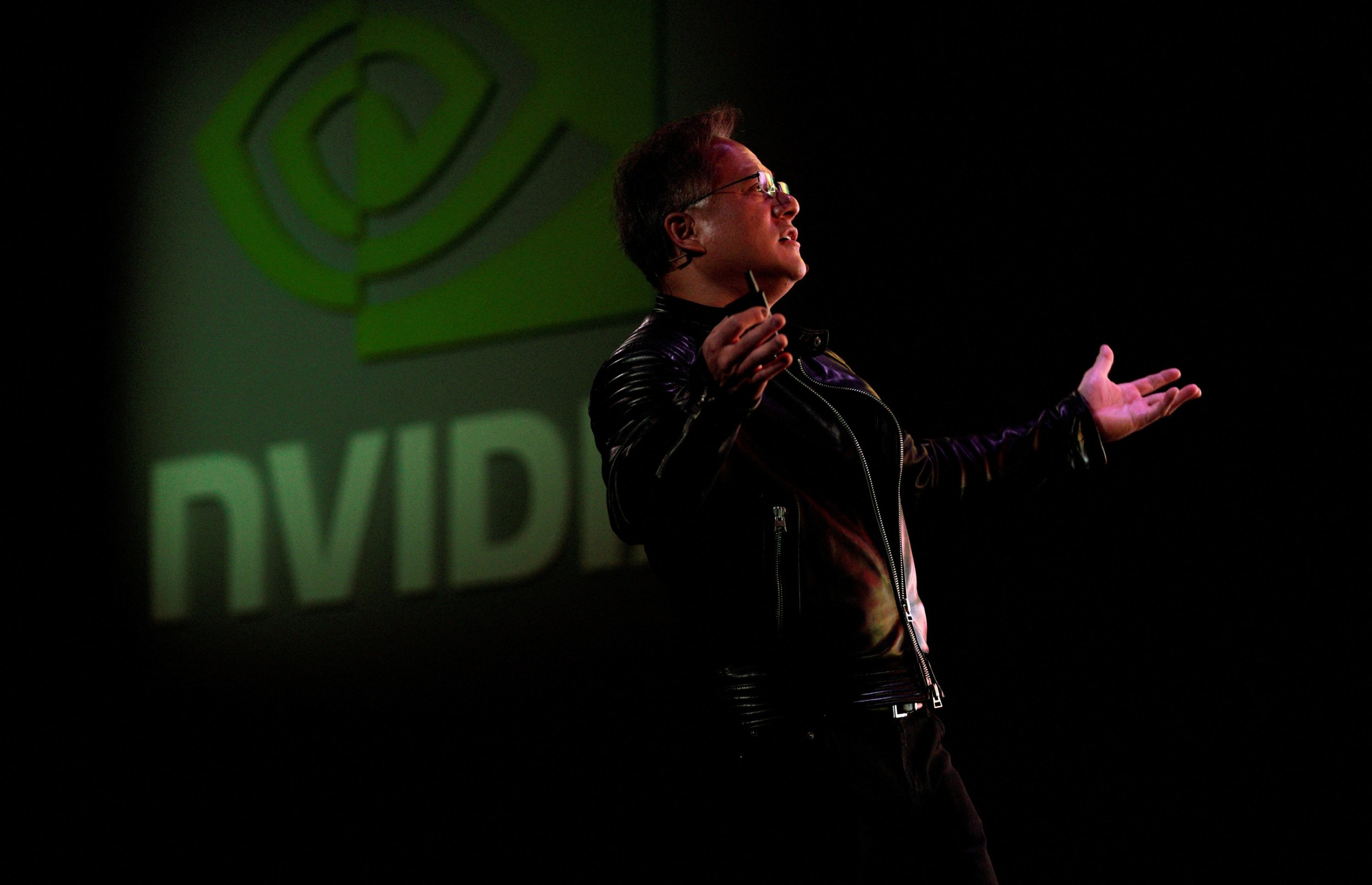
Jensen Huang’s forced exit from Nvidia has left the AI industry without one of its most influential boosters and the chip giant that has been called the “central bank of AI” without its longtime leader at a delicate moment.
Huang resigned Thursday after reports of multiple extramarital affairs, including with a suspected Chinese spy. Chief Financial Officer Colette Kress was named interim CEO.
The departure comes days before the highly anticipated IPO of AI company Anthropic, which is valued at $1.3 trillion, and amid growing concerns about the soundness of the industry’s enormous spending. Nvidia has committed to buying $10 billion worth of shares in the offering.
“Jensen Huang’s resignation is a watershed moment for Nvidia, which now has to prove it can maintain its AI dominance without the leader largely responsible for building it,” said Asa Hiken, a senior analyst at research firm eMarketer.
“And given the broader AI industry’s heavy dependence on Nvidia’s chips, Huang’s departure introduces uncertainty well beyond the company itself.”
Booster with political clout
Huang was a very public face of a company that dominates the market for chips used to train and run AI models. Nvidia and Apple trade places as Wall Street’s most valuable company. In March, Huang predicted Nvidia would face a $1 trillion backlog in chip orders by the end of the year, double his estimate from a year earlier.
He built close ties to U.S. President Donald Trump, accompanying him on Air Force One earlier this year to a summit in Beijing with Chinese leader Xi Jinping. Huang persuaded Trump to allow sales of some of Nvidia’s high-end chips to China despite export controls. He will now be absent when Trump meets Xi next week at the APEC summit in Shenzhen.
While some executives urged slowing AI development over safety concerns, Huang pushed ahead and advocated a light touch on regulation. He is not the only face of AI. OpenAI’s Sam Altman, Google’s Demis Hassabis and Nobel Prize winner Geoffrey Hinton are among the others.
Lizzi C. Lee, a fellow at the Asia Society Policy Institute’s Center for China Analysis, said Huang “had played an outsized role as its chief strategist, dealmaker and – very importantly – political advocate, with close access to both Washington and Beijing.”
Rivals see opening
Shares of Nvidia rivals Broadcom, Intel and Advanced Micro Devices rose as investors bet customers will look to diversify their suppliers. Nvidia’s filings also name cloud companies such as Google, Amazon and Microsoft as competitors.
Some analysts said that could benefit the industry. “This could turn what has effectively been a monopoly into a horse race again, as competitors rush to meet growing demand,” said Bret Greenstein, chief AI officer at the consultancy West Monroe.
Others were more cautious.
Jay Aldebert, chief growth officer of International Services Inc., said Nvidia has long answered each competing chip with a better one.
Chester Spatt, a finance professor at Carnegie Mellon University, said rivals’ gains will be smaller than Nvidia’s losses, though chip buyers may become “much more reluctant to concentrate their purchases with a single source.”
Nvidia’s near-term outlook appears solid. Ming-Chi Kuo, an analyst at TF International Securities, wrote on X that the CEO change would not affect Nvidia’s “product development and competitiveness” until 2028 at the earliest.
Gary Marcus, a longtime tech industry critic, was more pessimistic. He wrote on Substack that “things will clearly never be the same” and predicted “chaos,” adding that “the market may crash.”
Scrutiny of financing
Huang’s relationships fueled Nvidia’s partnerships and investments in companies that buy its chips, a strategy Kress helped drive. That approach is drawing closer scrutiny. Critics have questioned what they call circular dealmaking, including a financing guarantee of more than $100 billion for a new OpenAI data center in Ohio.
CoreWeave, which buys Nvidia chips and rents access to them, closed down nearly 7% Thursday. Nvidia holds a nearly 13% stake in the company.
Aldebert said tech leaders likely spent Thursday looking for a “backup plan” for some financing, and he called the practice of circular financing “incestuous.”
The fallout also lands after midterm elections marked by hostility toward data centers, which brought in many Democrats promising aggressive AI regulation.
Lee said the scandal is likely to prompt lawmakers to seek stronger export controls, which could benefit Chinese chipmaker Huawei, though China’s AI developers still depend heavily on Nvidia’s ecosystem. “This could be both an opportunity and a headache for China,” she said.
Analyst Dan Ives called the saga a “black eye moment” for Huang but said it might “sharpen the sword in the battle and arms race” between the U.S. and China. He said other tech leaders, including Microsoft CEO Satya Nadella, Google CEO Sundar Pichai and Apple Chairman Tim Cook, “are now going to have (to) step in.”
Tributes from Silicon Valley
Several industry figures lamented the exit. Epic Games CEO Tim Sweeney wrote on the social media platform X that it was “a sad day for Nvidia, developers, America, and all humanity.”
Clement Delangue, CEO of Nvidia-owned Hugging Face, called it “a really sad day” and vowed to “keep fighting for open-source AI, harder than ever.”
Shaun Maguire, a partner at venture capital firm Sequoia Capital, wrote that “infidelity is obviously bad” but that Huang’s contributions “cannot be overstated.” He warned his exit leaves “a huge void.”
Elon Musk, the world’s richest person, said in a video shared on X that it would be “an honor” to hire Huang.
Greenstein said the coming weeks could be telling. “This is all very interconnected, and I think that we’re going to see a lot of interesting dynamics happening the next month as it plays out,” he said.
DAILYSABAH wp:paragraph
About the Author