
Scott Bessent, the US treasury secretary, said today that “for months” he has been in favor of putting Megaspeed, the data company whose executive is an alleged Chinese spy, on a trade blacklist to stop Nvidia from exporting advanced chips to Beijing.
However, Bessent said this has been stalled because “commerce [department] has the pen”.
“You will have to ask them about their internal process,” the treasury secretary added in an interview with CNBC on Friday.
Earlier this week, Axios reported that Bessent allegedly confronted Howard Lutnick, the commerce secretary, about his failure to put Megaspeed on the trade blacklist in the White House Situation Room.
However, speaking to CNBC, Bessent refused to comment on the meeting.
“We don’t repeat conversations in the Situation Room,” he said.
Senate Chris Van Hollen, who is challenging Chuck Schumer to lead upper chamber Democrats in the new Congress, said today that he will no longer pursue a 2028 presidential bid.
“I believe the size and scale of these majorities provides an opportunity for the United States Senate to answer the call with the American people,” he said a the What’s Next post-election conference in Denver.
Zohran Mamdani, the New York mayor, has struck a deal with Donald Trump to secure a 90-day delay on new rules for the Supplemental Nutrition Assistance Program (Snap), so that bodegas and corner stores across the country have time to comply, according to a source familiar.
The new guidelines, implemented by the US agriculture department, which retailers had to meet by 4 November, require stores to stock at least seven varieties within each staple food category: dairy, grains, protein, and fruits or vegetables.
Retailers would also have to ensure that they offer perishable items (that require refrigeration after being opened) in three of the staple food categories.
Several advocates were concerned that the new rules would mean those relying on Snap would be unable to buy groceries at their only accessible store. According to the Food Action Research Center, bodegas, convenience stores and small grocery stores comprise roughly 70% of Snap retailers.
According to the source, the reprieve came about through Mamdani’s direct negotiations with the president. The New York mayor also sent a letter to Brooke Rollins, the agriculture secretary, earlier this month to ask requesting an extension. More than 100 bodega owners have reached out to Mamdani’s office with concerns about the new rule. According to the New York Department of City Planning, there are more than 10,000 bodegas and corner stores across the five boroughs.
As we continue covering Chris Van Hollen’s bid for Senate majority leader in the new Congress, it’s worth noting the Progressive Democrats of America have launched a campaign to urge consitutents to call their senators to back Van Hollen’s challenge to current party leader, Chuck Schumer.
Meanwhile, the IAM Union (International Association of Machinists and Aerospace Workers) announced their support for Van Hollen’s leadership run. “Senator Van Hollen understands this is a fight of workers v billionaires and has the courage to deliver the change voters demanded,” said Brian Bryant. “Workers did their part on election night. Now it’s Senate Democrats’ turn. Senator Van Hollen is the right choice.”
Schumer, however, said that while he welcomes discussion about the party’s direction, he was confident he had the votes to prevail as majority leader.
Here is my colleague George Chidi’s profile on Chris Van Hollen’s background and political career so far.
US Central Command (Centcom) said that it has intercepted two Iranian drones heading toward Bahrain. Officials claimed there were no injuries or damage.
This comes after Iran’s Islamic Revolutionary Guard Corps (IRGC) said it attacked and destroyed a “US early-warning radar” in Bahrain. The Guard also said a tanker struck a naval mine while attempting to sail through the Strait of Hormuz, causing an explosion.
This week Donald Trump also said he had asked the vice-president, JD Vance, to end his interest in negotiating a new deal with Iran and instead focus on corruption and fraud in Democrat-run cities and states.
Reporting from Denver
Congressman Hakeem Jeffries of New York is discussing what Democrats will prirotize during the 120th Congress, emphasizing expanding healthcare access to all Americans, banning congressional stock trading and ending Citizens United v FEC – a landmark ruling that allows allowing corporations and unions to spend unlimited amounts of funds on advertising to support or oppose political candidates.
Jeffries said he would support ending mid-cycle redistricting efforts, which Republicans used this past year to try and pickup seats in the House
“Republicans and MAGA extremists started this re-districting war, and we’re going to end it,” Jeffries said.
He also voiced support for new rules that would limit how long members of Congress can serve as leaders on committess in an effort to get new, younger lawmakers an opportunity.
The audience is packed, nearly every seat is taken in the concert hall, leaving more than 50 standing in the wings of the venue. So far two separate yelling protests have interrupted the conversation.
As a fun intro, “Our House” the 1970s song by Crosby, Stills, Nash & Young played before Jeffries and moderator Jessica Tarlov appeared on stage.
Reporting from Denver
At the Democrat’s “Whats Next” event in Denver, Colorado, protesters have tried to disrupt Hakeem Jeffries as he is on-stage event discussing the next Congress.
As Jeffries greeted the crowd, a group of demonstrators began shouting asking why Democrats had not paid attention to young voters looking for more progressive leadership. They were removed from the event shortly after.
But they’re not the only protesters trying to get Democrats’ attention in Denver.
Outside of the venue, a group of pro-Palestinian and anti-billionaire protesters shouted at cars as they drove by. Another smaller group of protestrs held an anti-Chuck Schumer sign, encouraging Democrats to elect new leadership.
Reporting from Denver
It’s day two of the Democratic conference here in Denver and there are more Democratic officials on the grounds today for some of the heavy-hitter events featuring former transportation secretary Pete Buttigieg, Pennsylvania Governor Josh Shapiro, Senators Raphael Warnock and Cory Booker among others.
Among the most anticipated events today is a discussion on the 120th Congress from Hakeem Jeffries, who is poised to become the next House speaker when Democrats re-take the House majority next year.
Energy is still high on the grounds, with lots of excited chatter about the officials who will at the conference today.
But there is a more serious undertone since today’s programing focusing a lot on what Democrats can do better, one event is called “The Lies We Tell Ourselves” another is “What You’re Still Getting Wrong about Gen Z”.
More attendees are dressed in suits and professional outfits, compared to the jeans and cowboy hats dozens adorned yesterday.
US senator Chris Van Hollen’s challenge to Chuck Schumer’s leadership of Senate Democrats presents an ideological and biographical contrast to the party as it takes control of Congress in two months.
Though only about eight years younger than Schumer, Van Hollen is seen as a more progressive senator who has drawn attention for his opposition to the Trump administration’s abusive immigration practices – visiting his constituent Kilmar Ábrego García after an unlawful deportation to El Salvador – as well as opposition to federal corruption and US support for the Israeli government’s war in Gaza.
Long a supporter of a two-state solution, Van Hollen visited the Rafah crossing between Egypt and Gaza in January 2024 to observe aid shipments, declaring the assistance process “broken”. He subsequently voted for a resolution proposed by US senator Bernie Sanders to apply the human rights provisions of the Foreign Assistance Act to US military aid to Israel. The resolution failed 72-11, with most Democrats also opposing the measure.
Van Hollen authored a report in November 2025 which described the war as a “plan to ethnically cleanse Gaza of Palestinians”, and that “America is complicit.” He has worked to end arms shipments to Israel and opposes American security agreements with Israel in the National Defense Authorization Act.
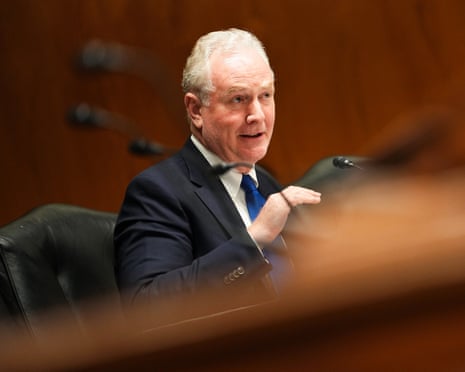
The Maryland senator is also a critic of cryptocurrency and decentralized finance in ways that distinguish him from Schumer and Democratic political ties to the New York financial markets.
“As we’ve seen time and again, cryptocurrency and digital assets are rife with opportunity for abuse if left unchecked,” Van Hollen said in a statement opposing the Clarity Act, a financial regulatory package offered by Republicans. Van Hollen has pursued legislation to ban federal officials from owning or promoting cryptocurrency, pointedly highlighting the president’s billion-dollar gains.
Speaking in post-election interviews last week, Van Hollen argued that Democrats “should not be overly cautious in going after corporations, billionaires and special interests that voters blame for making their lives harder”.
The leader of the world’s fourth biggest economy, California governor Gavin Newsom, has explicitly endorsed a global phase out of the fossil fuels that drive climate breakdown.
Newsom told the Guardian that California is “100%” behind the efforts of the so-called Santa Marta coalition, a group of more than 50 countries that includes many of the world’s largest economies, to transition away from oil, gas and coal toward solar, wind, batteries and other non-carbon energy sources.
Speaking at the Cop31 UN climate summit on Thursday, Newsom said:
When you have a product that is obviously superior, which clean energy is for the climate and the economy, why wouldn’t you make that shift as quickly as possible?
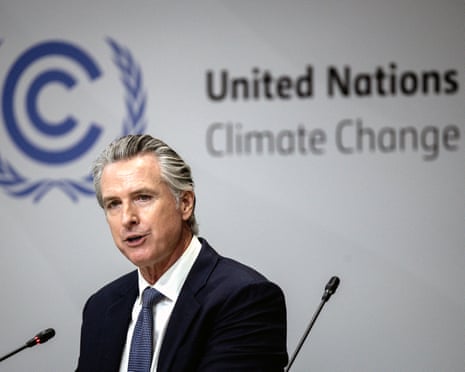
As the head of America’s most populous and economically powerful state, Newsom is the most prominent US politician at Cop31, a process Donald Trump’s administration continues to boycott.
Newsom, a Democrat, is widely expected to run for president in 2028. His statement raises the possibility that the US, the world’s biggest economy and largest historical emitter of planet-warming gases, could join the Santa Marta coalition if he wins the presidency two years from now.
More on this story here:
Mexico’s president, Claudia Sheinbaum, has again rebutted Donald Trump this morning, reiterating that no migrant caravans are headed toward the northern border with the United States.
There are two migrant caravans in Mexico, she said at her daily news briefing, “One dissolved while en route, and most of its members have already returned to their countries of origin, and another caravan is only just forming.”
“There is no caravan currently in transit through our country on its way to the [US] border,” Sheinbaum added, in comments reported by Reuters.
It comes after Trump threatened yesterday to double tariffs on Mexico if it did not stop the “huge CARAVANS” of migrants from reaching the US border, to which Sheinbaum had told her Thursday briefing that “not a single migrant caravan has reached the north” since January 2025, when Trump took office.
As the Washington Post (paywall) notes this morning regarding Trump: “The warning fused two of the president’s favored issues – immigration and tariffs – as he regroups following historic losses for the Republican Party in the midterm election last week … Trump has long warned of migrant caravans at moments of political peril for him, including ahead of the 2018 midterm election, in which Republicans lost control of the House.”
The votes are still being counted in the nail-biting US Senate race in Alaska, where Democrat Mary Peltola, a former congresswoman, is leading the Republican incumbent, Dan Sullivan, by 5,800 votes.
As of now, 88% of the ballots have been counted. But since Alaska uses a ranked-choice voting system, if no candidate reaches 50% of the vote, the weakest of the four on the ballot will be eliminated and their votes will be redistributed to their next choice and then the overall number will be recounted.
The bright blue map that emerged on election night in the US was unthinkable two years ago. When Donald Trump won the 2024 presidential election, many Democratic voters curled up in bed and doomscrolled, fatigued and fearful about the direction of the country. Any desire to fight back was dampened by the enormity of the loss.
But the mood gradually shifted over the following two years, culminating in a generational shift on election day: Democrats flipped five governors’ seats and took control of the House and Senate by wide margins. Voters were angry about the rising cost of living, the war in Iran, masked immigration agents in their neighborhoods and datacenters rising in their backyards.
But anger alone didn’t boost turnout. That required years of building coalitions, developing local campaigns and expanding movement infrastructure that turned frustration into organized action – and, eventually, votes.
Now, these same organizers are determining where to go next. The goal was never about any one party or politician. To continue to build power, movements must diversify their tactics, make clear demands, put pressure on the newly elected and keep building community-based networks, movement experts said. And they must be unrelenting.
“Elections themselves don’t achieve what it is that people want,” said Keeanga-Yamahtta Taylor, an African American studies professor at Princeton University and the author of From #BlackLivesMatter to Black Liberation. “They set the table for the possibility of change.”
The Guardian
About the Author