Home – CBSNews.com
Israel’s pilots “can reach anywhere in Iranian airspace, and are prepared to do so if required,” Prime Minister Benjamin Netanyahu said in an address discussing the country’s military power.
“Israel is stronger than ever, and it must always remain far stronger than our enemies,” Netanyahu said.
He said that Israel is building up forces, including acquiring a squadron of F-35 planes and another of F-15IAs. He said the planes will “reinforce Israel’s overwhelming air superiority.”
Netanyahu said that he has also instructed the country to invest in domestic production capabilities for munitions. The defense budget will increase over the next decade, he said, to “reduce dependence on foreign countries.” He said Israel will also “develop groundbreaking Israeli-made aerial systems.”
The prime minister also said that he will receive “a progress report” in a “special project to counter the drone threat” from Iran and its proxy groups.
“It will take time — but we are on it,” Netanyahu said. “We will continue to ensure Israel’s superiority across all arenas.”
President Trump said Saturday that the U.S. will significantly reduce its troop presence in Germany, escalating a dispute with Chancellor Friedrich Merz as he seeks to scale back America’s commitment to European security.
The Pentagon on Friday had initially announced it would pull some 5,000 troops out of Germany, but when asked Saturday about the reason for the move, Mr. Trump didn’t offer an explanation and said an even bigger reduction was coming.
“We’re going to cut way down. And we’re cutting a lot further than 5,000,” Trump told reporters in Florida.
Earlier on Saturday, Boris Pistorius, Germany’s defense minister, appeared to take in stride the news that 5,000 U.S. troops would be leaving his country.
Boris Pistorius said the drawdown, which Trump has threatened for years, was expected, and he said European nations needed to take on more responsibility for their own defense. But he also emphasized that security cooperation benefited both sides of the trans-Atlantic partnership.
“The presence of American soldiers in Europe, and especially in Germany, is in our interest and in the interest of the U.S.,” Pistorius told the German news agency dpa.
Senior defense officials who spoke to CBS News Friday characterized the 5,000 troop drawdown as a signal of Mr. Trump’s discontent with the level of assistance that European allies have offered in the U.S.-Iran war.
Mr. Trump has publicly criticized German Chancellor Friedrich Merz and the leaders of other NATO member states for not getting directly involved in the war.
CBS/AP
President Trump said Saturday he will review a new peace deal submitted by Iran.
Earlier in the day, Iranian state media outlet Tasnim News reported that Tehran has delivered a 14-point proposal to the U.S.
“I haven’t seen it,” Mr. Mr. Trump told reporters on the tarmac of Palm Beach International Airport before boarding Air Force One bound for Doral, Florida.
“I’m looking at it up here,” Mr. Trump said. “I’ll let you know about it later…They told me about the concept of the deal. They’re going to give me the exact wording now.”
The president later wrote on Truth Social that he would “soon be reviewing the plan that Iran has just sent to us, but can’t imagine that it would be acceptable in that they have not yet paid a big enough price for what they have done to Humanity, and the World, over the last 47 years.”
Israeli airstrikes on southern Lebanon killed at least seven people and wounded others on Saturday while the Israeli military demolished parts of a Catholic convent in a border village, officials said.
Israel’s military on Saturday issued a new warning for residents of nine southern villages to evacuate. Israel and the Lebanon-based militant group Hezbollah, an Iranian proxy, have kept up their attacks despite a ceasefire in place since April 17.
In the border village of Yaroun, Israel’s military used bulldozers to destroy parts of a Catholic convent that had been empty as a result of the latest fighting.
“What we heard is that it was destroyed with bulldozers,” said Gladys Sabbagh, the superior general of the Basilian Salvatorian Sisters. Sabbagh told The Associated Press that the convent included a school that had been closed since the 2006 Israel-Hezbollah war, as well as a clinic that was recently moved to the nearby village of Rmeich.
She described the convent as a small compound housing just two nuns, who left because of the war. Sabbagh did not have further details as Yaroun’s residents have been displaced.
The Israeli military issued a statement saying that as the army was destroying Hezbollah infrastructure in Yaroun, a house that had no religious signs was damaged. It added that as soon as the military knew it was linked to a church, soldiers “prevented any further damage from being done.”
The military added that Hezbollah used the compound in the past to fire rockets toward Israel on several occasions. It added that the military does not strike religious institutions intentionally.
The Catholic Church in Lebanon rejected claims that the compound was used for military purposes.
“We are against all practices against places of worship and churches. These are places to spread peace, love and education,” said Rev. Abdo Abou Kassm, director of the Catholic Center for Information. “These are not military bases.”
The White House has confirmed Nick Stewart was added as an adviser to the team negotiating a deal to end the war with Iran.
“Nick Stewart is a sharp, seasoned policy expert who is a valuable asset to Special Envoy Steve Witkoff’s talented team,” White House spokeswoman Olivia Wales said in a statement. “He brings a wealth of leadership and Iran policy experience to the role — from serving at the Department of State in the first Trump Administration and on Capitol Hill — and is a trusted voice as Special Envoy Witkoff works in lockstep with President Trump and his entire national security team to make a deal that is good for the United States and the world.”
Stewart was brought on by Jared Kushner, U.S. officials told CBS News, and formerly worked for the lobbying arm of Foundation for the Defense of Democracy — a hawkish group known to have been very supportive of military action against Iran.
Qatari Prime Minister Mohammed bin Abdulrahman bin Jassim Al-Thani spoke with Iranian Foreign Minister Abbas Araghchi on Saturday about the ongoing negotiations to end the war in Iran.
Iran has repeatedly targeted Qatari infrastructure in the wake of the Israeli-U.S. strikes as a way of trying to turn up pressure on Israel and the U.S., including a natural gas facility and Hamad International Airport.
“His Excellency affirmed the State of Qatar’s full support for mediation efforts aimed at resolving the crisis through peaceful means, stressing the need for all parties to respond positively to these efforts in a way that helps create suitable conditions for progress in the negotiations and reduces the risk of renewed escalation,” according to a statement from the Qatari Ministry of Foreign Affairs.
There was no direct mention of the strikes on Qatar, but did mention adhering to international law.
Qatar also emphasized “freedom of navigation is a well-established and non-negotiable principle” of the Strait of Hormuz.
Nick Stewart, a former lobbyist and member of the State Department during President Trump’s first term, has joined the diplomatic team working to end the war with Iran, two U.S. officials told CBS News.
Stewart joined the delegation that traveled to Islamabad in early April, which was led by Vice President JD Vance as well as Trump’s son-in-law, Jared Kushner, and U.S. special envoy Steve Witkoff. That round of diplomacy failed.
Stewart was brought on by Kushner, U.S. officials told CBS News, and formerly worked for the lobbying arm of Foundation for the Defense of Democracy — a hawkish group known to have been very supportive of military action against Iran. A White House official described Stewart’s role as policy support for Witkoff and Kushner.
He is listed on a dozen lobbying records filed with the Senate since 2023. The records list more than $2 million in lobbying spending on foreign policy-related issues, including work in 2026 on the Enhanced Iran Sanctions Act, the Sanctioning Russia Act of 2025 and the Muslim Brotherhood Terrorist Designation Act of 2025.
U.S. officials, including Energy Secretary Chris Wright, have recently been asked by Congress to explain why there are no American nuclear experts from the National Nuclear Security Administration or Department of Energy on the delegation. The general response has been they provide insight from afar but do not participate in talks alongside the Trump representatives.
“The No. 1 person is me,” Wright said when asked who was providing nuclear expertise to negotiators during testimony before the Senate National Resources and Energy Committee on April 21. “I have a background in nuclear as well, but people on our nonproliferation team have been engaged as well. In fact, we have a special team that is focused on solutions to the Iran situation, depending on which way it goes.”
Stewart formerly worked for Congresswoman Claudia Tenney, R-N.Y., who posted on X that Stewart is “one of America’s sharpest experts on Iran policy” and is joining the Office for the Special Envoy for Peace Missions.
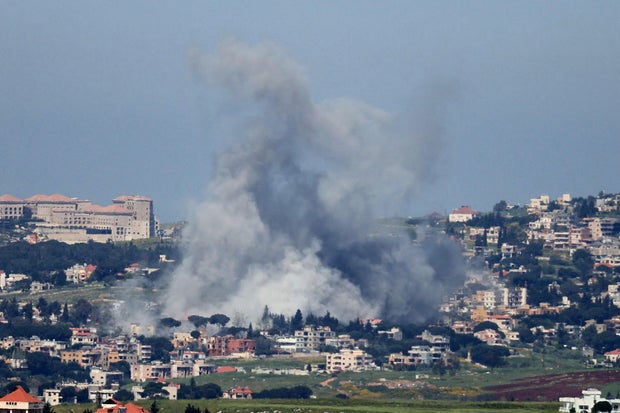
The total number of people killed in Lebanon by Israeli attacks is now up to 2,659 since March 2, according to the Ministry of Public Health.
There have been another 8,183 injuries, the ministry said.
AFP via Getty Images
Seventy-three people have been killed and 163 injured since Lebanon’s health ministry last gave an update on April 30.
While the two countries have agreed to a ceasefire, both sides have accused the other of regularly violating the deal and each side has continued to conduct smaller-scale attacks on the other since the deal was agreed to on April 16.
The total number of Iranian ships that have been forced to turn around by the U.S. blockade of the Strait of Hormuz is now up to 48 over the last 20 days, according to U.S. Central Command.
Three ships have been redirected in the past 20 hours, according to CENTCOM. The U.S. is not allowing any vessels into or out of ports in Iran.
President Trump has said the blockade will remain in effect until a deal can be worked out with Iran to end the war. Iran, meanwhile, has called the blockade a violation of the ceasefire.
“We’re sort of like pirates,” Mr. Trump said of the blockade at The Villages in Florida on Friday night, “but we’re not playing games because, you know, for 47 years, Iran has been pushing everybody around.”
“They’ve used the Hormuz Strait as a weapon for many, many years,” he added. “They said they’ll close it. So, they closed it. Then I closed it on them.”
The U.S. has sold a new tranche of about $9 billion in weapons to Israel and several Middle East allies, the Trump administration announced late Friday.
While the State Department notified Congress of the deals, it bypassed traditional congressional review. The administration has repeatedly dispensed with congressional review in recent weapons deals, citing an emergency that necessitated immediate sales.
The U.S. sold 10,000 of its Advanced Precision Kill Weapon Systems to Israel at a total cost of $992.4 million, the State Department said. The APKWS turns non-guided rockets into precise, laser-guided weapons. The U.S. sold the same systems to Qatar and the United Arab Emirates at the same cost.
Kuwait purchased an Integrated Battle Command System, an advanced missile defense system developed by Northrup Grumman, for $2.5 billion. The U.S. also sold Qatar 500 Patriot missiles to replenish its defense system at a cost of $4.01 billion, according to the State Department.
The systems will give Qatar and Kuwait better protection from Iran’s missile and drone attacks on civilian infrastructure that began when the U.S. and Israel started their bombing campaign in February.
A senior Iranian military officer said on Saturday that renewed fighting between the United States and Iran was “likely,” hours after Trump said he was “not satisfied” with a new Iranian negotiating proposal.
Mohammad Jafar Asadi, a senior figure in the Iranian military’s central command, said “a renewed conflict between Iran and the United States is likely,” in a statement published by Iran’s Fars news agency.
“Evidence has shown that the United States is not committed to any promises or agreements,” he said.
President Trump on Friday described the U.S. Navy’s interdiction of an Iranian-linked vessel near the Strait of Hormuz as akin to the actions of pirates.
“We took over the ship,” Mr. Trump said in remarks at a dinner at the Forum Club of the Palm Beaches in Florida. “We took over the cargo, took over the oil. It’s a very profitable business. Who would have thought we were doing that? We’re like pirates. We’re sort of like pirates. But we’re not playing games, because, you know, for 47 years, Iran has been pushing everybody around.”
Mr. Trump appeared to be referring to the actions of the U.S. Navy destroyer USS Spruance last month, which intercepted the Iranian-flagged cargo ship Touska in the Gulf of Oman.
“They’re five miles away, and one shot into the engine room, blew up the engine room, the ship stopped, “Mr. Trump said Friday. “They used tug boats, and then we landed on top of it.”
In an April 19 Truth Social post on the incident, the president wrote that the “Iranian crew refused to listen, so our Navy ship stopped them in their tracks by blowing a hole in the engine room.”
Since the U.S. began its blockade of Iranian ports on April 13, U.S. Central Command says it has redirected at least 41 ships.
President Trump said in a speech in Florida that he believes it’s “treasonous” when the “radical left” suggests the U.S. is not winning against Iran.
Mr. Trump has repeatedly lashed out at critics of his Iran strategy. The crime of treason, as defined by the Constitution, is strictly limited to waging war against the U.S. or giving “Aid and Comfort” to the country’s enemies — not verbally criticizing a war.
The Pentagon is planning to withdraw about 5,000 American forces from Germany, senior defense officials said Friday.
The officials characterized the move as a signal of President Trump’s discontent with the level of assistance that European allies have offered in the U.S.-Iran war. Mr. Trump has publicly criticized German Chancellor Friedrich Merz and the leaders of other NATO member states for not getting directly involved in the U.S. military campaign against Iran.
Speaking to seniors at The Villages in Florida, the president said he thought, before the war began, that gas prices would be higher than they are now. He recognized that prices aren’t low, but said he thought they’d be higher.
“I thought oil would be much, much higher than it turned out to be,” he said.
Mr. Trump also said he thought the stock market would drop 25%.
“I thought the stock market would go down by 25%,” he said.
“We’re winning so big,” he said of the United States’ military accomplishments against Iran.
Senate Minority Leader Chuck Schumer pushed back on President Trump for telling Congress on Friday that “hostilities” with Iran have “terminated.”
“That’s bulls***,” the New York Democrat wrote on X. “This is an illegal war and every day Republicans remain complicit and allow it to continue is another day lives are endangered, chaos erupts, and prices increase, all while Americans foot the bill.”
A 1973 federal law requires the president to end military hostilities that haven’t been authorized by Congress within 60 days. Friday marks the 60th day since Mr. Trump formally notified lawmakers about the Iran war, setting up a key deadline.
But the Trump administration’s position is that the clock isn’t ticking on the 60-day time limit because the U.S. and Iran have been in a ceasefire since early April. Since then, the two sides have not exchanged direct fire, though the U.S. has sought to enforce a blockade on Iranian ports and Iran has prevented ships from traversing the Strait of Hormuz. Mr. Trump has suggested military strikes could resume if Iran doesn’t strike a deal.
Several Republicans have suggested they want the Trump administration to either wind down operations in Iran at the 60-day mark or seek formal authorization from Congress.
President Trump on Friday told congressional leaders that “hostilities” with Iran have “terminated,” addressing a critical 60-day deadline under a law meant to limit the unauthorized use of military force.
“There has been no exchange of fire between the United States Forces and Iran since April 7, 2026,” the president wrote in nearly identical letters to House Speaker Mike Johnson and GOP Sen. Chuck Grassley, the president pro tempore of the Senate. “The hostilities that began on February 28, 2026 have terminated.”
The framers of the Constitution gave Congress the power to declare war. Nearly two and a half centuries later, that authority is once again at the center of a political and constitutional storm.
At issue is the 1973 War Powers Resolution, a post-Vietnam statute intended to restrain presidential authority and ensure that prolonged military engagements receive congressional approval. But as the war with Iran enters a critical phase, the law’s limits — and its ambiguities — are being tested in real time.
Israeli authorities said Friday they were taking two high-profile activists who led an aid flotilla bound for Gaza, and who were captured by Israel in international waters in the Mediterranean Sea, to Israel for questioning. The governments of Spain and Brazil accused Israel of “kidnapping” its citizens.
The activists, Spanish-Swedish citizen of Palestinian origin Saif Abukeshek and Brazilian citizen Thiago Ávila, were among dozens of activists intercepted by the Israeli navy off the coast of Crete. They are members of the Global Sumud Flotilla’s steering committee, whose mission was to break Israel’s naval blockade and bring some humanitarian aid to the Palestinian territory.
In all, 22 boats and 175 activists were intercepted by the Israeli navy. Activists said Israeli forces stormed their vessels, smashed engines and detained some of those onboard. The incident occurred hundreds of miles from Gaza and Israel overnight from Wednesday to Thursday.
Israeli officials said they needed to take early action against the flotilla before it reached the country’s waters because of the high number of boats involved.
The Israeli Foreign Ministry said Friday on X it was taking the two activists to Israel for questioning, and that Abukeshek was “suspected of affiliation with a terrorist organization” and Ávila was “suspected of illegal activity,” without providing evidence.
In a joint statement, the governments of Brazil and Spain condemned “the kidnapping of two of their citizens in international waters by the Government of Israel.” Unlike other flotilla participants who were disembarked in Crete, the Spanish and Brazilian activists remained detained aboard an Israeli navy ship in Greek territorial waters.
New sanctions have been placed on several entities involved with Iran selling oil to China, including a company the U.S. says has “enabled the flow of billions of dollars to Tehran,” the State Department announced Friday.
Qingdao Haiye Oil Terminal Co., a Chinese-based petroleum terminal operator, has allegedly imported “tens of millions of barrels of sanctioned Iranian crude oil” since the start of the war with Iran, the Department of State said in a release.
“This flow often entails sophisticated evasion schemes, including illicit ship-to-ship transfers and ‘dark fleet’ operations that employ deceptive shipping practices endangering legitimate maritime commerce,” the department said.
In addition to Qingdao Haiye, the U.S. has sanctioned Xinchun Li, the president of the company, and a so-called “dark fleet” tanker ship, New Fusion, and the company that manages the tanker, Thriving Times International Co.
President Trump has repeatedly said Iran wants to make a deal with the U.S. for a long-term peace — and the reopening of the Strait of Hormuz — but he did not sound an optimistic tone on Friday.
“So, they want to make a deal, but I don’t,” Mr. Trump said Friday while leaving the White House for Florida. “I’m not satisfied with it. We’ll see what happens. Iran wants to make a deal because they have no military left, essentially. And, they want to make a deal, but I’m not satisfied.”
Tehran delivered to the U.S. — through Pakistani mediators — a revised response to the latest U.S. amendments on the agreement to end the war earlier Friday, according to Pakistani officials.
The last Iranian offer had attempted to push any discussion on nuclear issues to a later date, which Mr. Trump rejected. He has consistently said Iran must agree not to pursue a nuclear weapon in order to make a deal.
President Trump is apparently not going to abide by the 60-day limit for a president to get congressional approval for a war.
“Let me just tell you, on the war powers, so many presidents, as you know, have gone and exceeded it,” Mr. Trump said while departing the White House for Florida on Friday. “It’s never been used. It’s never been adhered to. And every other president considered it totally unconstitutional. And we agree with that.”
The War Powers Resolution of 1973 lays out a timeline for when lawmakers must be notified of hostilities and when a president is required to withdraw American forces from a conflict in the absence of congressional authorization. But Mr. Trump is right in saying many presidents, from Harry Truman in Korea to Lyndon Johnson and Richard Nixon in Vietnam, have not gotten congressional approval.
Under the law, the president is required to give formal notification to Congress within 48 hours of introducing American forces into hostilities, which officially begins a 60-day clock for the president to terminate the use of force unless Congress has declared war or authorized the use of the military.
The 60 days ran out on Friday.
Secretary of War Pete Hegseth on Thursday made it clear ahead of time the administration did not consider the need to get a vote from Congress to continue military action in Iran, saying the ceasefire paused the clock anyway.
“We are in a ceasefire right now, which in our understanding means the 60-day clock pauses or stops in a ceasefire,” he told the Senate Armed Services Committee.
The United Nations Refugee Agency, or UNHCR, warned Friday that the impacts of the Iran war on global shipping would be most acutely felt by nations already facing emergencies, citing “major disruptions to global humanitarian supply chains, forcing the agency to adjust its delivery operations due to rising transport costs, shipping delays, and instability in key maritime routes such as the Strait of Hormuz.”
The agency said higher fuel prices, port congestion, insurance premiums and reduced cargo capacity had significantly increased the costs and time needed to deliver humanitarian aid.
“For some shipments, costs have more than doubled, such as transport costs for relief items from UNHCR’s global stockpiles in Dubai to our Sudan and Chad operations, which have increased from around $927,000 to $1.87 million,” the agency said
“Particularly worrisome is the situation for Africa, where many overlapping displacement crises are ongoing — often tragically neglected,” the agency said. “In Kenya, where one of UNHCR’s global stockpiles is located, a recent fuel price increase of around 15 percent triggered delays and reduced truck availability for shipments to Ethiopia, the Democratic Republic of the Congo, and South Sudan.”
“In Sudan, where the conflict has entered its fourth year, the cost of delivering aid has doubled in recent months, while rerouting shipments around the Cape of Good Hope adds up to 25 days in delivery times,” the UNHCR said.
The U.S. Treasury issued a notice on Friday warning that any individual or company, American or foreign, that pays the Iranian regime a “toll” for safe passage through the Strait of Hormuz was at risk of violating U.S. sanctions against Iran.
“The Office of Foreign Assets Control (OFAC) is aware of Iranian threats to shipping and demands for ‘toll’ payments to receive safe passage through the international Strait of Hormuz,” the Treasury office said in a note posted on its website, noting that such payments could be sought in hard currency, crypto currencies, “or other in-kind payments, such as nominally charitable donations made to the Iranian Red Crescent Society, Bonyad Mostazafan, or Iranian embassy accounts.”
“OFAC is issuing this alert to warn U.S. and non-U.S. persons about the sanctions risks of making these payments to, or soliciting guarantees from, the Iranian regime for safe passage,” the statement said. “These risks exist regardless of payment method.”
Iranian authorities currently demand that any commercial vessel must coordinate with the country’s military to ensure safe passage through the vital shipping lane — under the threat of violence and seizure.
The threat, which Iran has maintained to varying degrees since the U.S. and Israel launched their war with the country on Feb. 28, has reduced shipping traffic in and out of the Persian Gulf by 90%, according to the U.K. navy.
A handful of international vessels have transited the strait in coordination with Iran, but none have acknowledged paying a fee.
The White House isn’t commenting directly on reports that Iran has presented a counter-proposal, or confirming that such a proposal has been received.
“We do not detail private diplomatic conversations. President Trump has been clear that Iran can never possess a nuclear weapon, and negotiations continue to ensure the short- and long-term national security of the United States,” said White House spokeswoman Anna Kelly.
Lebanon’s Ministry of Public Health said Friday that the death toll from Israel’s ongoing airstrikes and military ground operations in the country since March 2 had reached 2,618, with 8,094 others wounded.
Israel says it is only targeting the Iranian-backed group Hezbollah in Lebanon and that it takes all possible measures to avoid harming civilians, including ordering the evacuation of towns and villages before strikes.
The health ministry said that, as of Thursday, at least 184 children and 296 women were among those killed.
At least 40 people have been killed in Israel by Iranian and Hezbollah attacks since the Iran war began on Feb. 28, according to the independent Institute for National Security Studies in Israel.
Wall Street stocks rose early Friday, boosted by strong Apple results and a pullback in oil prices on hopes for new U.S.-Iran peace talks.
Apple shares jumped more than 4% as it reported its best results ever for a March quarter. Apple iPhone sales grew by double digits in just about every country where it does business.
More broadly across large companies, the first-quarter “earnings growth rate has blown past expectations,” said Briefing.com analyst Patrick O’Hare.
About 20 minutes into trading the Dow Jones Industrial Average was up 0.3% at 49,774.73. The broad-based S&P 500 gained 0.5% to 7,248.17, while the tech-rich Nasdaq Composite Index jumped 0.7% to 25,076.36.
Oil prices dipped as Iranian state media reported that Iran had delivered a new proposal for peace talks with the U.S. via Pakistani mediators. A barrel of international benchmark Brent crude was trading at about $107 Friday morning, after briefly touching $126 a barrel on Thursday when there was no sign of peace talks even possibly resuming.
Oil prices have fluctuated since the war began, but they remain significantly higher than they were before the conflict erupted. Stocks, however, have remained resilient despite the war and the closure of the Strait of Hormuz.
“The market remains resolute in its belief that the Iran War and the blockade will end without creating long-lasting damage to the global economy,” O’Hare said.
CBS/AFP
Hezbollah and the Israeli military both announced new operations in southern Lebanon Friday.
Both sides claimed to have carried out their attacks in response to ceasefire violations by the other.
“In response to the Israeli enemy’s violation of the ceasefire and the attacks that targeted villages in southern Lebanon, resulting in the death of martyrs and several injuries among civilians, fighters of the Islamic Resistance targeted, at 13:15 on Friday 01-05-2026, a military vehicle in the town of Al-Bayyada using a strike drone, achieving a confirmed hit,” Hezbollah said in one of several statements announcing purported attacks on Israeli soldiers and military hardware in southern Lebanon.
Israel Defense Forces spokesman Avichay Adraee, in his latest notice to Lebanese civilians issued via social media, warned residents in the southern village of Habboush to flee their homes ahead of looming strikes.
“In light of the terrorist Hezbollah party violating the ceasefire agreement, the Defense Army is compelled to act against it forcefully and does not intend to harm you,” Adraee said in the Arabic language post. “Out of concern for your safety, you must evacuate your homes immediately and move away from the village for a distance of no less than 1000 meters to open areas. Anyone present near Hezbollah elements, their facilities, and their combat means exposes their life to danger!”
Israeli forces have ordered the evacuation of scores of southern Lebanese towns and villages over the last two months, displacing more than 1 million people, according to Lebanese authorities.
The IDF says Israeli forces will continue occupying a section of southern Lebanon stretching from the northern Israeli border at least six miles into Lebanese territory until the Hezbollah threat is completely removed.
Pakistani officials told CBS News on Friday that a revised Iranian response to the latest U.S. terms to end the war had been conveyed to American officials, confirming Iranian state media reports that Iran had offered a new proposal to at least hold a second round of direct peace talks.
The Pakistani officials said Tehran had delivered to the U.S. through Pakistani mediators a revised response to the latest U.S. amendments on an agreement to end the war.
The previous Iranian offer had attempted to push any discussion on nuclear issues to a later date, which President Trump rejected.
The Pakistani officials expressed optimism that a deal could be nearer than it was before Iran made its new offer.
Iran has delivered a new proposal for talks with the United States via mediator Pakistan, state media reported Friday.
“The Islamic Republic of Iran delivered the text of its latest negotiating proposal to Pakistan, as the mediator in talks with the United States, on Thursday evening,” the official IRNA news agency reported, without elaborating.
The head of the International Affairs Office of Iran’s Assembly of Experts leadership institution, Mohsen Qomi, offered a new insight Friday on the Islamic Republic’s Supreme Leader Ayatollah Mojtaba Khamenei, who survived the Feb. 28 U.S. or Israeli strike that killed his father and predecessor, Ali Khamenei.
Quomi confirmed that the younger Khamenei was wounded in the strike, which U.S. officials say may have left him severely incapacitated, but he claimed the supreme leader was “in full health” and carrying out his duties.
Khamenei has not been seen or heard from directly since he was announced as his father’s successor.
“He was in the building at the time, the same building that was bombed and where those inside were martyred. A few minutes earlier, by coincidence or by divine will, he had gone into the courtyard, and God intended him to be spared,” Qomi said in a video published by Iran’s Fars news agency. “I assure you that despite the injuries he sustained there — God Almighty preserved him.”
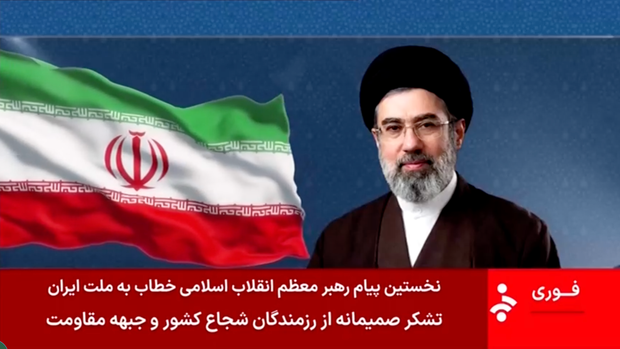
Reuters
Qomi dismissed questions about Khamenei’s condition as deliberate efforts by the U.S. to create uncertainty and pressure on the regime.
“This is a tactic of the enemy, trying to say: why is he not present? Why does he not send an audio message? Why does he not send a video message? Why do those who have met him not come forward to report it? They want, through these ‘whys,’ to force us into reactions while they continue their own plans,” said Qomi, adding: “He is in full health and is managing affairs. He is overseeing both negotiations and field matters under his supervision, and recently he also gave some instructions to the negotiating team regarding what they should do under certain conditions. He has full oversight over these issues.”
The statement did not offer any new evidence to back up the assertion that Khamenei is leading the country. So far, only written statements attributed to him have been offered by the regime since he was announced as the supreme leader.
Israel’s military said Friday that it had destroyed “more than 40 Hezbollah infrastructure sites” in a single day of strikes in Lebanon.
The strikes “across various areas in southern Lebanon” hit targets including “command centers where terrorists were present, military structures, and additional terrorist infrastructure,” the Israel Defense Forces said in a statement.
The IDF said it would “continue to operate against threats directed at Israeli civilians and IDF soldiers” amid the ongoing ceasefire between the Israeli and Lebanese governments brokered by the Trump administration, which Hezbollah and Israel have accused each other of violating repeatedly.
Iran’s Foreign Ministry spokesman Esmail Baqaei decried the Trump administration’s characterization of the joint U.S.-Israeli war against his country as an act of self-defense in a social media post on Friday, highlighting part of a U.S. State Department statement that lays out a legal basis for the war.
That April 21 statement from State Department legal adviser Reed Rubinstein says, in part, that the U.S. “is engaged in this conflict at the request of and in the collective self-defense of its Israeli ally, as well as in the exercise of the United States’ own inherent right of self-defense,” citing the threat of Iran’s conventional missile stockpile and a need to ensure Iran “will never have nuclear weapons.”
“‘Self-defense’ against what?” Baqaei asked in his post on Friday. “Was there any ‘armed attack’ by Iran to justify ‘self defense’? Definitely not! So this was absolutely NOT ‘self-defense’ — it was an act of AGGRESSION against the nation of Iran.”
“They are constantly repeating ‘nuclear bomb’ and are misleading the entire world with this claim,” said Baqaei separately in an interview Friday on Iranian state television. “For 30 or 40 years, the other side has been claiming that Iran is seeking a nuclear bomb, but there is no such thing, and no one has found even the slightest evidence for it.”
Iran has always denied efforts to build a nuclear weapon. While Tehran ramped up its enrichment program in response to President Trump pulling the U.S. unilaterally out of the 2015 international nuclear agreement, gaining its first 60%-enriched uranium stockpile, the U.N.’s International Atomic Energy Agency said just before the current war started that there was no indication of any effort by Iran to try and build a weapon.
Dozens of activists on a Gaza-bound aid flotilla which was intercepted by Israeli forces in international waters off Crete disembarked Friday on the Greek island, an AFP journalist saw.
Israel’s foreign ministry earlier said around 175 activists had been taken off more than 20 boats on Thursday.
Global Sumud Flotilla (GSF) organizers put the number at 211, and condemned the Israeli interception of its vessels in international waters as “piracy,” arguing that its members were “abducted” by Israeli naval forces.
CBS/AFP
A senior Iranian military commander responded Friday to reports that President Trump has been briefed on plans for a potential new wave of strikes on Iran by warning that any new attack would be met with a “sustained, wide-ranging, and painful retaliation.”
“We will respond to any enemy operation — whether it is a short, sudden strike or otherwise — with sustained, wide-ranging, and painful retaliation,” Brigadier General Seyed Majid Moosavi, commander of the powerful Islamic Revolutionary Guard Corps’ aerospace force, said in a statement posted on social media.
Axios reporter Barak Ravid reported that Mr. Trump was briefed for 45 minutes on Thursday by top military commanders on “new operational plans for potential strikes against Iran,” citing two senior American officials.
He said previously that the options would include a wave of “short and powerful” strikes on Iran, including against infrastructure sites.
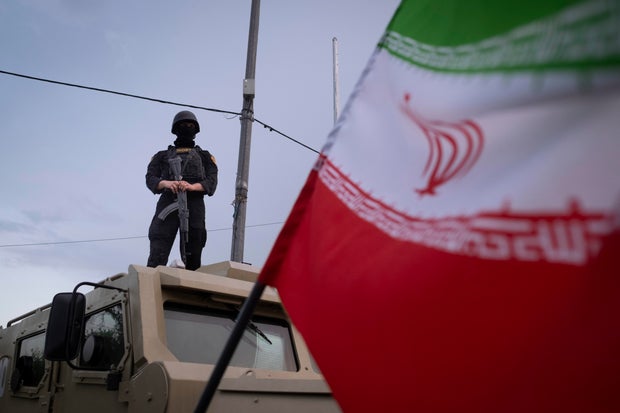
Morteza Nikoubazl/NurPhoto/Getty
Neither the Pentagon nor the White House have confirmed the Axios reports. President Trump, speaking Thursday with Newsmax, again insisted the U.S. had “already won” the war with Iran, but he said: “I want to win by a bigger margin.”
“We have to have guarantees they will never have a nuclear weapon,” Mr. Trump said.
“Shipping traffic in the crucial Strait of Hormuz has dropped by more than 90% since the conflict in the Middle East began,” the U.K. Royal Navy said in a statement on Friday, warning that the gridlock in the shipping lane was causing not only a “strangulation of international trade,” but also a looming humanitarian crisis for the roughly 20,000 seafarers stuck on ships in the waterway.
“More than two dozen ships have been damaged or suffered casualties attempting to run the gauntlet into/out of the [Persian] Gulf,” the Navy said, citing experts with the Navy-led U.K. Maritime Trade Operations (UKMTO) center, which monitors traffic in the region.
“With the world’s gaze focused on the Strait of Hormuz, there is a warning of resurgent piracy off the coast of Somalia,” the center warned.
“After intense periods in the late 00s/early 10s when Somali-based piracy was at its peak, and again at the end of 2023 when Houthi rebels in Yemen targeted Red Sea shipping, traffic in the Middle East’s sea lanes had resumed some form of normality.”
The U.S.-Israeli war with Iran has ended that period of normality, and in addition to the attacks on and ongoing threat to ships in the Persian Gulf and Strait of Hormuz, Iran has threatened at least three times to have its Houthi allies again attack ships to limit access to the Red Sea via the Bab el-Mandeb strait.
The U.S. Embassy in Beirut has called on Lebanon’s government to further its engagement with Israel – and tacitly, to sideline the Iranian-backed group Hezbollah which, while designated a terrorist organization by the U.S. and Israel, has been a massive force in Lebanese politics for decades.
“Lebanon stands at a crossroads. Its people have a historic opportunity to reclaim their country and shape their future as a truly sovereign, independent nation,” the embassy said in a social media post on Thursday, warning the “time for hesitation is over.”
The post did not refer directly to Hezbollah, but said Lebanon should have “never been at war” with neighboring Israel. Hezbollah dragged Lebanon into the regional conflict by launching attacks on northern Israeli communities in retaliation for the U.S.-Israeli strikes on Iran that began on Feb. 28.
Israel responded with overwhelming force, opening a new offensive against Hezbollah with a blistering campaign of airstrikes across the country, and later an ongoing ground invasion in the south of Lebanon that authorities say has killed almost 2,590 people and displaced more than a million. Israeli leaders have said forces will continue to occupy a buffer zone across southern Lebanon, from which residents have been forced to evacuate, indefinitely, until the Hezbollah threat is removed.
Hezbollah and Israel have accused each other of near daily violations of a ceasefire the Trump administration brokered between the Israeli and Lebanese governments, which has been extended until mid-May.
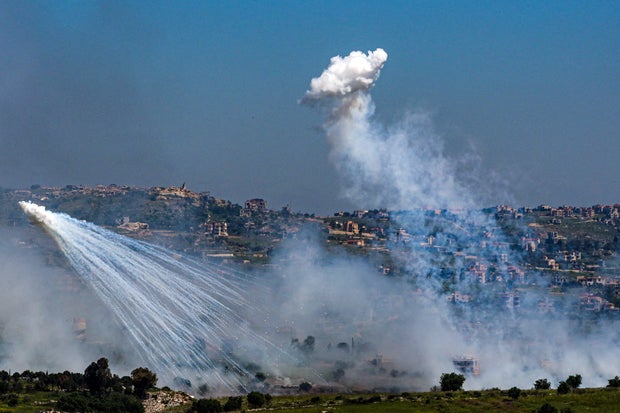
AYAL MARGOLIN/REUTERS
The U.S. embassy said Thursday that “a direct meeting between [Lebanon’s] President Aoun and Prime Minister Netanyahu, facilitated by President Trump, would give Lebanon the chance to secure concrete guarantees on full sovereignty, territorial integrity, secure borders, humanitarian and reconstruction support, and the complete restoration of Lebanese state authority over every inch of its territory — guaranteed by the United States.”
“This is Lebanon’s moment to decide its own destiny, one which belongs to all its people. The United States is ready to stand with Lebanon as it seizes this opportunity with confidence and wisdom,” it said.
Lebanon’s Prime Minister Dr. Nawaf Salam met Friday with U.S. Ambassador Michel Issa at his office in Beirut, for “discussions focused on consolidating the ceasefire and on talks related to negotiations with Israel,” Salam’s office said in a brief statement.
The war keeps costing American motorists more at the pump, with the average price of gas hitting $4.39 a gallon early Friday, according to AAA. That’s up a steep 9 cents from Thursday and 34 cents from just a week ago.
Crude oil shipments have been severely curtailed by the vital Strait of Hormuz remaining all but closed due to Iran’s threats to shipping, which it has refused to lift while the U.S. blockade of its ports and vessels remains in place.
Global oil prices are a significant factor behind the prices Americans pay at the pump, and the tanker gridlock in the strait combined with a lack of any imminent sign of a diplomatic resolution to the war helped push the price of international benchmark Brent crude briefly over $126 a barrel on Thursday.
Brent was trading early Friday at just over $111 a barrel. Before the war began in late February, it was trading around $70 per barrel.
President Trump faces a key deadline in the war with Iran on Friday under a decades-old law that limits the use of force without authorization from Congress.
The War Powers Resolution of 1973 lays out a timeline for when lawmakers must be notified of hostilities and when a president is required to withdraw American forces from a conflict in the absence of congressional authorization.
Under the law, the president is required to give formal notification to Congress within 48 hours of introducing American forces into hostilities, which officially begins a 60-day clock for the president to terminate the use of force unless Congress has declared war or authorized the use of military force.
Defense Secretary Pete Hegseth, testifying before the Senate Armed Services Committee Thursday, expressed doubt that the 60-day window was closing this week. “We are in a ceasefire right now, which in our understanding means the 60-day clock pauses or stops in a ceasefire,” he said.
In an interview with Newsmax’s Greta Van Susteren, President Trump again proclaimed “We’ve already won” the war in Iran but said he wants to “win by a bigger margin.”
Mr. Trump said Iran’s navy and air force have been destroyed, along with the country’s leadership, claims the administration has been making since very early in the war.
But multiple U.S. officials with knowledge of intelligence on the matter told CBS News last week that Iran maintains more military capabilities than the White House or Pentagon has publicly admitted.
About half of Iran’s stockpile of ballistic missiles and its associated launch systems were still intact as of the start of the ceasefire in early April, three of the officials told CBS News.
“We’ve destroyed everything. If we leave right now, it would take them 20 years to rebuild if they ever could rebuild,” Mr. Trump said Thursday, but added it’s “not good enough.”
“We have to have guarantees they will never have a nuclear weapon,” Mr. Trump said.
The United Arab Emirates’ Foreign Ministry announced Thursday it was banning citizens from traveling to Iran, Lebanon and Iraq “in light of the current developments in the region.”
The ministry also urged “all citizens present in these countries to depart quickly and return to the United Arab Emirates at the earliest opportunity.”
wp:paragraph
هلدینگ کاسپین استانبول | خرید ملک در ترکیه | صرافی معتبر ایرانی در ترکیه | خرید و فروش طلا در ترکیه | مهاجرت به ترکیه | واردات و صادرات در ترکیه | نیازمندیهای ترکیه | اخبار ترکیه | اخبار جهانی | توریست ایران | خدمات توریستی در ایران | تورهای گردشگری ایران | هلدینگ اول | خدمات کاریابی و فریلنسری و شغل | مرجع اطلاعات ایران (همه چیز در ایران) | کیف پول و خدمات مالی و پرداخت یار | اخبار ایران | تابلو زنده قیمت ارز در ترکیه و استانبول | صرافی آنلاین ترکیه | قیمت طلا و نقره در ترکیه | سرمایه گذاری در ترکیه | جواهرات در ترکیه | نرخ لحظه ای ارزها در استانبول | قیمت دلار امروز در ترکیه | قیمت دلار استانبول امروز | قیمت لحظه ای دلار | اخبار روز ترکیه استانبول | اپلیکیشن ISTEX | اپلیکیشن قیمت لحظه ای دلار و یورو و لیر و ارزها در ترکیه
/wp:paragraph wp:paragraph /wp:paragraph
About the Author