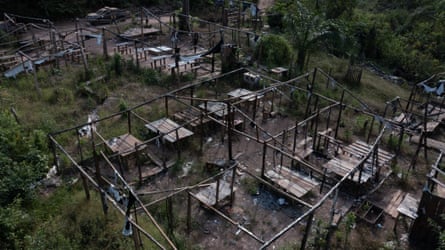
The jerry-built bordello at the foot of Vila Cururu, an illegal gold-mining settlement at the heart of Brazil’s most desecrated Indigenous territory, was a hive of depravity until just a few weeks ago.
Inebriated prospectors huddled around wooden tables, swigging beer and Scotch whisky, and ogling pole-dancing sex workers before going with them to shacks behind the brothel.
The encircling encampment also teemed with intruders as hordes of miners used pickaxes and explosives to burrow deep into the hillsides and savanna in search of treasure.
“They wiped out everything. They destroyed nature,” said Jackson Katitãurlu, an Indigenous leader from the Nambiquara people, whose village is a few miles from the chaos in the south-western Amazon.
One recent morning, however, Vila Cururu was deserted: the once-bustling illicit community having been razed by Brazilian security forces as they fought to fulfil a pledge by the president, Luiz Inácio Lula da Silva, to eradicate illegal mining in Indigenous territories after years of mayhem under his far-right predecessor, Jair Bolsonaro.
As Lula’s eviction tsar, Nilton Tubino, hiked through the encampment’s charred ruins, he recalled how miners fled into the surrounding forests after troops launched a land and air assault in late March to halt one of the most ferocious attacks on Indigenous lands in Brazil’s recent history.
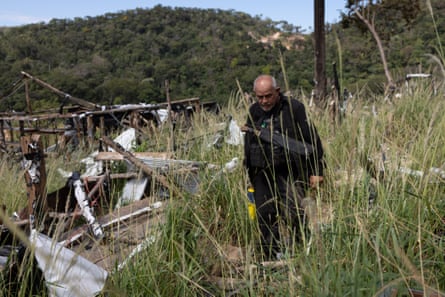
Other much larger protected territories have suffered damage on a greater physical scale but nowhere was the vandalism as intense as in Sararé, a Singapore-sized chunk of savanna and woodland near the border with Bolivia that lost 4% of its forests between January 2024 and August 2025. A total of about 17.3 sq miles (44.8km) have been destroyed since the gold rush began about five years ago – an area almost half the size of Manhattan.
“It’s total devastation,” Tubino sighed as he marched through Garimpo Quatro, one of Sararé’s largest mines, with an 18-inch machete strung across the front of his black fatigues and three radios strapped to his belt.
Paradoxically, part of the explanation for Sararé’s ordeal lies in the success of Lula’s anti-mining crusade, which he launched after returning to power in January 2023. After Tubino’s team kickstarted Lula’s “disintrusion” drive in the better-known Yanomami Indigenous territory, some miners flocked south to Sararé, hoping to continue working far from the crackdown.
Another driving force has been surging gold prices, which have hit record levels amid the global instability unleashed by Donald Trump and his erratic foreign policy. “The price of gold, this crazy global context, Trump, these things … [have a direct impact] all across the Amazon,” said Tubino, who saw a clear link between global turmoil and the annihilation of the forests around him, as investors sought a safe haven for their money.
The Guardian spent two days touring the destruction in Sararé with government forces, the only foreign media organisation given permission to visit the embattled territory, where about 200 members of the Nambiquara people live.
Seen from a helicopter, the astonishing extent of the depredation became clear. Seemingly endless brown gashes had been ripped across the once verdant landscape, dotted with pools of stagnant bronze-coloured water contaminated with the mercury that miners use in their giant sluice boxes.
Above Vila Cururu, which is named after a poisonous tropical toad with a propensity for digging, the pilot gasped as he absorbed the scale of the illegal operation. “It’s like a favela. It’s like Rio de Janeiro,” he said of the sprawling mining camp as his six-seat aircraft swooped down towards dozens of demolished makeshift structures cobbled together from tarpaulins and planks.
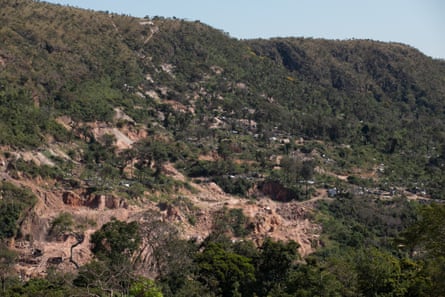
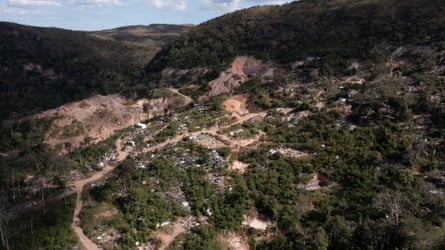
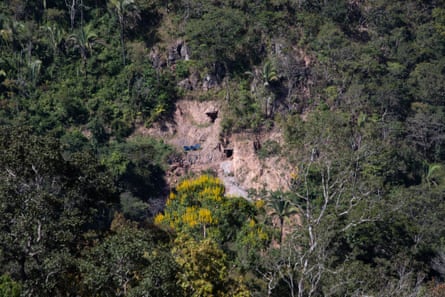
Nearby, half a dozen tunnels had been bored into a rock face in the frenzied hunt for gold.
On a nearby plain, an even larger mine had been gouged out of the forest by Hyundai excavators that the security forces had now torched. The trees had been levelled and replaced by colossal hillocks of grey and copper-coloured rubble over which red macaws soared.
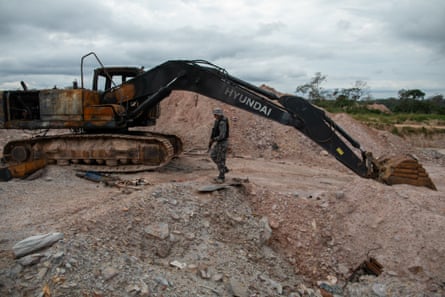
“It’s a complete desert. I was born and raised here and when I saw it I just couldn’t believe it,” said Katitãurlu, describing how his territory’s rivers were poisoned and its wildlife scared off by the constant din of music and explosions.
The crisis in Sararé, which began during Bolsonaro’s environmentally catastrophic 2019-2023 presidency, is not the Nambiquara people’s first taste of outside aggression.
In David Price’s 1989 book Before the Bulldozer, about the small Indigenous group, the anthropologist described how outsiders first came to the region in the 1730s when gold was found in the surrounding hills. “The heavy work of digging and washing the gravel was done by slaves, first Indians, and then Africans,” Price wrote.
More misery came after the Nambiquara were “discovered” in the early 1900s by the explorer Cândido Rondon, who had been sent to the border region to build a telegraph line. That mission “brought new and dreadful diseases to which the Indians had no defence. There were epidemics of flu in the 1920s that decimated large groups in a matter of days. An epidemic of measles at the beginning of 1946 was so devastating that survivors could not bury the dead,” Price wrote.
There was more disease and violence in the late 1970s, as the military dictatorship bulldozed a large highway through their lands with support from the World Bank. In just a few years, Price wrote, the Nambiquara had gone from being “a free and proud people” to having been “overwhelmed by western society”. Their population had plunged from perhaps 10,000at the start of the 20th century to about 600.
Today’s emergency has two new and disturbing elements: the use of cutting-edge heavy-duty hydraulic excavators, which have enabled devastation on an unprecedented industrial scale, and the suspected arrival of heavily armed organised crime groups such as Rio de Janeiro’s Red Command.
Drug factions from Rio and São Paulo have been advancing into the Amazon in recent years and some reports have claimed that the Red Command, which the Trump administration recently designated a foreign terrorist group, had seized control of Vila Cururu and other Sararé mines, causing an explosion of bloodshed.
Tubino played down the Red Command’s possible role in the region and said he had yet to see hard proof it ran Sararé’s goldmines. But the growing violence is undeniable. When environmental special forces raided the area in 2024, five heavily armed men were killed in a gunfight. Days earlier four people were murdered during an apparent goldmine turf war.
Saulo Katitãurlu, Sararé’s top Indigenous leader, said he had heard reports of miners roaming the territory with automatic rifles, 12-gauge shotguns and pistols. He was convinced they were faction members and recalled receiving threats from one miner who warned him not to speak out about the destruction, “otherwise I’ll come to your village and kill the lot of you”.
Jackson Katitãurlu, Saulo’s brother, said that a few days earlier Indigenous hunters had found a corpse near their village, wrapped in a tarpaulin and with a deep slash wound to its chest. When police arrived to recover the body, it had disappeared.
Nambiquara leaders said the crackdown appeared to have largely succeeded, for now, in expelling the miners. But what would happen when troops inevitably left?
“Good question,” Jackson answered. “If the operation is suspended, I think they’ll come back. 100% they will come back.”
Even more daunting was the prospect of Lula losing this year’s presidential election to Bolsonaro’s senator son, Flávio, with the leftist not far ahead in the polls. “If that happens, we’re fucked,” Jackson joked grimly, recalling how Bolsonaro’s anti-Indigenous rhetoric emboldened a historic gold rush during which tens of thousands of miners flooded into protected areas.
Tubino said he believed Lula’s re-election was crucial if the inter-agency clampdown on illegal mining and deforestation was to continue, safeguarding Indigenous and other traditional communities in the Amazon. He believed Brazil’s sovereignty was also at stake in October’s vote, noting how Trump had used Nicolás Maduro’s alleged complicity with illegal mining as one of the pretexts for abducting Venezuela’s president in January this year.
For now, though, the vigorous 65-year-old has more immediate concerns.
Despite the crackdown – the 10th that Tubino has spearheaded under Lula – some trespassers still lurk in Sararé. As his convoy rolled into Vila Cururu, police radios picked up chatter between lookouts in the hills. “There’s a guy in a flak jacket taking photographs and two different-looking guys,” one scout could be heard announcing, apparently referring to the Guardian’s reporters.
Further ahead, Tubino crawled into a claustrophobic, pitch-black 100-metre-long tunnel that had been drilled out of an escarpment, and found tools suggesting miners were still at work – perhaps operating by night to avoid detection.
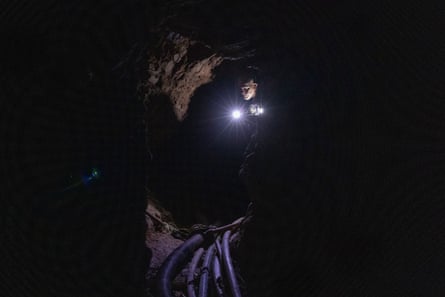
Nearby, troops uncovered an underground bunker containing a generator capable of powering the whole of Vila Cururu.
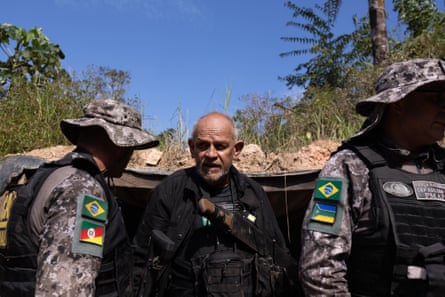
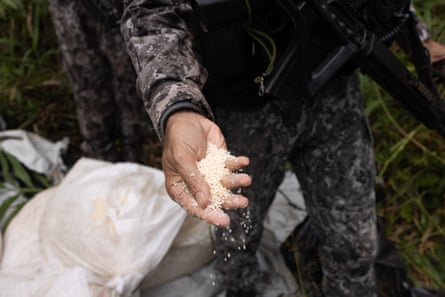
In a patch of undergrowth beside another deactivated mine, troops found white sacks containing 300kg of ammonium nitrate explosives. “It’s painstaking work,” Tubino said as troops made that discovery after spotting fresh footprints on a dirt path. “Someone’s walked through here in the past few days,” he added, before giving orders for the explosives to be destroyed.
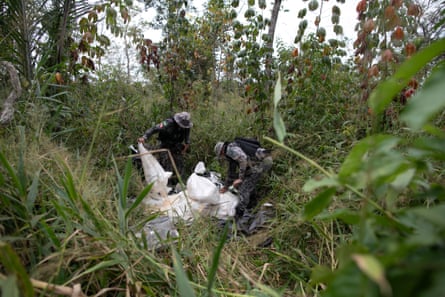
Lula’s anti-mining campaign is back-breaking, dangerous and seemingly interminable work for the men and women on the frontline of the Amazonian war against a multibillion-dollar illegal industry. But with another big mission planned for later this year, Tubino vowed that work would go on.
“Holidays? There’s no such thing as holidays,” he quipped as he sat in the wreckage of a recently destroyed mining shack, mosquitoes swarming around his black sleeves.
The Guardian wp:paragraph
هلدینگ کاسپین استانبول | خرید ملک در ترکیه | صرافی معتبر ایرانی در ترکیه | خرید و فروش طلا در ترکیه | مهاجرت به ترکیه | واردات و صادرات در ترکیه | نیازمندیهای ترکیه | اخبار ترکیه | اخبار جهانی | توریست ایران | خدمات توریستی در ایران | تورهای گردشگری ایران | هلدینگ اول | خدمات کاریابی و فریلنسری و شغل | مرجع اطلاعات ایران (همه چیز در ایران) | کیف پول و خدمات مالی و پرداخت یار | اخبار ایران | تابلو زنده قیمت ارز در ترکیه و استانبول | صرافی آنلاین ترکیه | قیمت طلا و نقره در ترکیه | سرمایه گذاری در ترکیه | جواهرات در ترکیه | نرخ لحظه ای ارزها در استانبول | قیمت دلار امروز در ترکیه | قیمت دلار استانبول امروز | قیمت لحظه ای دلار | اخبار روز ترکیه استانبول | اپلیکیشن ISTEX | اپلیکیشن قیمت لحظه ای دلار و یورو و لیر و ارزها در ترکیه
/wp:paragraph wp:paragraph /wp:paragraph
About the Author