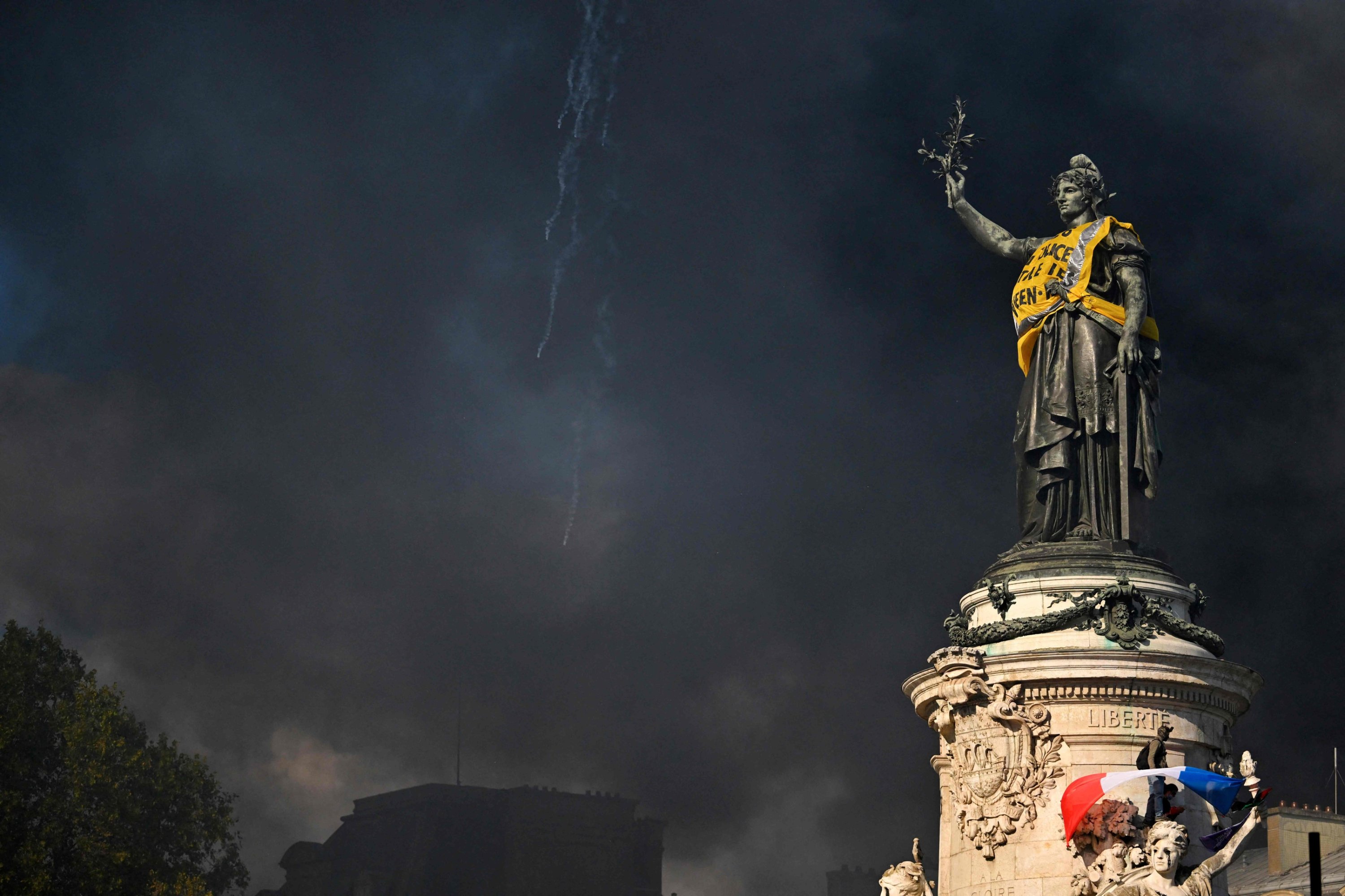
Mass demonstrations over the housing crisis took place in Spain, and the streets erupted in unrest. In Parliament, bills in favor of tenants were rejected. Following the demonstrations, Spanish Prime Minister Pedro Sanchez called an early election in order to “implement reforms and overcome the resistance of the elites.” Spain will go to the polls on Nov. 29.
In France, demonstrations were held in all of the country’s major cities over problems such as neglected schools, underinvestment and teacher shortages. Last week, the Yellow Vests also protested the rising cost of living, setting fire to and vandalizing public buildings. Such actions are expected to continue until the elections, which are seven months away.
Some circles analyzing the situation in Spain and France are debating who is shaping the circulation of the current anger, the perception of its scale and its political direction, and with what tools. They worry that the usual suspects, seeking to influence the elections, may be behind these events.
Since 2015, the world has been debating how voters are manipulated through social media algorithms. Since the Cambridge Analytica scandal concretely exposed specific forms of interference, foreign meddling in elections has become an accepted fact in many countries.
That countries with the technological capacity to intervene amplify social opposition against governments, leaders and politicians they see as hostile to their policies is no longer up for debate. Such practices are becoming normalized.
The fact that people react to issues that trouble them, and that protests have legitimate grounds, does not mean those protests are immune to foreign interference. In this context, foreign interference often takes the form of amplifying existing crises and stoking anger toward targeted political movements and leaders.
For an interferer seeking to weaken a government, eroding the confidence of the government’s supporters, driving undecided voters away from politics, and gathering disparate grievances into a common narrative of “failure to govern” produces more effective political results than one might expect. Funded media outlets then carry social media content into the mainstream.
Artificial intelligence has lowered the cost of manipulation and disinformation. Results can be achieved very quickly and effectively. Accounts that appear to belong to local users, synthetic audio and video, and automated comments can be produced with ease. Interferers first circulate messages designed to provoke reactions, then manufacture public opinion by having other accounts react to the same content.
Following the latest demonstrations in Spain and France, the possibility of foreign interference has begun to be discussed in mainstream media as well. As is well known, Sánchez was, from the very outset, among the Western leaders who reacted most strongly to Israel’s genocide in Palestine.
In a media interview on Aug. 31, Sanchez said that after the Ceuta crisis (when thousands of migrants from Africa arrived at the Spanish border at once), Israel-linked social media networks, together with the international far right, amplified disinformation. Numerous mainstream outlets, led by El Pais, wrote that there were attempts “to punish Sanchez for his stance on Gaza.”
Last June, France’s Viginum, the agency that monitors foreign digital interference, found that digital outlets linked to the Israel-based BlackCore had targeted pro-Palestinian politicians. Some are also linking the recent protests over education, and the large demonstrations that followed when the Yellow Vests joined them, to French President Emmanuel Macron’s U.N. speech.
As will be recalled, Macron criticized the humanitarian situation in Gaza and Israel’s practices in the West Bank in his U.N. speech, and Israel reacted harshly.
It is nothing new for great powers to exploit countries’ internal vulnerabilities for their own interests. AI and digital platforms have made interference cheaper and faster, and identifying its source with concrete evidence is becoming increasingly difficult.
In this context, protecting electoral security against manipulation and disinformation should be a priority for states. They need to strengthen their capacities and societal resilience in these areas. This applies to our country as well.
The views and opinions expressed in this article are solely those of the author. They do not necessarily reflect the editorial stance, values or position of Daily Sabah. The newspaper provides space for diverse perspectives as part of its commitment to open and informed public discussion.
DAILYSABAH
هلدینگ کاسپین استانبول | خرید ملک در ترکیه | صرافی معتبر ایرانی در ترکیه | خرید و فروش طلا در ترکیه | مهاجرت به ترکیه | واردات و صادرات در ترکیه | نیازمندیهای ترکیه | اخبار ترکیه | اخبار جهانی | توریست ایران | خدمات توریستی در ایران | تورهای گردشگری ایران | هلدینگ اول | خدمات کاریابی و فریلنسری و شغل | مرجع اطلاعات ایران (همه چیز در ایران) | کیف پول و خدمات مالی و پرداخت یار | اخبار ایران | تابلو زنده قیمت ارز در ترکیه و استانبول | صرافی آنلاین ترکیه | قیمت طلا و نقره در ترکیه | سرمایه گذاری در ترکیه | جواهرات در ترکیه | نرخ لحظه ای ارزها در استانبول | قیمت دلار امروز در ترکیه | قیمت دلار استانبول امروز | قیمت لحظه ای دلار | اخبار روز ترکیه استانبول | اپلیکیشن ISTEX | اپلیکیشن قیمت لحظه ای دلار و یورو و لیر و ارزها در ترکیه
About the Author