Hamas’ Oct. 7, 2023 attacks and Iran’s subsequent direct strikes left deep marks on Israel’s internal balance, calling into question Zionism’s promise of a safe homeland for Jews worldwide. Israeli Prime Minister Benjamin Netanyahu is widely held responsible for failing to secure the country, and recent polls suggest this verdict is shaping voter preferences and steadily raising the odds of his defeat.
With the general election days away, the debate centers on whether Israel’s course will truly change once his era ends. Electoral arithmetic, deepening social fault lines and a right-wing security consensus set structural limits that reach far beyond a change of leader. The Oct. 27 vote for the 120-seat Knesset is a final verdict on the longest-serving prime minister in Israel’s history and a referendum on the foreign policy paradigm forged in wartime.
Background of Israeli politics
Israel’s current political equation is the product of a half-century structural shift rather than a momentary swing. Since the 1977 Mahapah (turning point) election, power has remained almost continuously in the hands of a right-wing bloc whose revisionist and religious Zionist components share an expansionist, uncompromising line on the Palestinian question and on regional influence.
That bloc rests on three currents. The right-wing Likud, born in 1973 from the merger of Herut and liberal parties under Menachem Begin, carries the legacy of Zeev Jabotinsky’s revisionist Zionism, an outlook that legitimized all forms of violence against Palestinians, and has anchored every right-wing government since. The Haredi (ultra-Orthodox) parties, Shas and United Torah Judaism, have been its most pragmatic and indispensable partners, shaping the lifespan of governments beyond their seat numbers. Ideologically distant from Zionism, they trade coalition support for communal interests and over the past two decades have fused with the right.
The ideological direction of Palestinian and settlement policy, however, has been set by Religious Zionism. Its roots lie in the National Religious Party, founded in 1956 and known by its Hebrew acronym Mafdal, which reconciled religious Judaism with the Zionist state and served as the moderate partner of Labour governments in Israel’s early decades. After 1967, it became the political voice of a settler movement that saw the occupied territories as the fulfilment of a divine promise. Absorbed into the Jewish Home in 2008, the tradition peaked in 2022 with the list of Bezalel Smotrich’s Religious Zionist Party.
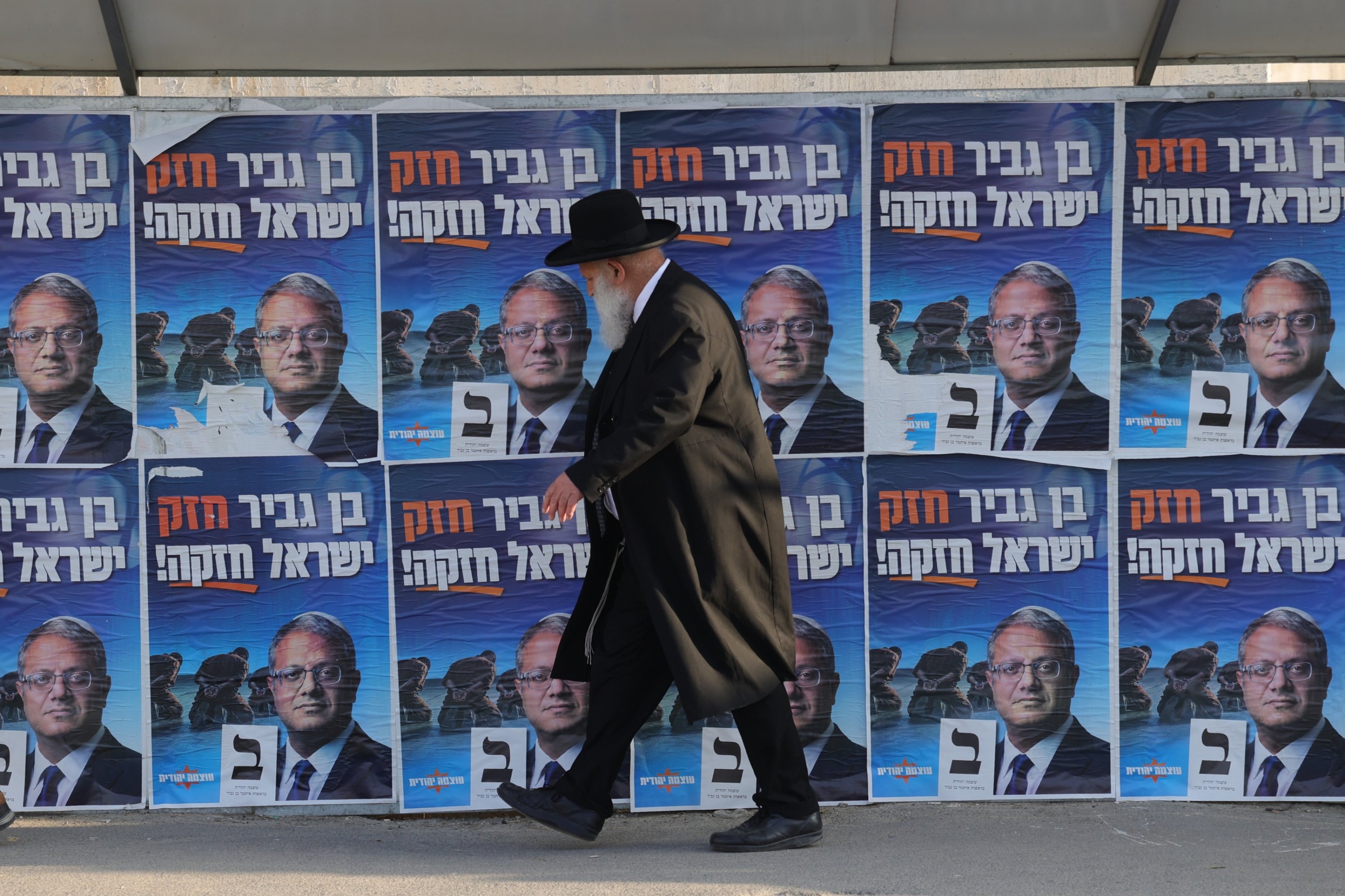
Netanyahu’s Cabinet of December 2022 was the most radical expression of this trajectory. Alongside Likud and the Haredi parties, whose demands included funding for religious institutions, it brought in a far-right settler wing made up of Smotrich’s party, Itamar Ben-Gvir’s far-right and Kahanist Otzma Yehudit party, and Avi Maoz’s ultra-conservative Noam, bearers of a maximalist vision that grants Palestinians neither sovereignty nor a right to life. Ben-Gvir’s forerunner, Rabbi Meir Kahane, was considered racist even by Israeli standards. His Kach party entered the Knesset in 1984, was barred from elections in 1988 for inciting racism, and was designated a terrorist organization in 1994. Today that same line enjoys wide legitimacy, and Ben-Gvir sits in the Cabinet as National Security Minister in charge of the police.
Oct. 27 elections
Putting his political survival above all else, Netanyahu gave these elements unprecedented ministerial powers and political cover, so the government is better read as the apex of a pyramid the right has built over decades than as an isolated aberration. Likud never ran on a joint list with them, but he personally brokered their mergers so that votes in his camp would not be wasted below the threshold. His 2021 deal brought Jewish Power, Smotrich’s party, and Noam onto one list, which won 14 seats in 2022. He tried the same formula for 2026 and failed.
Since the late 1970s, it has been almost impossible for a left-wing coalition to come to power. The left’s periods in government were limited to the short-lived Cabinets formed by Yitzhak Rabin in 1992 and Ehud Barak in 1999, and no left-led government has been formed since 2001. Moreover, even these Cabinets depended on the support of religious parties to survive. For this reason, the anti-Netanyahu front facing the current ruling bloc also draws largely from the right and rests on a personalised objection rather than a unified vision. At its forefront are former Prime Minister Naftali Bennett, former Chief of Staff Gadi Eisenkot and Yair Lapid, who heads Yesh Atid and currently leads the official opposition. Yet the fact that Bennett and Eisenkot are not running on a joint list reveals the fragility of this structure from the outset.
In April 2026, Bennett joined forces with Lapid’s party to form the Beyachad (Together) alliance under his own leadership. A kippah-wearing Modern Orthodox Jew who entered politics from the helm of the Yesha Council, the settlers’ umbrella organization, he went on to lead the Jewish Home, the flagship of Religious Zionism, and in 2021 became Israel’s first religiously observant prime minister. His right-wing politics reach out to secular voters without shedding his religious identity, and he flatly rejects a Palestinian state on security grounds.
Unwilling to settle for second place in the alliance, Eisenkot submitted an independent list for his centrist Yashar party in September 2026. A former chief of staff, he is the architect of the Dahiya doctrine devised against Lebanon in 2008, which legitimizes disproportionate force and the destruction of civilian infrastructure. Yashar’s cadres are largely secular, though its list includes Religious Zionist candidates. Among its likely post-election partners is Avigdor Liberman’s Yisrael Beytenu, a secular nationalist party identified with immigrants from the former Soviet Union.
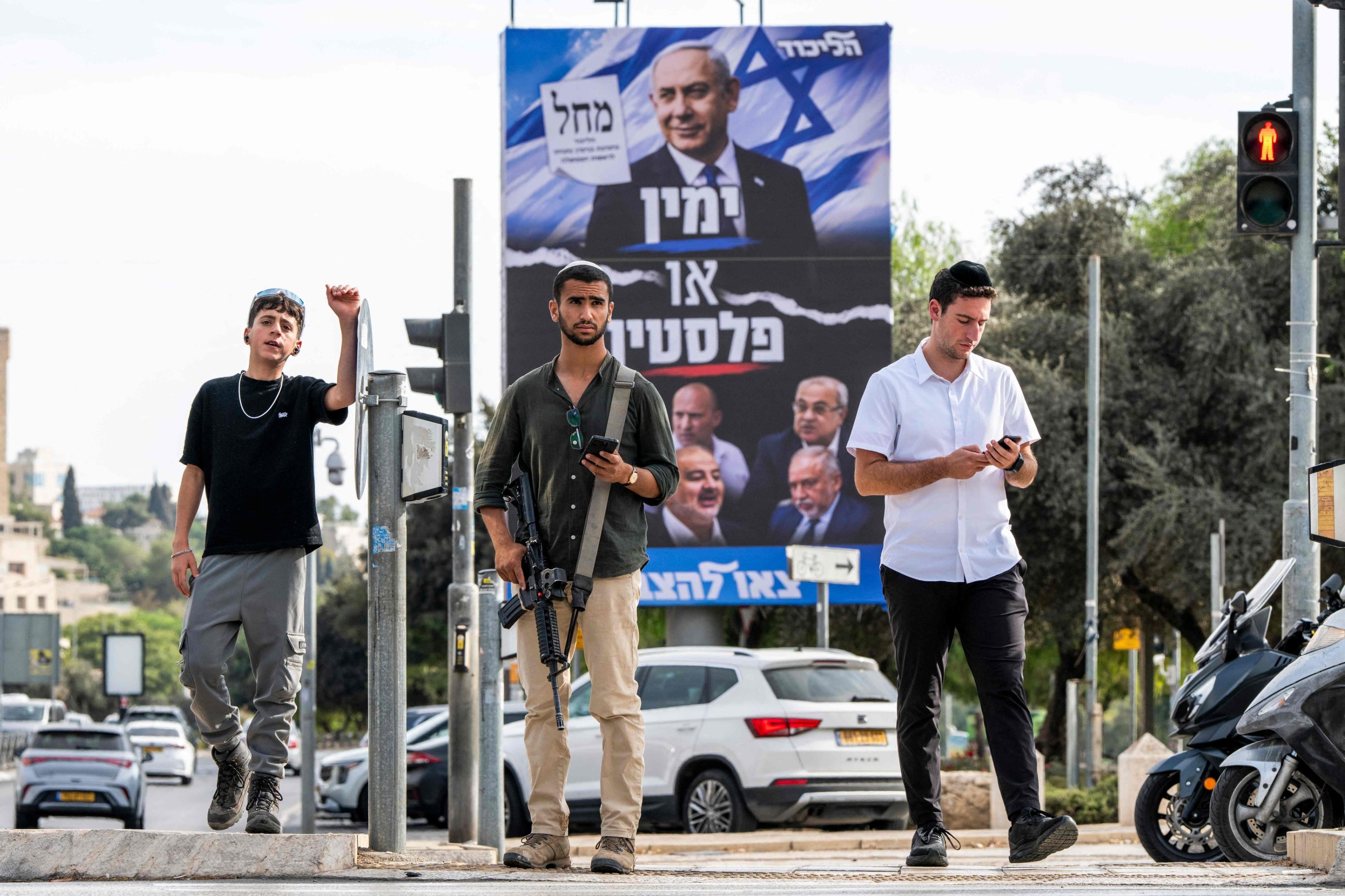
The opposition leaders’ failure to agree on a single candidate for prime minister has merely postponed the real contest within the bloc until after the vote. That contest will be decided by the numbers. Israelis do not elect their prime minister directly, and a government needs the backing of at least 61 of the Knesset’s 120 members. Projections dated Oct. 12, 2026, put Yashar first with 23 seats and Likud second with 20. By bloc, the anti-Netanyahu Zionist front, including Yashar, stands at 54, the Likud-led coalition at 49, Arab parties at 13 and others at four.
On paper, the opposition and the Arab parties together command a comfortable 67 seats. Yet the opposition is unlikely to rely on Arab parties, whether inside government or as outside support, since its own right wing regards their backing as illegitimate, and this keeps the majority from turning into power. Whether Netanyahu stays or goes, almost no plausible outcome points to a serious shift in Israel’s foreign policy.
Palestine, Iran in debates
Many in public debate and foreign capitals expect Netanyahu’s exit to open a calmer era on Gaza, the West Bank, Iran and regional alliances. That expectation overlooks the “hyper-securitized consensus” underpinning Israel’s political system. The opposition is no alliance of doves. Its leaders come largely from the right, and their quarrel with Netanyahu concerns his conduct, not the state’s strategic aims. His departure would matter symbolically and institutionally, but Israel’s security architecture and the core of its regional policy are unlikely to change.
Palestinian policy illustrates the point. Bennett and Eisenkot both reject a two-state solution, and Eisenkot’s record shows that the devastation on the ground reflects institutional strategy as much as Netanyahu’s personal cruelty. Dropping provocateurs such as Ben-Gvir and Smotrich could soften the diplomatic tone and ease humanitarian coordination with the West, yet control over Gaza, annexation pressure in the West Bank, and the military presence would remain.
Iran will remain an existential threat for any successor government. Bennett faults the current leadership for lacking a concrete military plan, while Eisenkot, who would welcome the regime’s collapse, doubts force alone can achieve it and would back a new strike only if Tehran moved toward a nuclear weapon. Their threat perception is identical; they differ only on the timing and scale of force and on coordination with Washington.
Both men find it “humiliating” that Netanyahu has made Israel dependent on Washington even for military decisions. Their deeper worry is that his open alliance with the Republicans has eroded bipartisan support among Democrats and the American public, and a new government would prioritise restoring that relationship.
From Türkiye’s perspective, opening a new chapter is not as easy as it seems. In February 2026, Bennett used his harshest language yet towards Ankara, calling Türkiye “the new Iran.” Casting President Recep Tayyip Erdoğan as a dangerous adversary bent on encircling Israel, he argued that a hostile Sunni belt is forming along a Türkiye, Qatar, Muslim Brotherhood and nuclear Pakistan axis.
While Bennett defines Türkiye as an ideological adversary, Eisenkot views Ankara through the military balance in Syria. Seeking to limit Turkish influence there, he tolerates a small, tactical presence in the north but treats ground forces near Israel’s border in the south, and radar and air defence systems that would restrict the Israeli air force, as red lines. Either way, Ankara is cast as a threat, whoever leads Israel. As long as current policies in Gaza and Jerusalem continue, the ground for a structural improvement in Turkish-Israeli relations will remain very narrow, even if the diplomatic tone changes.
A possible Netanyahu defeat could roll back the toxic rhetoric in domestic politics and give institutions room to breathe, and that would be no small gain. Yet the state mindset that regards domination over the West Bank and Gaza as an existential necessity, and reads foreign policy threats through the same lens, will keep operating no matter who holds office, and the Oct. 27 ballot will only decide who runs this course and with which partners.
The views and opinions expressed in this article are solely those of the author. They do not necessarily reflect the editorial stance, values or position of Daily Sabah. The newspaper provides space for diverse perspectives as part of its commitment to open and informed public discussion.
DAILYSABAH
هلدینگ کاسپین استانبول | خرید ملک در ترکیه | صرافی معتبر ایرانی در ترکیه | خرید و فروش طلا در ترکیه | مهاجرت به ترکیه | واردات و صادرات در ترکیه | نیازمندیهای ترکیه | اخبار ترکیه | اخبار جهانی | توریست ایران | خدمات توریستی در ایران | تورهای گردشگری ایران | هلدینگ اول | خدمات کاریابی و فریلنسری و شغل | مرجع اطلاعات ایران (همه چیز در ایران) | کیف پول و خدمات مالی و پرداخت یار | اخبار ایران | تابلو زنده قیمت ارز در ترکیه و استانبول | صرافی آنلاین ترکیه | قیمت طلا و نقره در ترکیه | سرمایه گذاری در ترکیه | جواهرات در ترکیه | نرخ لحظه ای ارزها در استانبول | قیمت دلار امروز در ترکیه | قیمت دلار استانبول امروز | قیمت لحظه ای دلار | اخبار روز ترکیه استانبول | اپلیکیشن ISTEX | اپلیکیشن قیمت لحظه ای دلار و یورو و لیر و ارزها در ترکیه
About the Author